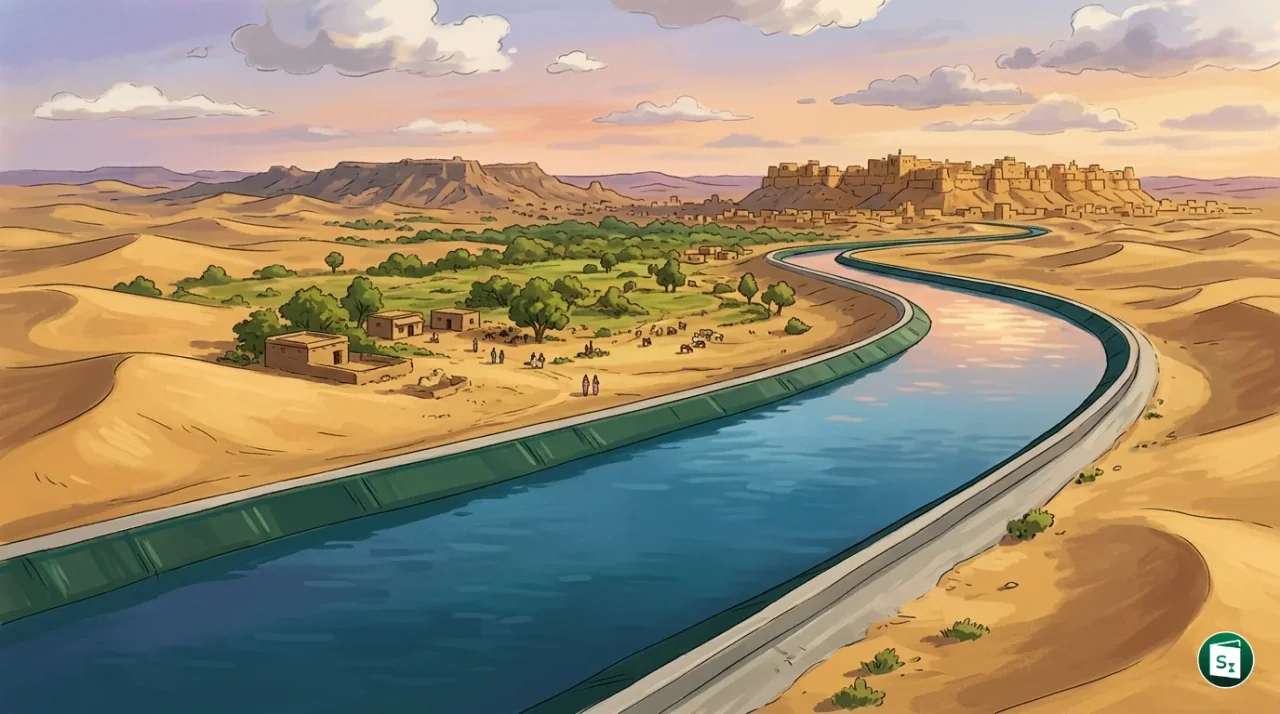
A massive 28-kilometre-long artificial reservoir lined with plastic sheeting has been built in the Thar Desert near Jaisalmer, Rajasthan, under the Jal Jeevan Mission (JJM) at a cost of ₹242 crore. The reservoir, recognised as one of Asia’s largest man-made desert water bodies, can store 1.41 billion litres of water and will provide year-round drinking water to nearly 50 lakh people in the border districts of Jaisalmer and Barmer. Built by the Rajasthan Public Health Engineering Department (PHED), the project addresses a chronic water shortage that has troubled these arid districts for decades, especially during the annual maintenance shutdown of the Indira Gandhi Canal.
Why the Reservoir Was Built
The Indira Gandhi Canal, which is the primary source of drinking and irrigation water for western Rajasthan, undergoes a scheduled annual maintenance closure known locally as Naharbandi. During this period, which can last up to a month, the canal is shut down for repair and relining work, cutting off the water supply to the districts that depend on it. Jaisalmer and Barmer, two of the most water-scarce districts in India located deep inside the Thar Desert, have historically faced severe drinking water shortages during this annual shutdown.
Before this project, there was no large-scale storage facility in the region capable of holding enough water to bridge the gap during the canal closure. Residents relied on tanker water supplies and traditional storage methods, which often proved inadequate during the scorching summer months. The idea for the reservoir emerged directly from this persistent problem. Construction began in January 2023 under the Jal Jeevan Mission and was originally targeted for completion in 2025, though the deadline was later extended. By July 2026, the reservoir was filled and ready for inauguration.
Executive Engineer Rampal Mundhiyara of the Indira Gandhi Nahar Project (IGNP) noted that the absence of buffer storage had made the region highly vulnerable to even brief interruptions in canal supply. This reservoir now serves as a strategic water bank for the two districts.
Engineering the Largest Desert Reservoir in Asia
The reservoir stretches 28 kilometres in length with a zigzag shape that follows the natural contours of the desert terrain. It has a base area of about 71 lakh square metres and has been excavated to a depth of nearly 13 metres (33 feet). The total storage capacity is 1.41 billion litres (141 crore litres), enough to supply the entire population of Jaisalmer and Barmer districts for a full year.
Officials say that walking from one end of the lake to the other would take nearly 24 hours. Given the vast, open desert landscape available in the region, the reservoir is believed to be the largest man-made water body in any desert region in Asia.
The HDPE Lining Solution
Building a water reservoir in a sandy desert poses a unique challenge. Desert sand is highly porous, and water stored directly on it would seep into the ground within hours, making the structure useless. To solve this, engineers used an ingenious method.
The entire 71 lakh square metre base of the reservoir has been lined with a 300-micron thick High-Density Polyethylene (HDPE) plastic sheet. This is the same material used in landfill liners and water containment systems worldwide. Approximately 76 lakh square metres of HDPE sheeting was used in the project. A protective layer of soil, about 80 centimetres (two-and-a-half feet) thick, has been spread over the plastic sheet to shield it from sunlight, heat, and physical damage. Officials estimate that this lining system will remain effective for nearly 100 years, and the top soil layer can be replaced whenever needed.
Water Sourcing and Treatment
The reservoir is fed by the Indira Gandhi Canal through a specially built 1-kilometre-long escape channel equipped with two gates. During the monsoon season, heavy rainfall in Punjab and Himachal Pradesh causes a surge in water flow through the canal. Since farmers require less irrigation water during the rainy season, this surplus water is diverted into the reservoir through the escape channel.
Once stored, the water is pumped from an intake well through four pipelines, each measuring 1.5 metres (60 inches) in diameter, to the Mohangarh Filtration Plant. After treatment and purification, the water is supplied through a pipeline network to households across Jaisalmer and Barmer districts.
The reservoir also includes a dedicated section reserved for the Indian Army to conduct military training exercises involving floating tanks and water-based operations.
The Indira Gandhi Canal: Lifeline of Western Rajasthan
The Indira Gandhi Canal, originally known as the Rajasthan Canal, is the longest canal in India and one of the world’s largest irrigation projects. It stretches about 649 kilometres from the Harike Barrage in Punjab, located at the confluence of the Sutlej and Beas rivers, all the way to the Thar Desert near Gadra Road in the Barmer district of Rajasthan.
The canal was conceived in 1948 by hydraulic engineer Kanwar Sain, who envisioned bringing Himalayan river waters to the parched deserts of western Rajasthan. Construction began in 1958, and the project was executed in two stages. Stage I, completed in the mid-1980s, covers 393 kilometres and irrigates parts of Ganganagar, Hanumangarh, and northern Bikaner. Stage II, completed in 2010, extends the canal by another 256 kilometres into the deeper desert districts of Jaisalmer and Barmer. The canal was officially renamed in 1984 after the assassination of Prime Minister Indira Gandhi.
The canal follows the paleochannel of the ancient Saraswati River, which gives it a natural gradient and eliminates the need for pumping stations along much of its length. Today, the canal system, including its network of distributaries spanning over 9,000 kilometres, irrigates about 16 lakh hectares of land, supports nearly 2 crore people with drinking water, and generates an estimated ₹6,500 crore in annual agricultural output. Mustard, cotton, wheat, cumin, and isabgol are now grown across the once-barren landscape.
Jal Jeevan Mission: The Broader Framework
The Jal Jeevan Mission (JJM) was launched by Prime Minister Narendra Modi on August 15, 2019, with the aim of providing a Functional Household Tap Connection (FHTC) to every rural household in India by 2024. The mission is implemented by the Ministry of Jal Shakti through its Department of Drinking Water and Sanitation (DDWS). The original outlay for the mission was ₹3.60 lakh crore, with the central government bearing 50% of the cost for most states.
The mission represents a fundamental shift from the earlier approach of creating water supply infrastructure to a service delivery model focused on ensuring that every household gets an assured quantity of potable water on a regular basis. It adopts a decentralised, community-managed approach where Gram Panchayats and Village Water and Sanitation Committees (VWSCs) play a central role in planning, implementation, and maintenance.
In March 2026, the Union Cabinet approved JJM 2.0, extending the mission until December 2028 with an additional allocation of ₹1.51 lakh crore. The extension came with mandatory reforms including the creation of a uniform digital framework called Sujalam Bharat for mapping water supply systems from source to tap, and a requirement for states to sign Memorandums of Understanding with the Centre covering 11 key reform areas.
In Rajasthan, the JJM has made significant progress. From only 11% of rural households having tap connections in 2019, the number has grown to 63.61 lakh households covering about 59% of the state’s rural population as of July 2026. A total of 12,095 villages have been declared Har Ghar Jal (every home with tap water). The Jaisalmer reservoir is one of four such escape reservoirs approved under the mission in Rajasthan, with a combined budget of ₹1,274.26 crore.
Significance and Impact
The Jaisalmer reservoir addresses a critical gap in the drinking water infrastructure of western Rajasthan. For decades, the annual canal closure forced residents to depend on water tankers, often leading to severe shortages in peak summer when temperatures cross 45 degrees Celsius. The reservoir effectively eliminates this vulnerability by creating a year-long buffer stock.
For the 50 lakh residents of Jaisalmer and Barmer, the project means an end to the seasonal anxiety that accompanied every Naharbandi period. Women, who traditionally bear the burden of fetching water from distant sources, will benefit significantly from a reliable household supply. The project also supports the Indian Army and Border Security Force (BSF) deployments along the India-Pakistan border, which depend on the canal for their water needs.
The use of HDPE lining technology in a desert setting is noteworthy from an engineering perspective. This method, while common in landfills and industrial containment, has rarely been applied at this scale in India. The success of this project could encourage similar interventions in other water-scarce desert regions across the country.
Economically, the project secures water for households in two districts that are strategically important for border security and tourism. Jaisalmer, known for its historic forts and desert tourism, attracts visitors from around the world. A reliable water supply strengthens the region’s capacity to sustain both its population and its economic activities.
Key Takeaways
- A 28-kilometre-long artificial reservoir lined with 300-micron HDPE plastic sheet has been built in the Thar Desert near Jaisalmer, Rajasthan, under the Jal Jeevan Mission at a cost of ₹242 crore.
- The reservoir can store 1.41 billion litres (141 crore litres) of water and will supply year-round drinking water to nearly 50 lakh people in Jaisalmer and Barmer districts.
- The reservoir addresses water shortages caused by the annual Naharbandi (maintenance shutdown) of the Indira Gandhi Canal, the longest canal in India at 649 kilometres.
- The Indira Gandhi Canal originates from the Harike Barrage at the confluence of the Sutlej and Beas rivers in Punjab and was renamed in 1984 from its original name, the Rajasthan Canal.
- The Jal Jeevan Mission, launched on August 15, 2019, aims to provide Functional Household Tap Connections to all rural households. It has been extended as JJM 2.0 till December 2028 with an additional outlay of ₹1.51 lakh crore.
- The reservoir is one of four such escape reservoirs approved for Rajasthan under JJM with a combined budget of ₹1,274.26 crore.