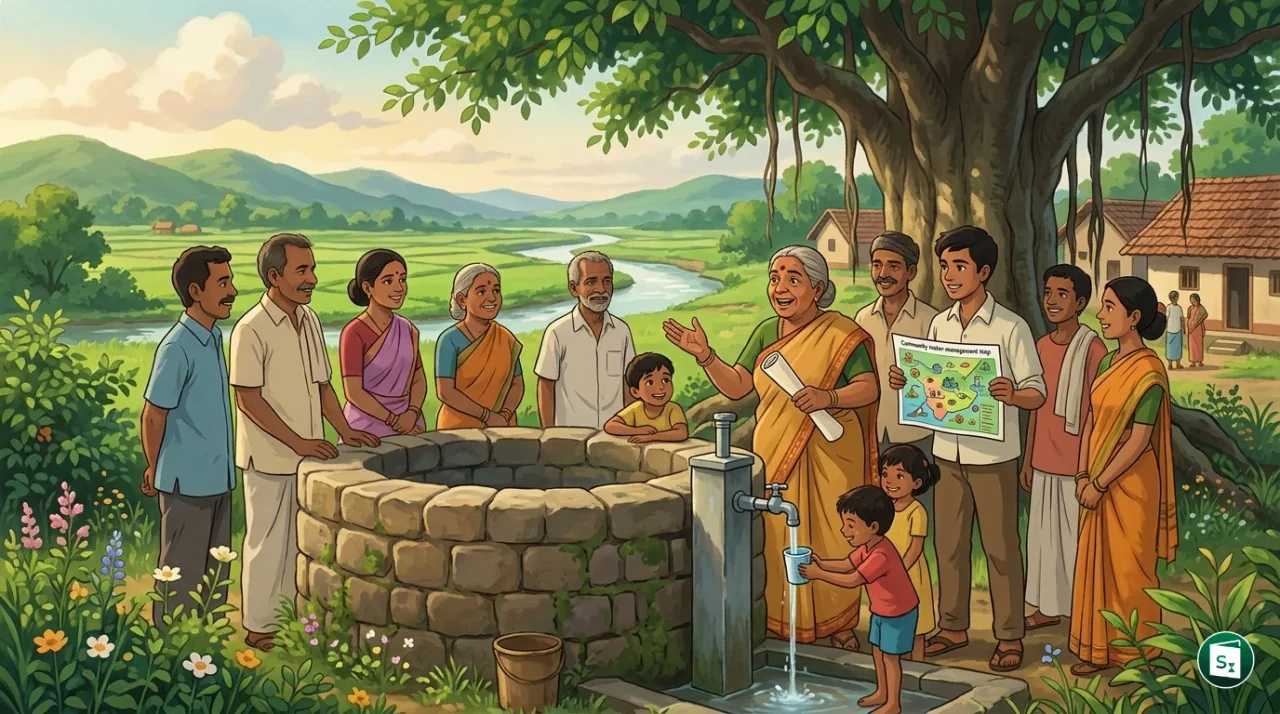
The Union Ministry of Jal Shakti signed reform-linked Memoranda of Understanding with Manipur and Bihar on June 10, 2026, marking their entry into the sustainability phase of the Jal Jeevan Mission 2.0. These agreements facilitate a strategic transition from the rapid expansion of water infrastructure to a community-led governance model focused on long-term service delivery. With these signings, 33 out of 34 eligible States and Union Territories have now adopted the new reform framework to ensure permanent water security in rural India.
The Strategic Evolution to Jal Jeevan Mission 2.0
The Jal Jeevan Mission (JJM) was originally launched on August 15, 2019, with the ambitious goal of providing a Functional Household Tap Connection (FHTC) to every rural home by 2024. Operating under the Ministry of Jal Shakti, which was formed in 2019 by merging the Ministry of Water Resources and the Ministry of Drinking Water and Sanitation, the mission set a service standard of 55 litres per capita per day (lpcd). While the first phase successfully expanded coverage to over 80 percent of rural households, the Union Cabinet approved Jal Jeevan Mission 2.0 in March 2026 to address the challenges of long term functionality.
Launched formally on March 22, 2026, coinciding with World Water Day, the second phase extends the mission timeline to December 2028. This phase involves a massive financial outlay of ₹8.69 lakh crore, nearly double the initial phase investment. The core philosophy has shifted from merely creating assets to managing them as professional utilities.
| Feature | JJM 1.0 (2019 to 2024) | JJM 2.0 (2026 to 2028) |
|---|---|---|
| Primary Objective | Infrastructure and Asset Building | Assured Service Delivery |
| Governance Mode | Government led Implementation | Gram Panchayat led Utility Model |
| Financial Outlay | ~₹3.60 Lakh Crore | ~₹8.69 Lakh Crore |
| Key Focus | Tap Connectivity | Source and Financial Sustainability |
| Monitoring Tool | Physical Progress Dashboard | Sujalam Bharat Digital Framework |
A Blueprint for Reform-Linked Sustainability
A distinguishing feature of Jal Jeevan Mission 2.0 is the introduction of Reform-Linked Memoranda of Understanding (MoUs). Unlike the previous phase, where funding was primarily based on the number of new connections, the current phase ties central financial assistance to specific governance and sustainability benchmarks. States like Manipur and Bihar have now committed to a comprehensive 11 point structural reform blueprint designed by the Department of Drinking Water and Sanitation (DDWS).
These reforms are aimed at building a robust Institutional Architecture that scales from the state level down to the village. The blueprint mandates the creation of a Service Utility Framework, treating water supply as a professional service rather than a simple construction project. By linking fund releases to the successful implementation of these reforms, the central government ensures that states prioritize the long term health of the water infrastructure over short term installation targets. This performance based model is expected to reduce the instances of “slip back” villages, where functionality is lost due to poor maintenance or source depletion.
Decentralised Governance: Gram Panchayats as Water Utilities
At the heart of the sustainability phase is the empowerment of the Gram Panchayat (GP) and its sub committee, the Village Water and Sanitation Committee (VWSC), also known as Pani Samiti. Under the new agreements signed by Manipur and Bihar, these local bodies are being transformed into decentralized water utilities. This move aligns with the spirit of the 73rd Constitutional Amendment Act, 1992, which devolved the responsibility of providing drinking water and sanitation to local self governments.
The mission introduces a formal process called Jal Arpan, where completed water supply schemes are officially handed over to the community. The Gram Panchayat then takes full responsibility for the daily operation and maintenance (O&M), ensuring that the water supplied meets the prescribed quality and quantity standards. To support this, the government is training local residents as Jal Vitaran Sanchalaks (Water Distribution Operators) and Nal Jal Mitras (local mechanics and plumbers). This approach fosters Jan Bhagidari or people’s participation, ensuring that the infrastructure is managed by those who benefit from it most.
Ensuring Source and Financial Resilience
Sustainability in Jal Jeevan Mission 2.0 is built on two critical pillars: Source Sustainability and Financial Resilience. To prevent the water sources from running dry, the mission mandates a “source first” approach. Every village must implement a Village Water Security Plan that integrates rainwater harvesting, greywater management, and the desilting of local water bodies to recharge groundwater aquifers. This is achieved through mandatory convergence with other schemes such as the Mahatma Gandhi National Rural Employment Guarantee Scheme (MGNREGS) and grants from the 15th Finance Commission.
On the financial front, the mission aims to make the local water utility self sustaining. While the central and state governments provide the initial capital for construction, the Gram Panchayats are encouraged to collect nominal user charges from households. These funds, typically ranging from ₹40 to ₹100 per month, are used to cover the costs of electricity, minor repairs, and the salaries of local operators. By shifting the burden of recurring costs to the community, the mission ensures that the systems remain operational for decades without constant dependence on government grants. This financial model also encourages water conservation, as users become more conscious of their water consumption when they pay for the service.
National Progress and the Sujalam Bharat Framework
To bring transparency and accountability to the mission, the government has launched the Sujalam Bharat Digital Framework. This advanced monitoring system uses Geographic Information System (GIS) mapping to track the entire water supply chain, from the source and treatment plant to the distribution lines and individual household taps. Every village is assigned a unique Sujal Gaon ID or Service Area ID, allowing the Ministry of Jal Shakti to monitor water flow, pressure, and quality in real time. This digital infrastructure ensures that any disruption in service can be identified and rectified quickly, preventing long term downtime.
As of June 2026, the progress of Jal Jeevan Mission 2.0 has been remarkable. With the recent inclusion of Manipur and Bihar, a total of 33 out of 34 eligible States and Union Territories have signed the reform linked MoUs with the Department of Drinking Water and Sanitation (DDWS). This near universal adoption reflects a national consensus on the need to move from asset creation to sustainable service delivery. By integrating technical innovation with community empowerment, the mission is paving the way for a water secure rural India, aligning with the broader Viksit Bharat @2047 vision.
Key Takeaways
- The Union Ministry of Jal Shakti signed reform linked MoUs with Manipur and Bihar on June 10, 2026, under Jal Jeevan Mission 2.0.
- Jal Jeevan Mission 2.0 focuses on the long term sustainability of rural water supply through a service delivery and utility based model.
- With the addition of Manipur and Bihar, 33 out of 34 eligible States and Union Territories have signed reform linked agreements with the Department of Drinking Water and Sanitation (DDWS).
- The sustainability phase of the mission has an enhanced financial outlay of ₹8.69 lakh crore and is scheduled to continue until December 2028.
- The mission mandates a Gram Panchayat led governance model, where local bodies act as water utilities responsible for daily operation and maintenance.
- Sujalam Bharat is the national digital framework used for GIS mapping and real time monitoring of water supply using unique Sujal Gaon IDs.
- The Ministry of Jal Shakti was established in 2019 and the original Jal Jeevan Mission was launched on August 15, 2019, with a service standard of 55 lpcd.