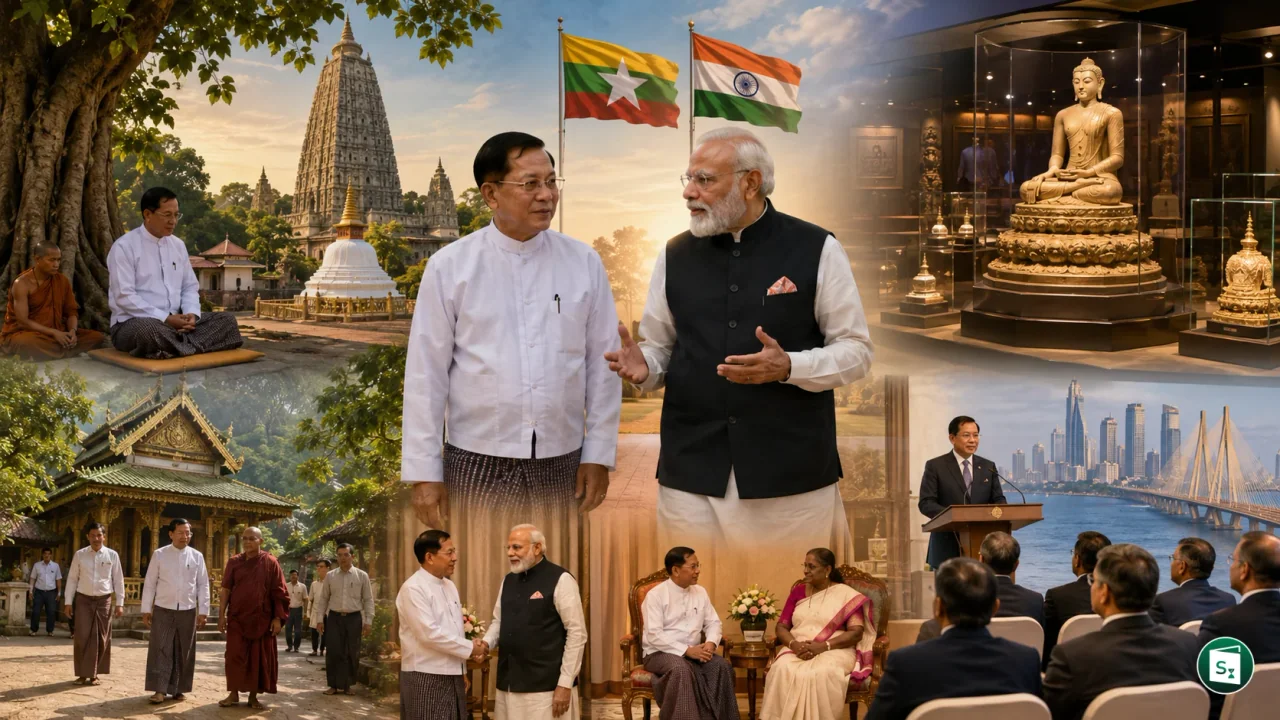
President U Min Aung Hlaing of Myanmar completed a five-day landmark state visit to India from May 30 to June 3, 2026, marking his first international trip since assuming office. The visit, which included high-level stops in Bodh Gaya, New Delhi, and Mumbai, was aimed at revitalizing bilateral ties across the domains of security, connectivity, and cultural diplomacy. By engaging with India’s top leadership and business communities, the President sought to align Myanmar’s strategic interests with India’s Neighborhood First and Act East policies.
Civilisational Ties: Pilgrimage to Bodh Gaya
President U Min Aung Hlaing began his visit with a spiritual journey to Bodh Gaya, the site where Prince Siddhartha attained enlightenment and became the Buddha. The President offered prayers at the Mahabodhi Temple Complex, a UNESCO World Heritage site since 2002. He meditated under the Bodhi Tree, which is a direct descendant of the original Peepal tree.
The President also visited the Sujata Temple, dedicated to the milkmaid who offered the Buddha his first meal after years of asceticism, and the local Burmese Monastery. This visit underscored the deep civilisational and religious bonds that serve as a soft-power bridge between the two nations.
| Feature of Mahabodhi Temple | Description |
|---|---|
| Location | Bodh Gaya, Bihar (Banks of Niranjana River) |
| Original Builder | Emperor Ashoka (3rd Century BC) |
| Current Structure | Predominantly from the Gupta Period (5th-6th Century AD) |
| Key Relic | Vajrasana (The Diamond Throne) |
| Main Idol | Buddha in Bhumisparsha Mudra (Earth-touching gesture) |
Diplomatic and Strategic Engagement in New Delhi
In the national capital, President U Min Aung Hlaing held extensive bilateral discussions with Prime Minister Narendra Modi at Hyderabad House. The talks focused on a broad spectrum of issues, including border management, connectivity, and capacity building. Both leaders reaffirmed their commitment to maintaining peace and stability along the 1,643-km shared border, particularly in the context of curbing insurgent activities and human trafficking.
Progress on Strategic Infrastructure
A key highlight of the discussions was the review of ongoing connectivity projects that are central to India’s outreach to Southeast Asia.
- Kaladan Multi-Modal Transit Transport Project: Both sides emphasized the need for the early completion of the road segment connecting Paletwa in Myanmar to Zorinpui in Mizoram.
- India-Myanmar-Thailand Trilateral Highway: Deliberations focused on overcoming security and logistical challenges in the Kalewa-Yagyi sector to ensure seamless road connectivity between India and the ASEAN region.
- Rupee-Kyat Settlement Mechanism: To facilitate easier trade, the leaders discussed scaling up the direct currency settlement mechanism, which aims to reduce reliance on the US dollar and streamline bilateral commerce.
The President also met with External Affairs Minister Dr. S. Jaishankar and called on President Droupadi Murmu at Rashtrapati Bhavan, further consolidating the diplomatic foundations of the relationship.
Cultural Diplomacy: The Buddha Relics Exposition
While in New Delhi, the President visited the Grand International Exposition of Sacred Piprahwa Relics at the Qila Rai Pithora cultural complex. The exposition, which features the bone fragments of Lord Buddha discovered in 1898, served as a poignant reminder of the shared spiritual heritage of the two nations.
The visit to the exposition highlighted the role of Buddhist Diplomacy in India’s foreign policy, particularly in its engagement with Southeast Asian nations where Buddhism is a predominant faith. The Piprahwa relics are considered among the most sacred artifacts in the Buddhist world, and their public display in Delhi has attracted high-level dignitaries from across Asia.
Economic Outreach: Strengthening Commercial Ties in Mumbai
The President concluded his visit in Mumbai, the financial capital of India, where he engaged with business and industry leaders. The focus of these interactions was to explore new avenues for investment and to strengthen existing commercial ties.
The discussions in Mumbai covered sectors such as energy, agriculture, and manufacturing. With Myanmar acting as a gateway to the ASEAN market, Indian businesses expressed interest in expanding their footprint in Myanmar’s infrastructure and retail sectors. The Rupee-Kyat settlement mechanism was again a point of interest, as it promises to make cross-border transactions more efficient for Small and Medium Enterprises (SMEs).
Strategic Significance: The Gateway to the East
The visit of President U Min Aung Hlaing is strategically significant for several reasons. Myanmar is the only ASEAN country that shares a land border with India, making it a critical partner for the security of India’s Northeast region.
For Myanmar, the visit marks a step towards greater international engagement. For India, it is a reaffirmation of the “Neighborhood First” policy, ensuring that regional stability remains a priority despite the complexities of Myanmar’s domestic political landscape. The cooperation on issues such as cybercrime and the rescue of Indian nationals from scam centers in the region further demonstrates the pragmatic nature of the current bilateral engagement.
Key Takeaways
- President U Min Aung Hlaing of Myanmar visited India from May 30 to June 3, 2026, covering Bodh Gaya, New Delhi, and Mumbai.
- The Mahabodhi Temple in Bodh Gaya, a UNESCO World Heritage site, was the first stop on the President’s itinerary.
- India and Myanmar reviewed the progress of the Kaladan Multi-Modal Project and the India-Myanmar-Thailand Trilateral Highway.
- Both nations discussed the expansion of the Rupee-Kyat settlement mechanism to boost bilateral trade and reduce dollar dependency.
- The President visited the sacred Piprahwa Buddha Relics exposition at Qila Rai Pithora in New Delhi.
- Discussions emphasized maintaining peace along the 1,643-km shared border and cooperating against online scam centers and human trafficking.