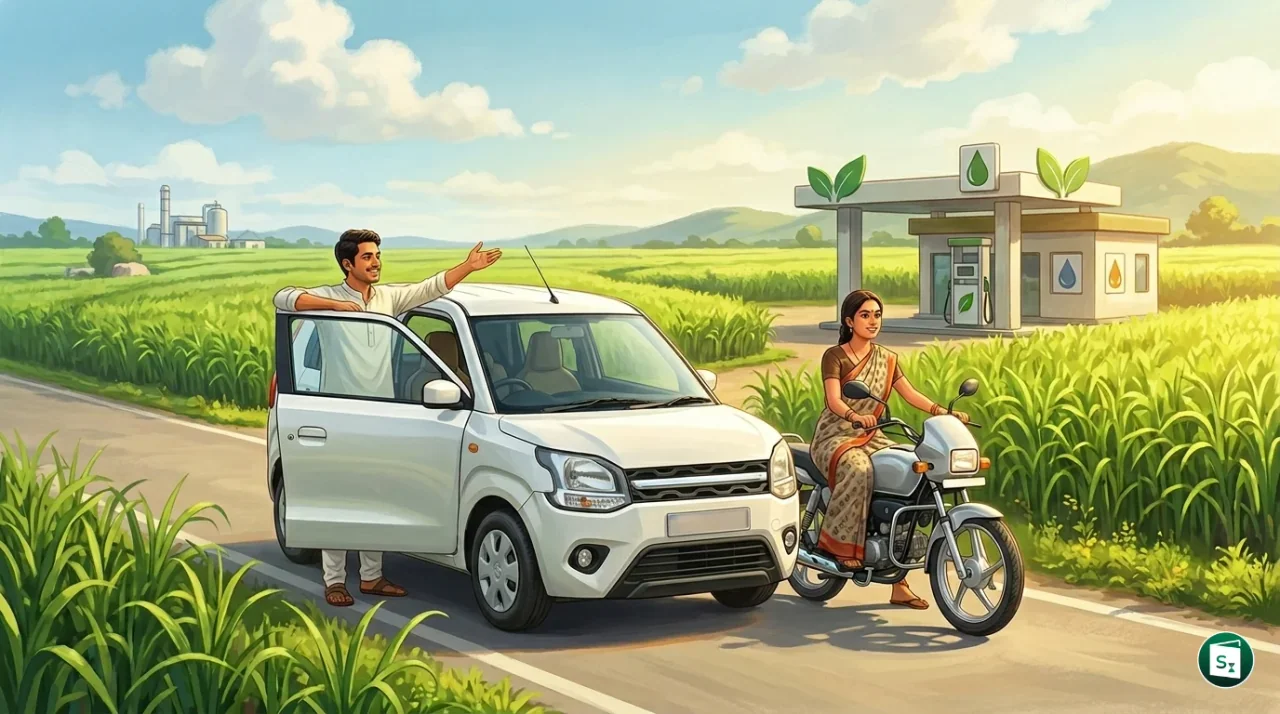
India reached a major milestone in its transition to sustainable energy with the launch of the country’s first flex-fuel passenger car and motorcycles on June 12, 2026. Union Minister Hardeep Singh Puri unveiled the Maruti Suzuki Wagon R Flex-Fuel, while Union Minister Nitin Gadkari introduced Hero MotoCorp’s flex-fuel motorcycle range. These launches mark a significant step toward reducing crude oil imports and empowering the domestic agricultural sector through ethanol-based mobility.
Pioneering Ethanol Mobility: India’s First Flex-Fuel Vehicles
The simultaneous launch of flex-fuel vehicles (FFVs) across the four-wheeler and two-wheeler segments marks a paradigm shift in India’s automotive landscape. Maruti Suzuki introduced the Wagon R Flex-Fuel, which is engineered to operate on any ethanol-petrol blend ranging from 20 percent (E20) to 100 percent (E100). This vehicle is specifically optimized for E85, a blend containing 85 percent ethanol and 15 percent petrol, which is expected to be a primary fuel choice for FFV users.
In the two-wheeler segment, Hero MotoCorp launched its popular commuter models, the Splendor+ Flex Fuel and the HF Deluxe Flex Fuel. These motorcycles are designed to run on blends from E20 to E85. To accommodate the higher ethanol concentrations, Hero MotoCorp modified approximately 36 engine components, including the fuel pump, fuel injectors, and the engine control unit (ECU). These vehicles are initially being rolled out in major cities like New Delhi, with a nationwide expansion planned as ethanol dispensing infrastructure grows.
Technical Specifications: Engineering for Ethanol
Flex-Fuel Vehicles (FFVs) differ from standard internal combustion engine vehicles in their ability to detect and adapt to varying levels of ethanol in the fuel tank. Because ethanol is more corrosive than petrol and has a different calorific value, engines must undergo extensive hardware and software modifications.
Hardware and Software Upgrades
A critical component in these vehicles is the ethanol sensor, which detects the exact percentage of ethanol in the fuel. This data is sent to the Engine Control Unit (ECU), which then automatically adjusts the fuel injection volume and ignition timing to ensure optimal performance and fuel efficiency. Furthermore, manufacturers use ethanol-compatible materials for fuel lines, tanks, and pumps to prevent corrosion.
The table below outlines the key differences between standard ethanol-blended petrol and high-ethanol flex-fuels:
| Feature | E20 (Standard Fuel) | E85/E100 (Flex-Fuel) |
|---|---|---|
| Ethanol Content | 20 percent | 80 to 100 percent |
| Engine Compatibility | Most BS-VI Phase II vehicles | Dedicated FFV engines |
| Calorific Value | High | Low (approx. 30 percent less than petrol) |
| Corrosiveness | Moderate | High |
| Environmental Impact | Reduced emissions | Significant CO2 and CO reduction |
Analogy · The Universal Adapter Expand analogy
Think of a flex-fuel engine like a universal travel adapter. Just as a universal adapter can accept different plug types from various countries and still power your device, a flex-fuel engine can ‘read’ different fuel types—whether it is 20 percent ethanol or 100 percent—and adjust its internal settings to keep the vehicle running smoothly.
Strategic Vision: The National Policy on Biofuels 2018
The introduction of flex-fuel vehicles is a cornerstone of the National Policy on Biofuels 2018, which was significantly amended in May 2022 to accelerate India’s green energy transition. A key outcome of these amendments was the advancement of the target for 20 percent ethanol blending (E20) in petrol from 2030 to the 2025-26 fiscal year. Having successfully met the E20 mandate across all major fuel outlets by April 2026, the government is now focusing on the next phase: the mass adoption of FFVs and the rollout of E85 and E100 fuels.
The implementation of this vision is a collaborative effort between the Ministry of Petroleum and Natural Gas, headed by Hardeep Singh Puri, and the Ministry of Road Transport and Highways, led by Nitin Gadkari. While the Petroleum Ministry oversees the production and distribution of ethanol through Oil Marketing Companies (OMCs), the Transport Ministry creates the regulatory framework and standards for vehicle manufacturers. Together, they aim to reduce India’s dependence on crude oil imports, which currently satisfy approximately 88 percent of the country’s energy needs.
Economic and Environmental Significance
The transition to ethanol-based mobility offers dual benefits for the Indian economy and the environment. By shifting from fossil fuels to biofuels, India is effectively turning its farmers from ‘Annadatas’ (food providers) into ‘Urjadatas’ (energy providers). Ethanol is primarily produced from sugarcane, maize, and surplus food grains, providing a guaranteed market and stable income for millions of farmers. Since 2014, the ethanol blending program has funneled over ₹1.5 lakh crore into the rural economy, significantly boosting farmer prosperity.
From a macroeconomic perspective, the use of domestically produced ethanol strengthens India’s trade balance. The country has already saved over ₹1.8 lakh crore in foreign exchange since 2014 by substituting imported crude oil with ethanol. Furthermore, the environmental impact of high-ethanol blends is substantial. Flex-fuel vehicles running on E85 can reduce carbon monoxide emissions by up to 77 percent and hydrocarbon emissions by approximately 26 percent compared to conventional petrol vehicles. These reductions are vital for India to achieve its long-term target of reaching Net Zero emissions by 2070.
The Way Forward: Building the Ethanol Infrastructure
The widespread adoption of flex-fuel vehicles depends heavily on the availability of high-ethanol fuel across the country. To address this, the government has launched an ambitious infrastructure roadmap. As of June 2026, the first wave of E85 and E100 dispensing stations has been established in key metropolitan areas, including New Delhi, Mumbai, Pune, and Nagpur. The government aims to increase this number to 500 stations by the end of 2026 and 5,000 stations by December 2027.
One of the primary challenges for FFV adoption is the ‘mileage gap,’ as ethanol has approximately 30 percent lower energy density than petrol. This means a vehicle will travel fewer kilometers on a liter of ethanol than on a liter of petrol. To ensure that ethanol remains a competitive choice for consumers, the government is working on a differential pricing strategy. By pricing ethanol significantly lower than petrol—estimated at a difference of approximately ₹20 per liter—the overall cost-per-kilometer for the consumer can be maintained or even reduced. As production capacities for second-generation (2G) ethanol from agricultural waste expand, India is well-positioned to become a global leader in the biofuel ecosystem, following in the footsteps of countries like Brazil.
Key Takeaways
- The Maruti Suzuki Wagon R Flex-Fuel is India’s first passenger flex-fuel vehicle, capable of running on ethanol-petrol blends from E20 to E100.
- Hero MotoCorp has launched the Splendor+ Flex Fuel and HF Deluxe Flex Fuel, which are the first flex-fuel motorcycles in India compatible with E20 to E85.
- The National Policy on Biofuels 2018, amended in May 2022, advanced the target for 20 percent ethanol blending (E20) to the 2025-26 fiscal year.
- India successfully achieved the E20 mandate across its nationwide network of approximately 90,000 petrol pumps by April 2026.
- Since 2014, the ethanol blending program has resulted in foreign exchange savings of over ₹1.8 lakh crore for India.
- Adoption of high-ethanol blends like E85 can reduce carbon monoxide emissions by up to 77 percent, supporting India’s 2070 Net Zero target.