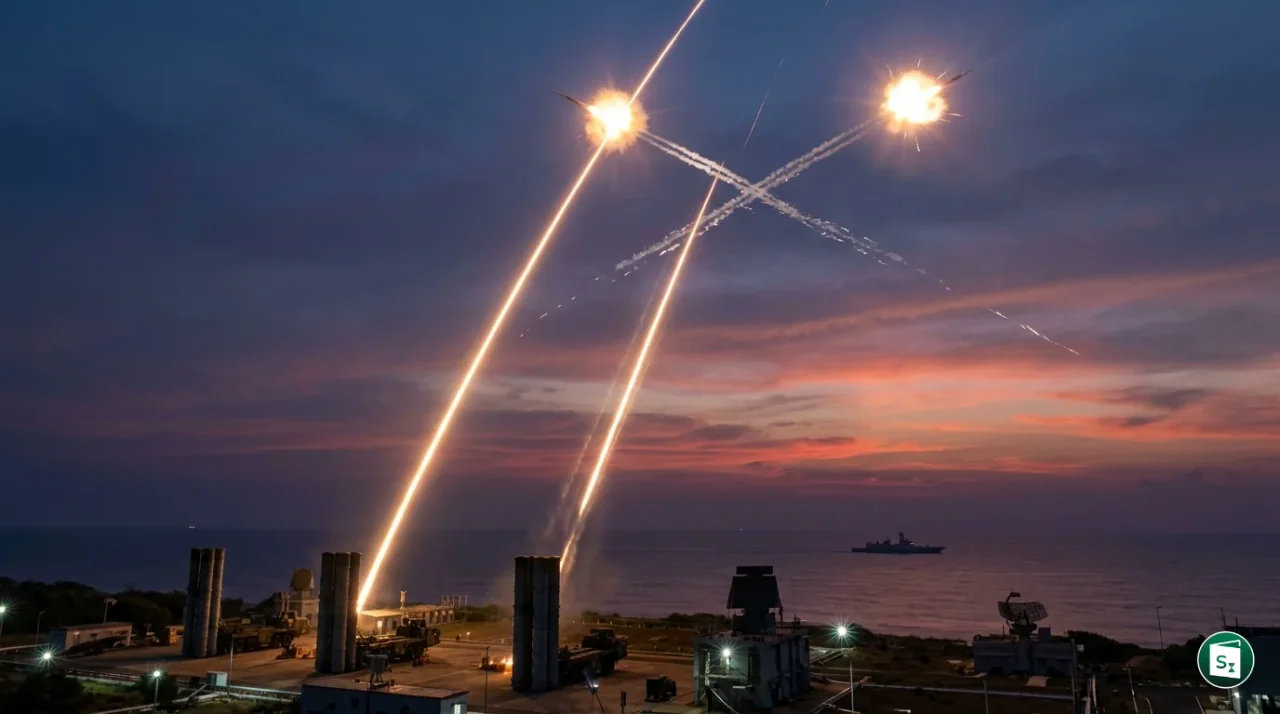
The Defence Research and Development Organisation (DRDO) successfully conducted three consecutive flight tests of its multi-layered Ballistic Missile Defence (BMD) system from the Integrated Test Range (ITR) in Chandipur, Odisha. These trials demonstrated India’s ability to intercept long-range missiles in the 5,000 km class using advanced AD-1 and AD-2 interceptors. This achievement, alongside the maiden test of the Naval Anti-Ship Missile–Medium Range (NASM-MR), marks a significant milestone in the nation’s strategic deterrence capabilities.
India’s Multi-Layered BMD Shield: A Strategic Leap
The Ballistic Missile Defence (BMD) program is a critical component of India’s national security architecture, designed to provide a protective shield against incoming ballistic missile threats. The system is being developed in two distinct phases by the Defence Research and Development Organisation (DRDO), which was established in 1958 and is headquartered in New Delhi. While Phase-I of the program was designed to intercept missiles with ranges up to 2,000 km, the recently tested Phase-II focuses on neutralizing high-speed threats from Intermediate-Range Ballistic Missiles (IRBMs) and Intercontinental Ballistic Missiles (ICBMs) with ranges up to 5,000 km.
The integrated system operates through a network of advanced sensors and control centers. The Integrated Test Range (ITR) at Chandipur, located in the Balasore district of Odisha, serves as the primary facility for evaluating these high-tech systems. The BMD architecture includes the Swordfish Long Range Tracking Radar (LRTR) for early detection and the Mission Control Centre (MCC), which serves as the brain of the operation by classifying targets and coordinating the launch of interceptor missiles.
AD-1 and AD-2: The New Interceptor Duo
The Phase-II BMD system utilizes two primary interceptors to create a multi-layered defence. These missiles are designed to engage targets at different altitudes and phases of flight, ensuring a higher probability of successful interception. Both interceptors are powered by two-stage solid-propellant motors and are capable of reaching hypersonic speeds, which are necessary to match the velocity of incoming long-range warheads.
| Feature | AD-1 Interceptor | AD-2 Interceptor |
|---|---|---|
| Primary Role | Endo-atmospheric and low exo-atmospheric | High-altitude exo-atmospheric |
| Interception Stage | Terminal phase (within atmosphere) | Mid-course phase (outer space) |
| Target Class | Long-range missiles and high-altitude aircraft | IRBMs and ICBM-class threats |
| Specialization | Large kill altitude bracket | Interception outside the atmosphere |
The AD-1 is a dual-purpose interceptor that can neutralize both ballistic missiles and hostile aircraft at high altitudes. Its advanced guidance system allows for precise “hit-to-kill” operations. On the other hand, the AD-2 is optimized for mid-course interception, engaging threats well before they re-enter the Earth’s atmosphere. By destroying a missile in space, the system prevents any potential debris or hazardous payloads from reaching the ground.
Strengthening Maritime Strike: The NASM-MR Maiden Test
Alongside the BMD trials, the DRDO successfully conducted the maiden flight test of the indigenous Naval Anti-Ship Missile–Medium Range (NASM-MR). Launched from a ground-based mobile launcher at the Integrated Test Range, the missile followed a low-altitude sea-skimming profile to engage its target with high precision. This sea-skimming capability is crucial for modern naval warfare, as it allows the missile to fly very close to the water surface, making it difficult for enemy radars to detect and intercept it.
The NASM-MR is designed to neutralize medium-sized warships such as frigates and destroyers. With an operational range of approximately 350 km, it fills a vital gap in the Indian Navy arsenal between short-range systems and long-range heavy missiles like the BrahMos. The missile features advanced indigenous technologies, including a two-way datalink and an X-band AESA RF seeker for terminal guidance. Its induction will significantly enhance India’s maritime strike envelope and bolster its deterrence posture in the Indian Ocean Region (IOR).
Strategic Significance: Joining the Elite Global Club
The successful validation of the Phase-II BMD system is a momentous achievement for India’s defence technology. By demonstrating the capability to intercept and destroy missiles in the 5,000 km range class, India has joined an elite group of nations that possess advanced ballistic missile defence technology. This exclusive club includes the United States, Russia, China, and Israel. The ability to neutralize high-speed, long-range threats provides India with a robust “no-first-use” nuclear posture by ensuring that the nation can survive and respond to a potential missile strike.
The simultaneous testing of the NASM-MR also underscores India’s focus on achieving Atmanirbhar Bharat (self-reliant India) in critical defence sectors. Developing indigenous missile systems reduces dependency on foreign imports and ensures that the technology can be customized to meet specific regional threats. These tests send a strong signal of India’s growing technological prowess and its commitment to maintaining peace and stability in the Indo-Pacific region through credible deterrence.
The Way Forward
The successful tests of Phase-II BMD and NASM-MR mark the beginning of a more intensive deployment phase. The DRDO is already working on Phase-III of the BMD program, which aims to develop specialized interceptors like the AD-AH and AD-AM. These future systems are designed to counter even more complex threats, such as Hypersonic Glide Vehicles (HGVs) and missiles equipped with Multiple Independently Targetable Re-entry Vehicles (MIRVs).
As these systems transition from testing to induction, they will be integrated into the integrated command and control structures of the Indian Armed Forces. This will provide a layered, 360-degree defensive umbrella over India’s major cities and strategic assets, ensuring the nation’s security against evolving global missile threats.
Key Takeaways
- The DRDO successfully conducted three consecutive flight tests of the Phase-II Ballistic Missile Defence (BMD) system in June 2026.
- The tests validated the capabilities of AD-1 and AD-2 interceptors to neutralize missiles in the 5,000 km class.
- India has joined an elite group of nations possessing this technology, alongside the US, Russia, China, and Israel.
- The maiden flight test of the indigenous Naval Anti-Ship Missile–Medium Range (NASM-MR) was successfully executed.
- The NASM-MR has an operational range of approximately 350 km and features a sea-skimming profile for high survivability.
- The DRDO was established in 1958, operates under the Ministry of Defence, and is headquartered in New Delhi.