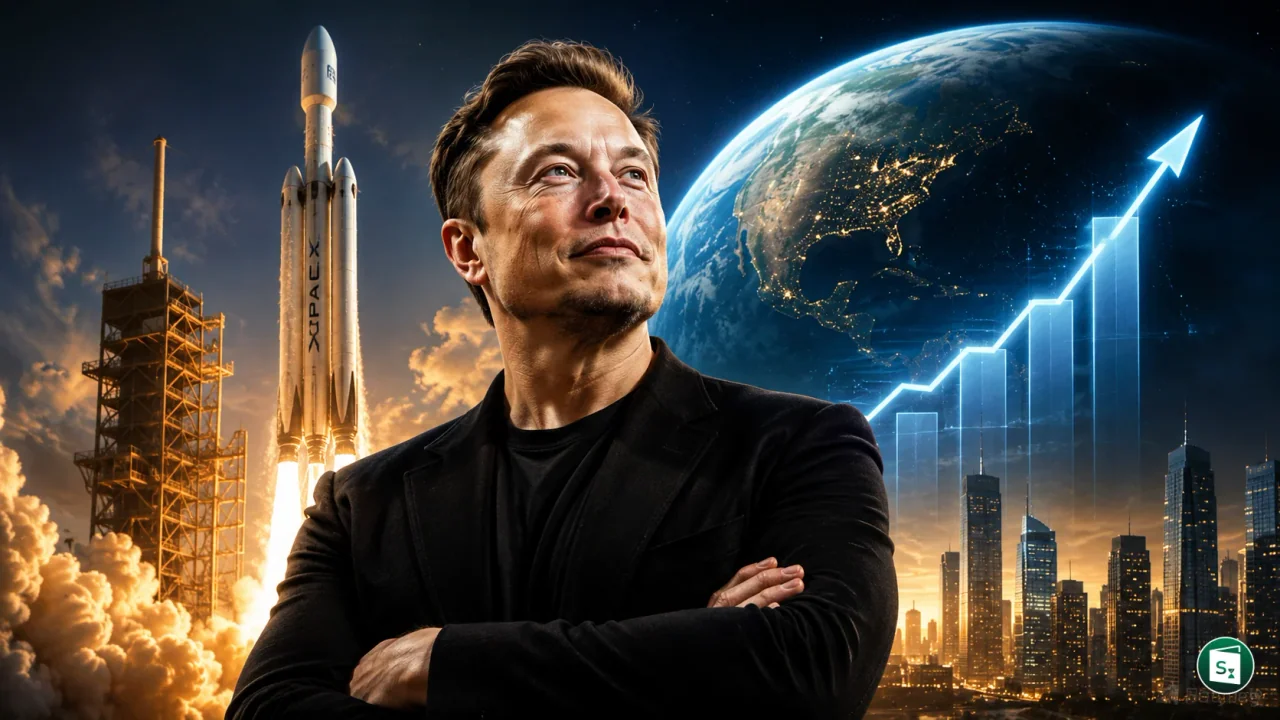
Elon Musk became the first individual to reach a trillion-dollar net worth on June 18, 2026, after the successful public listing of his aerospace venture, SpaceX. The company raised a record-breaking 75 billion dollars through its Initial Public Offering, surpassing all previous global benchmarks for public listings. This financial milestone marks a transformative shift in the space industry and highlights the immense commercial potential of Starlink and Starship technologies.
SpaceX Makes Historic Market Debut
SpaceX, officially known as Space Exploration Technologies Corporation, made its debut on the Nasdaq stock exchange under the ticker symbol SPCX. The company, which was founded by Elon Musk in 2002 with a personal investment of 100 million dollars, has grown from a fledgling startup into a global leader in orbital delivery and satellite internet. While its engineering and manufacturing hub remains in Hawthorne, California, the company moved its corporate headquarters to Starbase, Texas, in 2024 to focus on the development of the Starship launch system.
The Initial Public Offering was heavily oversubscribed, with demand from institutional and retail investors far exceeding the available shares. SpaceX initially priced its shares at 135 dollars, but the valuation surged as the market opened, briefly pushing the company’s market capitalization toward 2.8 trillion dollars. This valuation places SpaceX among the most valuable companies globally, rivaling technology giants like Microsoft and Apple.
Surpassing Saudi Aramco: The World’s Largest IPO
With a capital raise of 75 billion dollars, the SpaceX IPO has decisively overtaken the 2019 Saudi Aramco listing as the largest public offering in history. The state-owned oil giant of Saudi Arabia, headquartered in Dhahran, had raised 25.6 billion dollars (later expanded to 29.4 billion dollars) during its debut on the Tadawul exchange. The sheer scale of the SpaceX listing, which is more than double the size of the previous record, underscores the massive shift in investor interest from traditional energy sectors toward the burgeoning space and technology economy.
| Feature | SpaceX (2026) | Saudi Aramco (2019) |
|---|---|---|
| Amount Raised | 75 Billion Dollars | 29.4 Billion Dollars |
| Initial Valuation | 1.77 Trillion Dollars | 1.70 Trillion Dollars |
| Listing Exchange | Nasdaq (United States) | Tadawul (Saudi Arabia) |
| Primary Ticker | SPCX | 2222 |
The success of the offering was bolstered by a rare decision to reserve approximately 30 percent of the shares for retail investors. This allowed thousands of individual traders to participate in the listing, contributing to the high volume of trading and the subsequent rally in share prices.
Elon Musk: The Rise of the First Trillionaire
The market debut of SpaceX has propelled Elon Musk to a net worth exceeding 1.1 trillion dollars, making him the first trillionaire in recorded history. His wealth is a reflection of his majority ownership in SpaceX, where he holds approximately 42 percent of the equity along with over 80 percent of the voting power. This concentration of ownership ensures that Musk retains strategic control over the company’s mission to colonize Mars while benefiting from the massive valuation of the Starlink satellite constellation.
Beyond SpaceX, Musk’s portfolio includes significant stakes in Tesla, the electric vehicle pioneer, and Neuralink, which focuses on brain-computer interfaces. In early 2026, a series of strategic mergers saw Musk’s artificial intelligence venture, xAI, and the social media platform X absorbed into the SpaceX corporate structure. This consolidation allowed the IPO to be marketed as a multi-pillar technology giant, encompassing space logistics, global connectivity, and advanced AI systems.
Pillars of Growth: Starlink, Starship, and xAI
The primary engine behind the record valuation of SpaceX is Starlink, a constellation of thousands of small satellites in low Earth orbit. Starlink provides high-speed internet access across the globe, particularly in remote and underserved regions. By mid-2026, the service has reached over 10 million active subscribers, generating billions in annual revenue and proving the commercial viability of large-scale satellite constellations.
Complementing Starlink is the Starship program, the world’s most powerful launch system. Starship is designed for full and rapid reusability, significantly lowering the cost of reaching orbit. It is a critical component of NASA’s Artemis program, which aims to return humans to the lunar surface. The integration of xAI further enhances the company’s capabilities, providing advanced autonomous systems for deep space navigation and satellite management.
Understanding IPOs and Market Capitalization
An Initial Public Offering (IPO) is the process through which a private company offers its shares to the general public for the first time. This transition marks the company’s entry into the Primary Market, allowing it to raise capital for expansion while providing an exit route for early-stage investors. In the United States, IPOs are overseen by the Securities and Exchange Commission (SEC), while in India, the Securities and Exchange Board of India (SEBI) performs a similar regulatory role to protect investor interests.
The valuation of a public company is typically measured through its Market Capitalization. This is calculated by multiplying the current market price per share by the total number of outstanding shares. SpaceX’s market capitalization reached historic levels shortly after its listing, briefly exceeding 2.8 trillion dollars. This metric is used to categorize companies into large-cap, mid-cap, and small-cap segments, with SpaceX firmly established as one of the largest large-cap entities in the global financial markets.
The Future of Space Commerce and Exploration
The public listing of SpaceX is expected to accelerate the commercialization of space, providing the capital necessary for long-term projects such as the establishment of a human colony on Mars. The company’s focus on reusability and high-cadence launches has already transformed the satellite launch market, and its new public status will likely encourage more private investment in the aerospace sector.
The integration of advanced artificial intelligence and satellite connectivity positions SpaceX as a central player in the global infrastructure of the future. As the company continues to scale its operations, it remains a critical partner for national space agencies and private enterprises alike, paving the way for a multi-planetary future for humanity.
Key Takeaways
- Elon Musk became the world’s first trillionaire on June 18, 2026, following the record-breaking Initial Public Offering of SpaceX.
- SpaceX raised 75 billion dollars through its debut on the Nasdaq exchange, surpassing the 2019 Saudi Aramco IPO as the largest public offering in history.
- The company’s market capitalization surged to over 2.8 trillion dollars, driven by the success of the Starlink satellite network and the Starship launch system.
- SpaceX was founded in 2002 and is currently headquartered in Starbase, Texas, with its manufacturing base in Hawthorne, California.
- An Initial Public Offering (IPO) is the primary market process by which a private company offers shares to the public for the first time.
- The company consolidated several of Musk’s ventures, including xAI and X, into its corporate structure prior to the public listing.