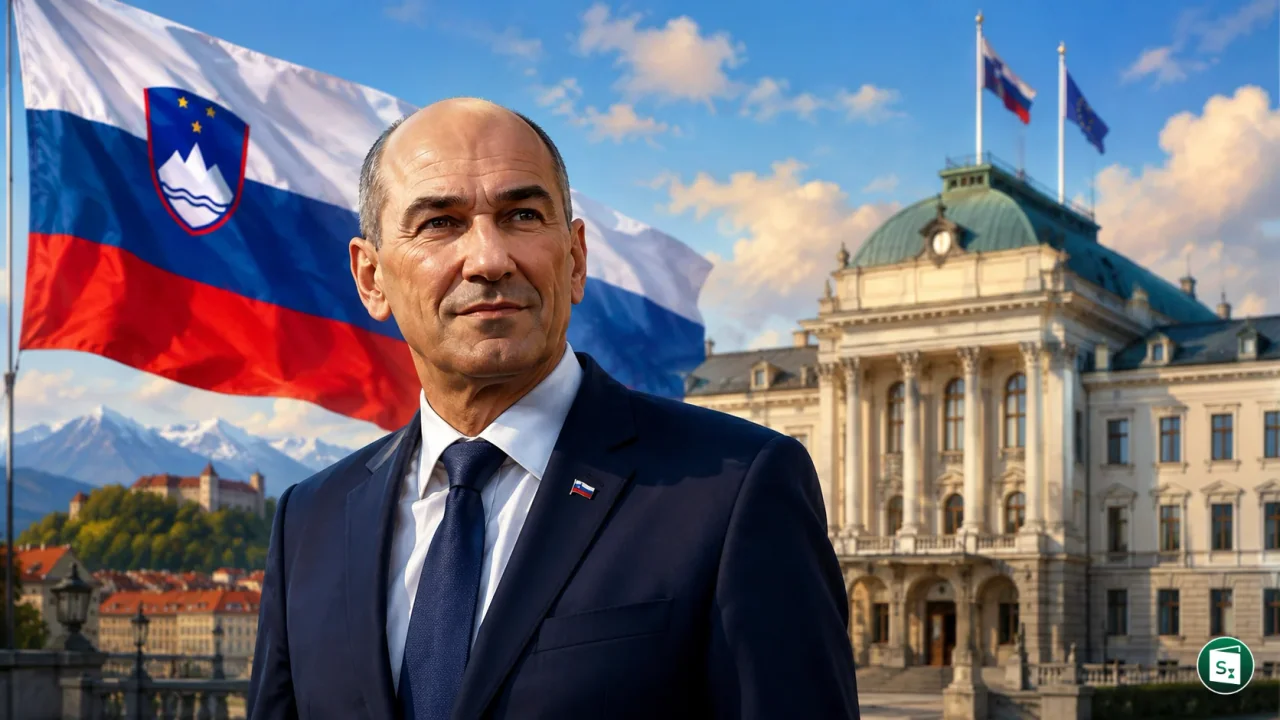
The Slovenian National Assembly elected veteran conservative leader Janez Janša as the Prime Minister of Slovenia on May 22, 2026, marking his fourth term at the helm of the central European nation. He succeeds Robert Golob of the center-left Freedom Movement after a two-month political deadlock following the general elections held in March 2026. The transition signals a significant shift in Slovenia’s domestic policy and its positioning within the European Union.
Historic Fourth Term for Janez Janša
The return of Janez Janša to the office of Prime Minister marks a key moment in the modern political history of Slovenia. Janša, who leads the conservative Slovenian Democratic Party (SDS), secured the premiership after the country’s parliament voted 51 to 36 in his favor. This victory seals his fourth term as the head of the Slovenian government. His previous tenures as Prime Minister spanned the periods of 2004 to 2008, 2012 to 2013, and 2020 to 2022.
Janša succeeds Robert Golob, who served as Prime Minister from June 2022 until the transition in 2026. Under Golob’s leadership, the center-left Freedom Movement (GS) had focused on green energy and social reforms. However, rising inflation, economic challenges, and coalition disputes weakened Golob’s administration, setting the stage for Janša’s political comeback.
Election Outcome and Government Formation
The parliamentary elections held on March 22, 2026, resulted in a highly fragmented legislature. The ruling Freedom Movement secured 29 seats, while the opposition Slovenian Democratic Party finished a close second with 28 seats. Since neither of the two major political forces managed to reach the threshold of 46 seats required for a working majority in the 90-seat National Assembly, the country entered a phase of intense political bargaining.
The Path to a Coalition
Although Robert Golob was initially given the opportunity to explore government formation, his efforts to assemble a stable center-left coalition fell through due to diverging policy priorities among the potential partners. Seizing the initiative, Janez Janša successfully negotiated a legislative alliance. He aligned with the conservative New Slovenia party and obtained support from the right-wing populist party Resni.ca. This coalition agreement enabled Janša to muster the necessary parliamentary votes, securing his confirmation as Prime Minister-designate. Janša is now in the process of finalizing the members of the 16th Government of Slovenia.
Profile of Janez Janša and the SDS Party
Born in 1958, Janez Janša has been a central figure in Slovenian politics for nearly four decades. He first gained prominence during the dissolution of Yugoslavia, serving as the country’s defense minister during the Slovenian Independence War of 1991, which is also referred to as the Ten-Day War. Under his stewardship, Slovenia successfully defended its sovereignty against the Yugoslav People’s Army, establishing his reputation as a key founder of the modern state.
Janša has led the Slovenian Democratic Party (SDS) since 1993. The party was originally founded in 1989 under the name Social Democratic Alliance of Slovenia. Over the subsequent decades, the party shifted its ideological alignment from social democracy to center-right conservatism and national populism, officially adopting its current name in 2003. Nationally, the SDS champions economic liberalization, judicial reforms, and conservative social values. Internationally, the party is a member of the European People’s Party (EPP), the largest political family in the European Parliament.
Political Structure of Slovenia
Slovenia is a parliamentary republic with a governance model divided between the Head of State and the Head of Government. The President of Slovenia serves as the Head of State, a role that is primarily ceremonial. The President is elected directly by the public for a five-year term. The incumbent President is Nataša Pirc Musar, who assumed office in December 2022. The Prime Minister serves as the Head of Government and holds executive authority.
The legislative branch is characterized by an incomplete bicameral system. The primary legislative powers lie with the National Assembly, while the National Council plays an advisory and supervisory role.
| Institution | Chamber Type | Number of Seats | Key Functions and Election Mode |
|---|---|---|---|
| National Assembly (Državni zbor) | Lower House | 90 seats | Serves as the primary legislative body. Out of the total, 88 members are elected through proportional representation, and 2 members are reserved for the Hungarian and Italian ethnic minorities. Members serve four-year terms. |
| National Council (Državni svet) | Upper House | 40 seats | Serves as an advisory body representing local, socio-economic, and professional interest groups. Members are elected indirectly and hold the power of suspensive veto over legislation passed by the lower house. |
Slovenia transitioned to a parliamentary democracy following its independence from Yugoslavia. It joined the European Union and the North Atlantic Treaty Organization (NATO) in 2004. The country adopted the Euro as its official currency on January 1, 2007, succeeding the Slovenian tolar.
Key Takeaways
- Janez Janša, leader of the Slovenian Democratic Party (SDS), was elected as the Prime Minister of Slovenia for his fourth term on May 22, 2026.
- Janša succeeded Robert Golob of the center-left Freedom Movement after winning a parliamentary vote of 51 to 36.
- The general elections were held on March 22, 2026, resulting in a hung assembly where the Freedom Movement secured 29 seats and the SDS won 28 seats.
- Slovenia’s lower house of parliament, the National Assembly (Državni zbor), consists of 90 seats, including two seats reserved for ethnic Italian and Hungarian minorities.
- The Head of State of Slovenia is President Nataša Pirc Musar, who assumed office in December 2022.
- Slovenia joined the European Union and NATO in 2004, and adopted the Euro as its official currency on January 1, 2007.