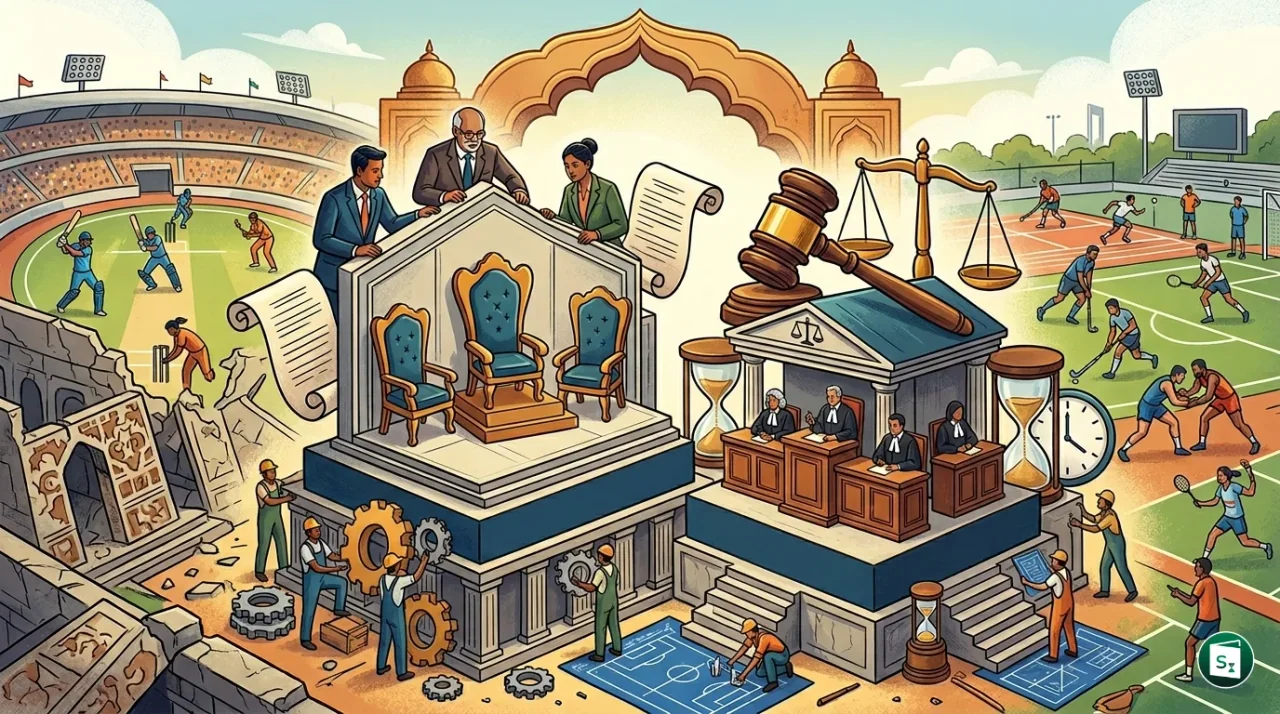
The Ministry of Youth Affairs and Sports notified the National Sports Governance (National Sports Board) Rules, 2026 and the National Sports Governance (National Sports Tribunal) Rules, 2026 to operationalize the landmark National Sports Governance Act, 2025. These rules establish a statutory regulatory authority to oversee national sports bodies and create a dedicated judicial forum for resolving administrative and selection-related disputes. The initiative marks a significant transition from voluntary executive codes to legally enforceable norms in Indian sports administration.
Background of Sports Governance Reform in India
For over a decade, the administration of sports in the country relied on executive instructions. The National Sports Development Code of India, 2011 served as the primary guideline for national sports organizations. While the code established age and tenure limits for office bearers, it lacked statutory power. This lack of legal backing led to frequent governance deadlocks, compliance failures, and prolonged court battles.
To address these challenges, Parliament passed the National Sports Governance Act, 2025. The legislation received presidential assent in August 2025 and commenced in part on December 31, 2025. By replacing voluntary guidelines with statutory laws, the government aims to bring transparency and financial accountability to the sports sector. The act mandates the creation of specialized regulatory and dispute resolution bodies to align Indian sports administration with international standards.
Structure and Role of the National Sports Board
The National Sports Board (NSB) serves as the central regulatory authority responsible for monitoring recognized sports bodies across the nation. The board is tasked with granting recognition to national sports organizations, overseeing their compliance with financial regulations, and maintaining public records of affiliate units.
Key provisions governing the composition and operations of the National Sports Board include:
- Composition: The board consists of a Chairperson and two members appointed by the Central Government.
- Appointment Process: The central government selects the board members from a panel recommended by a dedicated Search-cum-Selection Committee.
- Tenure: The Chairperson and the two members hold office for a maximum term of three years or until they attain the age of 65 years, whichever is earlier.
- Exclusion of Conflict: To maintain absolute neutrality, members are barred from holding any parallel administrative positions in regional, national, or international sports organizations during their tenure.
The National Sports Tribunal and Dispute Resolution
The National Sports Tribunal (NST) is established as an independent, quasi-judicial body designed to handle internal conflicts, election deadlocks, and athlete grievances. By providing a single-window dispute resolution mechanism, the tribunal aims to resolve disputes swiftly, reducing the burden on traditional civil courts.
Operations and Selection
The central government appoints the members and the Chairperson of the tribunal based on the recommendations of a high-level committee. This committee includes the Chief Justice of India or a designated Supreme Court judge, the Sports Secretary, and the Secretary in the Ministry of Law and Justice.
To ensure accessibility and speed, the rules mandate a digital-first approach. All processes, including the filing of disputes, submission of evidence, virtual hearings, and the publication of orders, will be managed through a dedicated online portal. However, the tribunal’s jurisdiction excludes doping infractions and disputes related to major international events like the Olympic Games, which remain governed by international sports bodies.
Structural Comparison of the NSB and NST
| Feature | National Sports Board (NSB) | National Sports Tribunal (NST) |
|---|---|---|
| Primary Role | Apex regulatory and compliance body | Independent dispute resolution tribunal |
| Composition | Chairperson and 2 members | Chairperson and members (initially two vacancies announced) |
| Chairperson Tenure | 3 years or up to 65 years of age | 5 years or up to 70 years of age |
| Member Tenure | 3 years or up to 65 years of age | 5 years or up to 67 years of age |
| Chairperson Eligibility | Selected by Search-cum-Selection Committee | Retired Supreme Court Judge or retired Chief Justice of a High Court |
| Key Functions | Grants recognition, monitors compliance, issues codes of ethics | Decides election disputes, selection grievances, and administration conflicts |
Implications for Indian Sports Governance
The notification of the board and tribunal rules completes the operational architecture of the National Sports Governance Act, 2025. These developments introduce several structural reforms that will redefine how national sports bodies function in India.
Promoting Athlete Welfare and Representation
A core focus of the new regime is the inclusion of athletes in decision-making processes. The rules mandate that all recognized sports federations incorporate Sportspersons of Outstanding Merit (SOMs) into their general bodies and executive committees. This ensures that active or former athletes have a direct voice in administration. Additionally, the guidelines require sports organizations to adopt a comprehensive Safe Sports Policy, containing specific safeguards to protect minors, women, and athletes with disabilities from harassment and discrimination.
Reducing Judicial Burden
By establishing the National Sports Tribunal as a specialized quasi-judicial body, the rules create an alternative dispute resolution path. In the past, leadership disputes and selection controversies often resulted in protracted litigations in High Courts, which temporarily halted training camps or disrupted team selections. The tribunal is expected to resolve these disputes within a specified timeframe, keeping focus on sports performance rather than administrative conflicts.
Compliance and Global Standards
The creation of the National Sports Board as an independent regulator ensures that national sports bodies adhere to clean administration and financial audits. By introducing independent oversight, the rules bring Indian sports governance in line with the expectations of the International Olympic Committee and other global federations. This reduces the risk of international suspensions, which have previously affected Indian sports federations due to governance deadlocks.
Key Takeaways
- The Ministry of Youth Affairs and Sports notified the rules for the National Sports Board and the National Sports Tribunal in May 2026.
- These rules were issued under the provisions of the National Sports Governance Act, 2025, replacing the National Sports Development Code of India, 2011.
- The National Sports Board consists of a Chairperson and two members appointed for a maximum term of three years or until attaining 65 years of age.
- The Chairperson of the National Sports Tribunal holds office for a term of five years or until reaching 70 years of age.
- Members of the tribunal hold office for a term of five years or until attaining 67 years of age.
- The tribunal selection committee includes the Chief Justice of India or a designated Supreme Court judge, alongside the Sports and Law Secretaries.