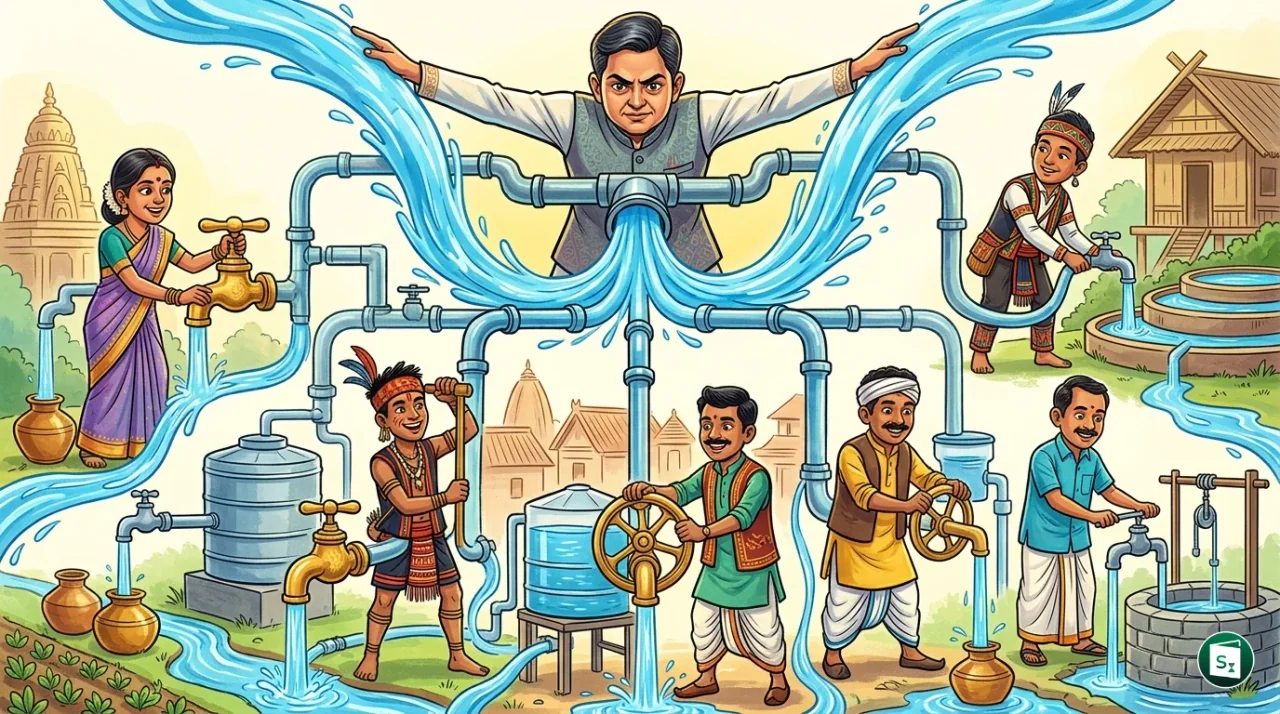
The Union Ministry of Jal Shakti has entered into reform-linked Memoranda of Understanding (MoUs) with Arunachal Pradesh, Jharkhand, Tamil Nadu, Nagaland, and the Union Territory of Puducherry under the revamped Jal Jeevan Mission (JJM) 2.0. These agreements establish a decentralized governance framework that transfers rural water supply operations to local Gram Panchayats as utility managers. By linking central fund releases to key structural reforms, the initiative aims to transition the rural water sector from asset creation to a sustainable, service-based utility model.
Decoupling Water Infrastructure from Governance: The Shift to JJM 2.0
The original Jal Jeevan Mission, launched on August 15, 2019, aimed to provide safe and adequate drinking water through Functional Household Tap Connections (FHTCs) to all rural households by 2024. While that phase achieved massive physical infrastructure footprints across India, maintaining the long-term functionality of these assets emerged as a major challenge. Issues such as drying water sources, pipe leakages, and inadequate operational funds often disrupted the supply.
To address these vulnerabilities, the Union Cabinet approved Jal Jeevan Mission 2.0 on March 10, 2026, extending the implementation timeline to December 2028. This revamped phase shifts the strategy from a purely infrastructure-driven model to a citizen-centric, utility-based service delivery model. Under JJM 2.0, the central government is decoupling asset building from daily governance. The new model establishes clear operational, financial, and management guidelines to ensure that clean water flows through the installed taps consistently for decades.
Understanding the 11-Point Structural Reform Blueprint
The reform-linked MoUs signed by the states mandate the execution of 11 key structural reforms to secure central funding. These reforms target every aspect of water management, from policy formulation to community-level operations.
| Structural Reform Area | Key Objective and Focus |
|---|---|
| Institutional Architecture | Building dedicated administrative structures for water governance. |
| Service Utility Framework | Shifting rural water supply departments toward utility-style management. |
| Technical Compliance | Enforcing standard engineering, safety, and operational designs. |
| Water Quality Governance | Establishing citizen-centric systems for water quality testing and reporting. |
| Source Sustainability | Implementing rainwater harvesting, groundwater recharge, and greywater management. |
| Digital Data Governance | Using real-time digital frameworks to track water supply operations. |
| Participatory Governance | Promoting community ownership through active village assembly participation. |
| Capacity Building | Training local leaders and officials in water management practices. |
| Human Resource and Skilling | Developing a trained local workforce for technical operations and maintenance. |
| Operational and Financial Sustainability | Designing water tariff models to recover operation and maintenance costs. |
| Research and Innovation | Integrating modern water technologies and research-backed solutions. |
The Institutional and Service Utility Framework
To implement these reforms, states are establishing formal service utility frameworks. Historically, rural water supply was treated as a basic public work managed by state engineering departments. Under JJM 2.0, the focus is on running these systems like professional utility companies. This means defining service level benchmarks, tracking water delivery hours, and addressing public grievances.
Additionally, the reforms require the creation of a local skilling ecosystem. By training rural youths in plumbing, electrical work, and pump operation, the program builds a self-reliant pool of technical personnel directly within the villages. This reduces repair response times and helps prevent long outages.
Citizen-Centric Quality and Digital Governance Systems
A major component of the reform blueprint is the integration of the Sujalam Bharat Digital Framework. This national platform maps the entire rural water supply chain. Under this framework, every village is assigned a unique Sujal Gaon ID or Service Area ID. This ID links the local water source, the purification plant, the main distribution lines, and individual household taps to a centralized digital map.
This digital infrastructure is paired with decentralized water quality monitoring. Local communities are equipped with Field Test Kits (FTKs), and at least five women in each village are trained to conduct regular water quality tests. The test results are uploaded directly to the portal, ensuring that water contamination is detected and resolved quickly.
Gram Panchayat-Led Decentralized Water Governance
To make water governance truly decentralized, the responsibility of operating and maintaining the piped water systems is being transferred from state departments to local communities.
The Jal Arpan Process and Community Ownership
The transfer of completed piped water supply schemes to local communities is formalized through a process known as Jal Arpan. Once a water supply scheme is completed and verified, it is handed over to the Gram Panchayat or the Village Water and Sanitation Committee (VWSC), often called the Paani Samiti.
This local committee takes full ownership of the daily operation, maintenance, and budgeting of the scheme. Gram Panchayats are empowered to set and collect nominal water tariffs from households. This financial autonomy ensures that the local body can fund routine maintenance, electricity bills, and minor repairs without relying on bureaucratic state approvals, ensuring long-term operational sustainability.
Participatory Tools: Jal Seva Aankalan and Meri Panchayat App
To ensure accountability and maintain high service standards, the mission introduces participatory evaluation tools. The Jal Seva Aankalan is a service delivery assessment conducted at the village level. It measures three critical parameters: water quantity, water quality, and regularity of supply.
The results of these assessments are shared with the villagers through the Meri Panchayat App. This digital application serves as a direct feedback loop, allowing residents to view service ratings, log supply issues, and monitor local water budgets. By integrating digital tracking with local assemblies, the program ensures that governance remains transparent and citizen-driven.
Funding and Financial Outlay under JJM 2.0
The financial architecture of Jal Jeevan Mission 2.0 has been enhanced to support these structural reforms. The Union Government has allocated a total outlay of ₹8.69 lakh crore for this extended phase. Within this amount, the central government’s share is ₹3.59 lakh crore, representing a significant rise in funding compared to the first phase.
Crucially, central assistance under the revamped mission is tied directly to performance. The signing of reform-linked MoUs by Arunachal Pradesh, Jharkhand, Tamil Nadu, Nagaland, and the Union Territory of Puducherry marks their commitment to implementing the service delivery guidelines. States that fail to set up utility frameworks, implement digital tracking systems, or transfer schemes to local bodies risk losing access to their subsequent central grant instalments. This model ensures that central funding is used effectively to build sustainable water supply networks rather than short-lived physical infrastructure.
Key Takeaways
- The Ministry of Jal Shakti signed reform-linked MoUs under Jal Jeevan Mission (JJM) 2.0 with Arunachal Pradesh, Jharkhand, Tamil Nadu, Nagaland, and Puducherry in June 2026.
- The revamped Jal Jeevan Mission 2.0 was approved by the Union Cabinet on March 10, 2026, extending the program’s timeline to December 2028.
- The extended phase operates with an enhanced total outlay of ₹8.69 lakh crore, which includes a central share of ₹3.59 lakh crore.
- Under the Jal Arpan process, completed piped water supply schemes are handed over to the Gram Panchayat or the Village Water and Sanitation Committee (VWSC).
- The Sujalam Bharat Digital Framework tracks the water supply chain by assigning a unique Sujal Gaon ID to each village.
- The Jal Seva Aankalan evaluates rural water delivery parameters and shares service quality ratings through the Meri Panchayat App.