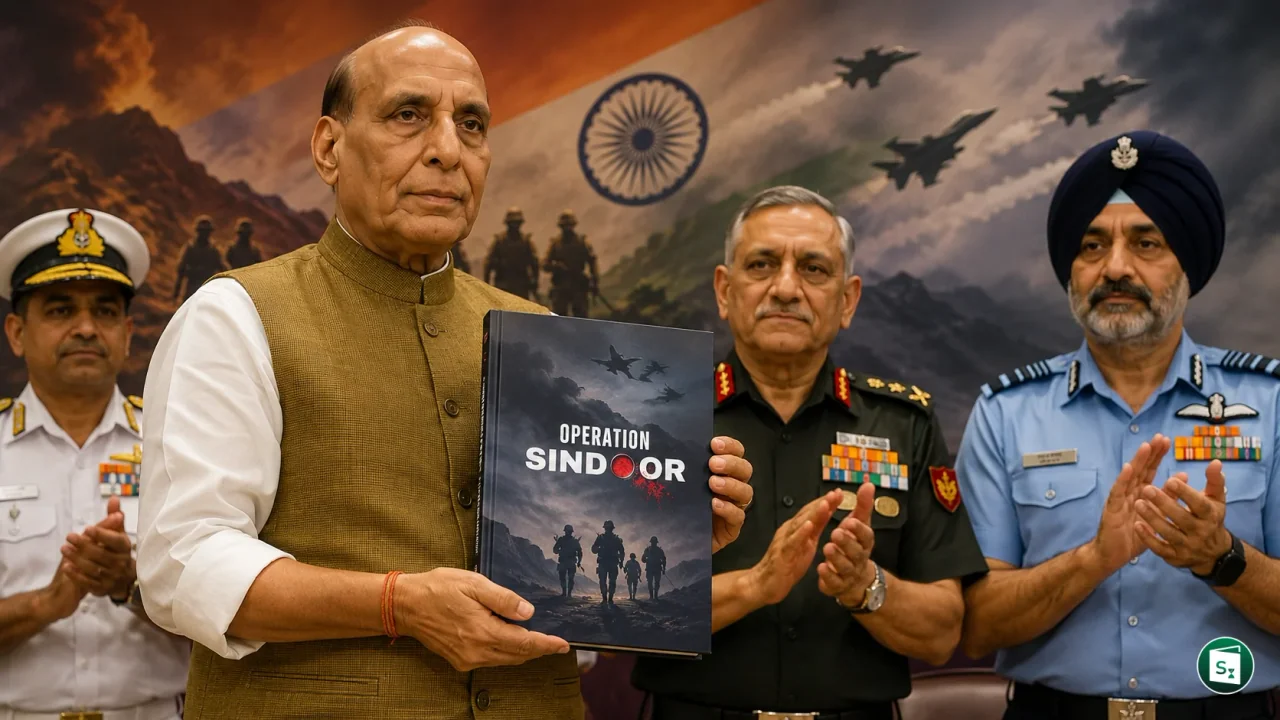
Union Defence Minister Rajnath Singh released a commemorative volume titled “Operation Sindoor” in New Delhi on May 29, 2026, to honour the frontline personnel of the Indian Armed Forces. The book compiles the firsthand testimonies of 100 military personnel who participated in the high-stakes tri-service operation conducted in May 2025. This publication marks the first anniversary of the operation, capturing the human dimensions of modern multi-domain warfare and leadership on the frontlines.
About the Commemorative Volume
The commemorative book provides a detailed narrative of the operation through the eyes of those who served on the ground, in the air, and at sea. Unlike conventional military history records that focus heavily on command-level strategy, this volume captures the experiences of 100 officers, sailors, airmen, and soldiers. It highlights stories of individual courage, frontline leadership, and the psychological impact of combat during the four-day conflict.
The collection of testimonies covers a wide range of operational roles. It features accounts from special forces operators who conducted high-risk actions, combat aviators who flew precision strike missions, and naval personnel who maintained maritime vigilance. Additionally, the book documents the critical contributions of military medical officers who managed casualties under intense operational stress.
The launch event in New Delhi was attended by India’s top military leadership. Key figures present included the Chief of Defence Staff (CDS) General Anil Chauhan, Chief of the Naval Staff Admiral Dinesh K. Tripathi, and Chief of the Air Staff Air Chief Marshal A.P. Singh. The gathering emphasized the significance of documenting frontline operational history to guide future generations of military officers.
What Was Operation Sindoor?
Operation Sindoor was a major multi-domain military campaign launched by the Indian Armed Forces in May 2025. The operation was initiated following a deadly terrorist attack on April 22, 2025, in the Baisaran Valley near Pahalgam, Jammu and Kashmir, which resulted in the deaths of 26 civilians, primarily tourists. The attack was attributed to The Resistance Front (TRF), a proxy group of the Pakistan-based terrorist organization Lashkar-e-Taiba (LeT).
In response, the Indian government authorized a joint tri-service campaign to target terrorist launchpads and training infrastructure across the border. On the night of May 7–8, 2025, the Indian Army, Navy, and Air Force carried out coordinated precision strikes against nine identified terror camps in Pakistan and Pakistan-occupied Jammu and Kashmir (PoJK). The operation was notable for its shift towards non-contact, high-technology warfare, representing the most extensive deployment of India’s military assets since the 1971 war.
The Escalation and Agreement
Following the initial strikes, the situation escalated into a active four-day conflict. The Pakistani military retaliated with heavy mortar and artillery fire along the Line of Control, alongside drone and missile attacks directed at Indian military positions. India responded by conducting further precision strikes targeting Pakistani air defence installations that had supported the counter-attacks.
Alongside the military response, India implemented several severe non-military measures. These included keeping the Indus Waters Treaty of 1960 in abeyance, suspending activities at the Integrated Check Post at Attari, and declaring several Pakistani defense advisors in New Delhi persona non grata. The conflict concluded after four days of intense exchanges when the Directors General of Military Operations (DGMOs) of both nations established contact and agreed to a formal ceasefire.
Institutional Roles in the Publication
The publication of the commemorative volume was a joint effort between the senior military leadership and India’s premier defense think tank. The compilation of the personal testimonies was guided directly by the office of the Chief of Defence Staff, while the United Service Institution of India (USI) provided crucial publishing and editorial support.
The United Service Institution of India
The United Service Institution of India (USI) is India’s oldest defense think tank, established in 1870 in Shimla by Major General Sir Charles MacGregor. Founded to encourage the study of military history, art, and science among defense personnel, USI has played a central role in documenting India’s military heritage. Its flagship publication, the USI Journal, has been published quarterly since 1872 and is recognized as the oldest active defense journal in Asia.
The institution relocated its headquarters to New Delhi in 1953, initially operating from Kashmir House, before moving to a dedicated campus in 1996. USI operates as an independent service institution, providing a platform for strategic research, lectures, and publications that bridge the gap between active military operations and academic study.
The Chief of Defence Staff
The office of the Chief of Defence Staff (CDS) was created on January 1, 2020, following recommendations from the Kargil Review Committee. The role was established to enhance jointness, coordinate procurement, and integrate the operations of the Army, Navy, and Air Force under a unified command structure. The CDS serves as the permanent chairman of the Chiefs of Staff Committee and acts as the Principal Military Advisor to the Minister of Defence.
General Bipin Rawat was appointed as the first CDS of India in January 2020 and served until December 2021. General Anil Chauhan, who guided the compilation of this volume, served as the second CDS, assuming office in September 2022 and retiring in May 2026. The CDS also heads the Department of Military Affairs (DMA), which was created within the Ministry of Defence to manage military-specific administrative and operational issues.
Key Takeaways
- Defence Minister Rajnath Singh released the commemorative book “Operation Sindoor” in New Delhi on May 29, 2026.
- The volume records the personal testimonies of 100 officers and soldiers from the Indian Armed Forces who served in the operation.
- Operation Sindoor was a major tri-service campaign conducted in May 2025 following a deadly terrorist attack in Pahalgam.
- The book was compiled under the guidance of General Anil Chauhan, who served as India’s second Chief of Defence Staff from September 2022 to May 2026.
- The United Service Institution of India (USI), which supported the publication, was founded in 1870 as India’s first defense think tank.
- The office of the Chief of Defence Staff (CDS) was established on January 1, 2020, to promote operational integration among the three military services.