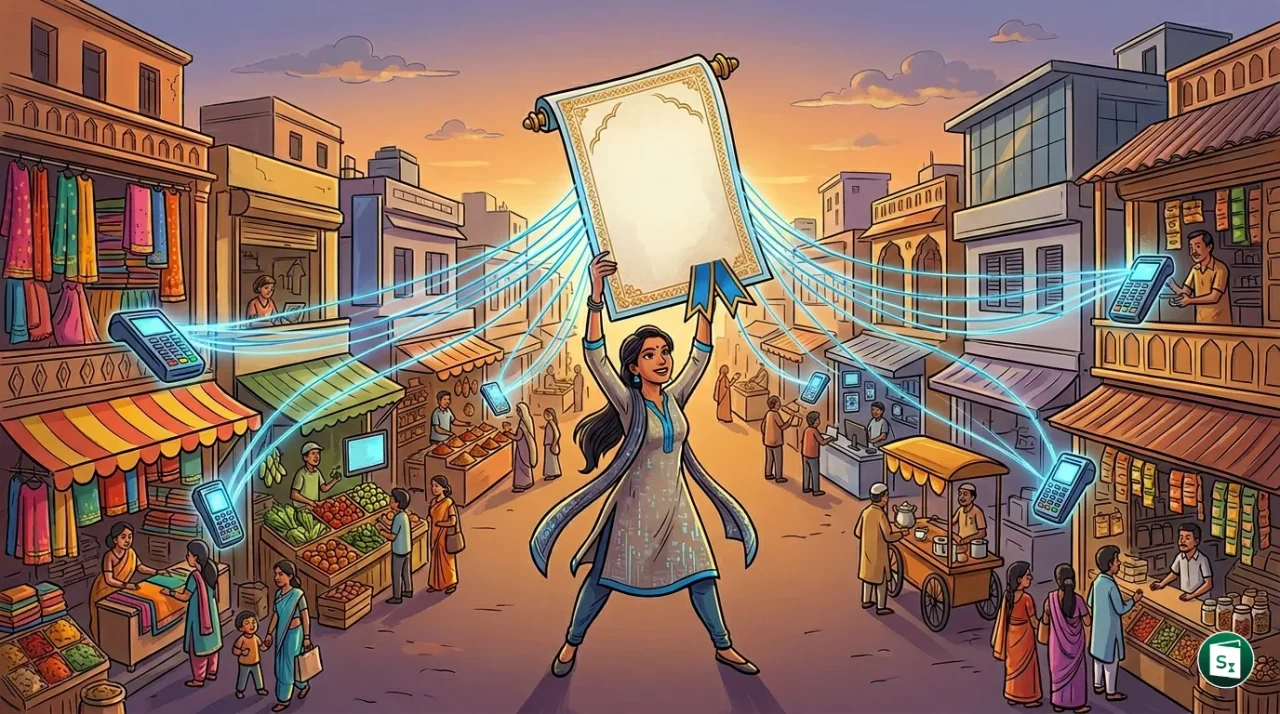
One MobiKwik Systems Limited, the parent entity of digital financial platform MobiKwik, has obtained in-principle approval from the Reserve Bank of India for a Payment Aggregator-Physical licence. This regulatory milestone allows the fintech company to establish and manage payment networks for offline merchants across the country. The approval supports the company’s objective to expand its ecosystem and transition from digital wallets into brick-and-mortar retail transactions.
Understanding the Payment Aggregator Framework and the PA-P Licence
A Payment Aggregator (PA) is a financial intermediary that enables merchants and e-commerce platforms to accept diverse payment instruments, such as credit cards, debit cards, unified payments interface transactions, and digital wallets, without needing to set up direct integration systems with individual banks. The Reserve Bank of India regulates these entities to ensure security, standardisation, and stability in the financial system.
Historically, payment aggregators primarily operated online, managing transactions where customers paid over the internet. These operations are governed by a Payment Aggregator-Online (PA-O) licence. However, the regulatory framework has expanded to cover physical retail spaces, introducing the Payment Aggregator-Physical (PA-P) licence.
A PA-P licence authorizes companies to manage transactions where both the customer’s payment instrument and the acceptance device are physically present at the point of sale. This physical infrastructure includes Quick Response (QR) codes, electronic soundboxes that announce transaction confirmations, and physical Electronic Data Capture (EDC) card swipe machines.
Strategic Expansion and MobiKwik’s Offline Merchant Strategy
The in-principle approval for a PA-P licence is key to MobiKwik’s efforts to establish a full-stack financial ecosystem. Founded in 2009 by Bipin Preet Singh and Upasana Taku, and headquartered in Gurugram, Haryana, MobiKwik has evolved from a digital wallet provider into a diversified financial services player. The physical payment licence will allow the company to offer offline merchant services directly, competing in a space that relies heavily on physical infrastructure like QR codes and Soundboxes.
MobiKwik aims to achieve a ten-fold expansion in its merchant business by the financial year 2027-2028. Over the next 18 to 24 months, the company plans to target specific brick-and-mortar segments, including organized retail stores, small local businesses, and oil and gas retail outlets.
This development works alongside MobiKwik’s existing licences to complete its product suite. The company’s payment gateway subsidiary, Zaakpay, secured a final PA-O licence from the Reserve Bank of India in May 2025 to handle online merchant payments. Additionally, MobiKwik acquired a Non-Banking Financial Company (NBFC) licence in April 2026. By combining physical merchant acquiring, online gateways, and digital lending capabilities, the company can deliver end-to-end services to both retail consumers and offline businesses.
Regulatory Requirements and the RBI Master Direction on Payment Aggregators
The Reserve Bank of India (RBI), established on April 1, 1935 under the Reserve Bank of India Act, 1934 and nationalized in 1949, is headquartered in Mumbai. In September 2025, the RBI issued its Master Direction on Regulation of Payment Aggregators, which consolidated the regulatory guidelines and officially brought physical payment aggregators under its direct supervision. This framework groups payment aggregators into three distinct classes, which are PA-Online (PA-O), PA-Physical (PA-P), and PA-Cross Border (PA-CB).
Under these directions, non-bank entities seeking to operate as physical payment aggregators must obtain a Certificate of Authorisation (CoA) from the central bank. To qualify for authorization, applicants must satisfy strict prudential and operational standards. Non-bank PA-Ps are required to have a minimum net worth of ₹15 crore at the time of application, which must be scaled up to ₹25 crore within a designated timeframe and maintained at that level thereafter.
In addition to financial thresholds, these entities must establish robust governance structures. They are required to register with the Financial Intelligence Unit-India (FIU-IND) to ensure compliance with anti-money laundering regulations. Furthermore, physical aggregators must maintain all merchant transaction funds in a dedicated escrow account with a scheduled commercial bank. This structure ensures that customer funds are insulated from the operating liabilities of the aggregator, protecting the retail ecosystem from defaults.
Key Takeaways
- One MobiKwik Systems Limited has received in-principle approval from the Reserve Bank of India (RBI) for a Payment Aggregator-Physical (PA-P) licence.
- The approval enables MobiKwik to offer offline payment solutions to physical merchants using tools like Quick Response (QR) codes, electronic soundboxes, and card reader terminals.
- MobiKwik was founded in 2009 by Bipin Preet Singh and Upasana Taku, and is headquartered in Gurugram, Haryana.
- The regulatory framework for physical payment aggregators was formalized under the RBI’s Master Direction on Regulation of Payment Aggregators issued in September 2025.
- Non-bank physical payment aggregators are required to meet a minimum net worth of ₹15 crore at the time of application, which must be increased to ₹25 crore within a designated timeframe.
- The Reserve Bank of India (RBI) was established on April 1, 1935 under the Reserve Bank of India Act, 1934, with its headquarters in Mumbai.