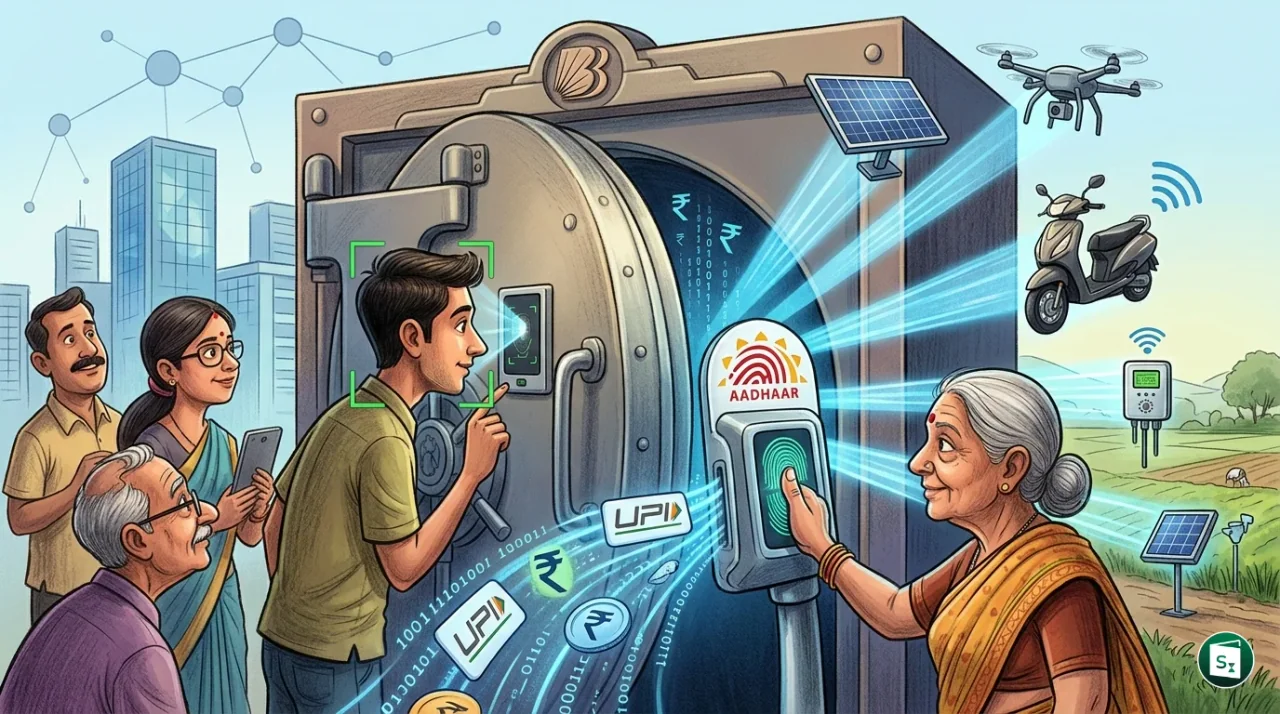
Bank of Baroda has launched advanced biometric authentication and Internet of Things-based payment features on its universal Unified Payments Interface application, bob इ Pay. The biometric upgrade integrates native device recognition and Aadhaar-backed face authentication to secure transactions and simplify PIN management. These technological additions aim to enhance transaction speed, improve digital security, and extend UPI connectivity to smart everyday appliances.
Overview of the New UPI Features on bob इ Pay
The updated bob इ Pay application introduces three primary features aimed at simplifying the payment process while strengthening security. These features leverage existing hardware on user smartphones and national digital identity databases.
Mobile OS-Native Biometric Authentication
The application now supports mobile operating system-native biometric authentication for everyday transactions. This allows users to authorize payments up to ₹5,000 using the fingerprint scanners or facial recognition sensors built into their smartphones. By enabling this option, users can complete transactions quickly without typing their security PIN for every transfer.
UIDAI Aadhaar-Based Face Authentication
The integration of Unique Identification Authority of India (UIDAI) services enables Aadhaar-based face authentication directly within the app. This feature simplifies the process of setting or resetting the personal identification number for transactions. Instead of requiring a physical debit card or traditional text message verification, the app captures a live face scan and verifies it against the central Aadhaar database alongside a one-time password.
Internet of Things (IoT)-Based UPI Payments
The upgrade introduces support for Internet of Things (IoT) payments. This capability allows users to link connected devices, such as smartwatches, fitness trackers, and connected vehicles, to their digital wallets. Users can make hands-free payments directly from these devices, expanding the utility of digital transactions beyond mobile phones.
Technology and Infrastructure Behind the Upgrades
The integration of these features is made possible by combining national digital networks and secure payment architectures developed by Indian authorities.
The UPI Circle and Delegated Payments Framework
The IoT payment capability operates on the UPI Circle framework, also known as the delegated payments framework. This framework allows a primary bank account holder to authorize a secondary user or connected device to make transactions. The account holder retains full control by setting specific transaction limits and approving or pre-authorizing payments. This structure ensures that payments made by linked smart devices remain within safe financial boundaries.
The Role of UIDAI and NPCI
These updates rely on the infrastructure of two major national entities. The Unique Identification Authority of India (UIDAI), established as a statutory authority in 2016 under the Aadhaar Act, 2016, operates under the Ministry of Electronics and Information Technology and is headquartered in New Delhi. UIDAI manages the central Aadhaar repository used for verifying facial scans during PIN setup.
Meanwhile, transaction processing and the underlying UPI ecosystem are managed by the National Payments Corporation of India (NPCI). Established in 2008 as a non-profit company under the guidance of the Reserve Bank of India and the Indian Banks’ Association, NPCI is headquartered in Mumbai and governs retail payments across the country.
Significance and Strategic Implications
The introduction of these features on the bob इ Pay application carries significant benefits for both users and the digital banking ecosystem. Bank of Baroda, which was established on July 20, 1908 by Maharaja Sayajirao Gaekwad III and nationalised in 1969, has long positioned itself as India’s International Bank. Under the leadership of Managing Director and Chief Executive Officer Debadatta Chand, the bank is headquartered in Vadodara, Gujarat, with its corporate office in Mumbai. This update reflects the bank’s strategy to stay at the forefront of digital banking technology.
The primary strategic benefit is the simplification of low-value transactions. Allowing PIN-free authentication up to ₹5,000 via native biometrics balances convenience and security. It reduces transaction abandonment and protects users from shoulder-surfing, where onlookers observe a typed PIN.
In addition, Aadhaar-based face verification lowers entry barriers for digital payments. Many account holders in rural and semi-urban areas do not possess active debit cards. By enabling PIN management through face scans verified by UIDAI, the bank makes UPI onboarding accessible without physical plastic cards. This transition supports national financial inclusion goals.
Finally, expanding payments to IoT platforms marks a transition towards a device-agnostic ecosystem. The capability to pay via connected vehicles or appliances paves the way for seamless automated transactions, such as paying at toll gates or charging stations directly from vehicle systems.
Key Takeaways
- Bank of Baroda has introduced native biometric authentication and IoT payment integration on its bob इ Pay UPI application.
- The app allows users to authorize transactions up to ₹5,000 without a PIN using mobile-native biometrics such as fingerprint and facial recognition.
- Users can set or reset their UPI PIN using face authentication verified by the Unique Identification Authority of India (UIDAI), bypassing the need for physical debit cards.
- The National Payments Corporation of India (NPCI), which processes UPI payments, was established in 2008 under the guidance of the Reserve Bank of India and the Indian Banks’ Association.
- The Unique Identification Authority of India (UIDAI) is a statutory authority established in 2016 under the Aadhaar Act, 2016, with headquarters in New Delhi.
- Bank of Baroda was founded in 1908, nationalised in 1969, and is currently headed by Managing Director and Chief Executive Officer Debadatta Chand.