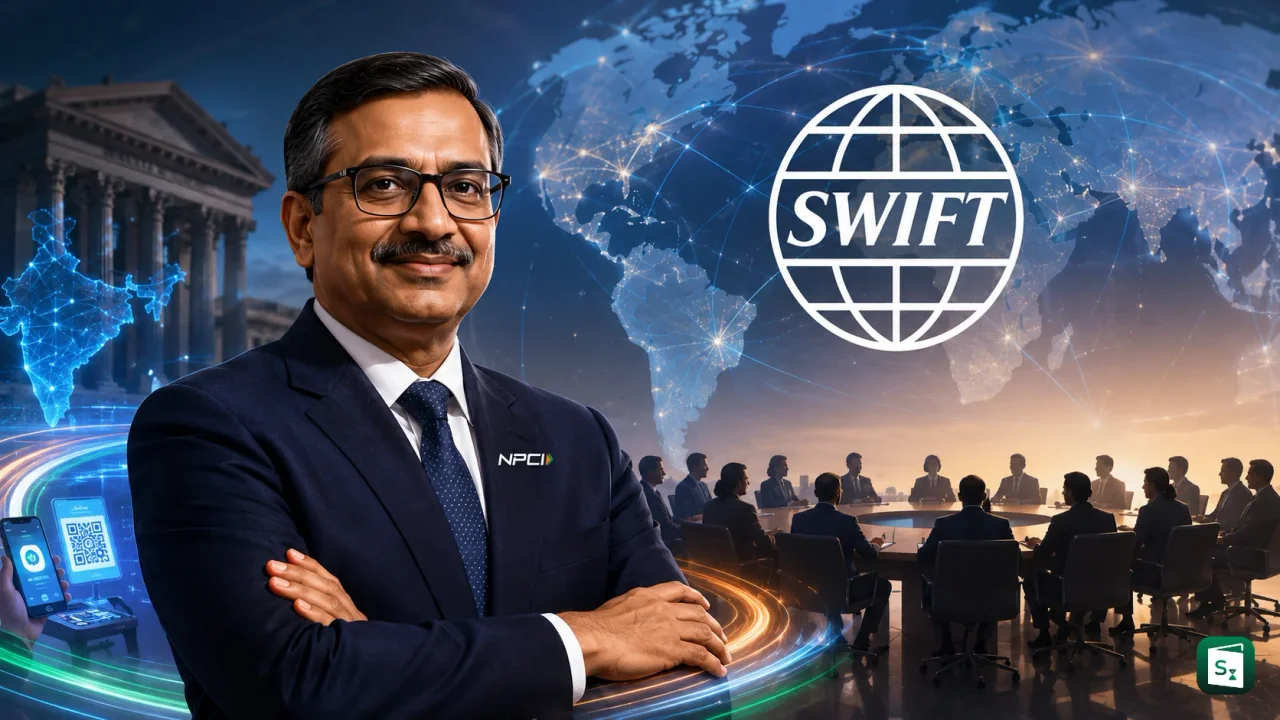
Dilip Asbe, the Managing Director and Chief Executive Officer of the National Payments Corporation of India (NPCI), has been appointed to the Supervisory Board of the Society for Worldwide Interbank Financial Telecommunication (SWIFT), the global financial messaging network that facilitates the majority of cross-border transactions worldwide. The appointment gives India a direct seat in the highest decision making body of the organisation that sets the standards for international financial communications. This milestone comes at a time when India’s digital payments ecosystem, anchored by the Unified Payments Interface (UPI), has emerged as one of the largest and most sophisticated real-time payment platforms in the world.
Who Is Dilip Asbe?
Dilip Asbe is the Managing Director and Chief Executive Officer of NPCI, a position he has held since January 2018. He was the first employee of NPCI, joining the organisation in January 2010 as its Chief Technology Officer. He later served as the Chief Operating Officer before taking over as CEO.
Asbe has played a central role in building and scaling India’s most transformative payment platforms, including the Immediate Payment Service (IMPS), the Aadhaar Enabled Payment System (AePS), the RuPay card network, FASTag for electronic toll collection, and the Unified Payments Interface (UPI). Under his leadership, NPCI created four subsidiaries: NPCI International Payments Limited (NIPL) to globalise UPI and RuPay, NPCI Bharat BillPay Limited for bill payments, NPCI BHIM Services Limited for the BHIM UPI app, and NPCI Tech Solutions to build next-generation payment infrastructure including Central Bank Digital Currency systems.
Asbe holds a Master of Science in Global Management from the London School of Economics and Political Science (LSE) and a degree in Electronics Engineering from Mumbai University. He is also an alumnus of the Harvard Business School Advanced Management Programme.
What Is NPCI?
The National Payments Corporation of India (NPCI) is an umbrella organisation for operating retail payment and settlement systems in India. It was incorporated in December 2008 as a not-for-profit company under Section 8 of the Companies Act and is promoted jointly by the Reserve Bank of India (RBI) and the Indian Banks’ Association (IBA) under the provisions of the Payment and Settlement Systems Act, 2007.
NPCI was set up on the recommendation of the Payment and Banking Systems Board, which the RBI constituted in 2005. Its mandate was to consolidate the multiple payment systems that existed separately across banks into a unified national infrastructure. It began operations in 2009 by taking over the National Financial Switch (NFS) from the Institute for Development and Research in Banking Technology.
Today, NPCI operates some of the world’s most advanced payment systems. UPI alone processed 22.72 billion transactions worth ₹28.9 lakh crore in June 2026, with a daily average of 757 million transactions, the highest ever recorded since its launch. NPCI is authorised and regulated by the RBI and is designated as a systemically important payment system.
SWIFT and Its Global Role
The Society for Worldwide Interbank Financial Telecommunication (SWIFT) is a limited liability cooperative company founded on 3 May 1973 in Brussels, Belgium. It is headquartered in La Hulpe, near Brussels. SWIFT provides a secure messaging network that enables financial institutions worldwide to send and receive information about financial transactions. It is not a payment system itself but the communications backbone that connects more than 11,500 institutions across over 200 countries and territories.
SWIFT is owned and controlled by its member banks and financial institutions. It is overseen by the G-10 central banks, including those of the United States, the United Kingdom, France, Germany, Japan, and others, along with the European Central Bank. The National Bank of Belgium acts as the lead overseer because SWIFT is incorporated in Belgium. The oversight framework was established in 1998 and focuses on ensuring that SWIFT does not pose risks to global financial stability.
SWIFT assigns Business Identifier Codes (BICs), commonly known as SWIFT codes, which are used globally to identify banks and financial institutions in international transactions. It also hosts the annual Sibos conference, the premier event for the financial services industry.
SWIFT’s New Governance Structure
Asbe’s appointment comes at a time of significant structural change at SWIFT. The organisation is transitioning from a single-tier Board of Directors, which had 25 members representing shareholders, to a new two-tier governance model comprising a Supervisory Board and a Management Board.
The new Supervisory Board, which came into effect after SWIFT’s Annual General Meeting in 2026, has 12 members. This can expand to 15 members in exceptional circumstances. The composition is as follows:
| Category | Number | Description |
|---|---|---|
| Shareholder-affiliated Directors | 8 | Non-Executive Directors from shareholder institutions |
| Independent Non-Executive Directors | 4 | Independent members who chair key committees |
| Total | 12 | Can expand to 15 in exceptional cases |
The three Independent Directors chair the Governance and Nomination Committee, the Audit and Finance Committee, and the Risk Committee respectively. Geographic balancing is built into the board composition to ensure that no single region dominates.
Asbe is one of the shareholder-affiliated directors on this board. Other members include Manish Kohli (HSBC), Arthur Ambrose (Citi), Patrick Colle (BNP Paribas), and Mark Monaco (Bank of America). The appointment received shareholder approval at SWIFT’s recent AGM and is subject to regulatory approval, expected in October 2026.
Why This Appointment Matters for India
This appointment is a recognition of the global stature that India’s digital payments ecosystem has achieved. UPI, which processes over 20 billion transactions every month, is among the most advanced real-time payment platforms in the world. Through NPCI International Payments Limited (NIPL), UPI is now operational in multiple countries including Singapore, the UAE, Nepal, Bhutan, Mauritius, France, Sri Lanka, Qatar, Greece, and Cambodia, with trials underway in Japan and Malaysia.
Having an Indian representative on the SWIFT Supervisory Board ensures that India’s experience in building large-scale, real-time payment infrastructure contributes directly to the discussions around the future of global cross-border payments. India is no longer a fast follower in the global payments landscape. It is increasingly becoming a rule setter, with the institutional credibility to influence the standards and architecture of the next generation of cross-border financial infrastructure.
The appointment also aligns with India’s broader strategic push to internationalise its payment systems. The RBI has set a target for NIPL to extend UPI to 20 countries by 2029. Asbe’s presence at SWIFT’s highest governance body gives India a direct voice in shaping the messaging standards that underpin global financial transactions, ensuring that the needs of emerging economies and real-time payment systems are reflected in the evolution of cross-border financial infrastructure.
Key Takeaways
- Dilip Asbe, the MD and CEO of NPCI, has been appointed to the Supervisory Board of SWIFT, the global financial messaging network.
- SWIFT is transitioning from a single-tier Board of Directors to a two-tier governance model with a Supervisory Board and a Management Board.
- The Supervisory Board has 12 members, with a provision to expand to 15 members in exceptional cases, comprising 8 shareholder-affiliated directors and 4 independent directors.
- SWIFT was founded on 3 May 1973 in Belgium and is headquartered in La Hulpe. It is overseen by the G-10 central banks, with the National Bank of Belgium as the lead overseer.
- NPCI was incorporated in December 2008 as a not-for-profit company under Section 8 of the Companies Act, promoted by the RBI and the IBA.
- Asbe joined NPCI in January 2010 as its first employee and Chief Technology Officer and became MD and CEO in January 2018.