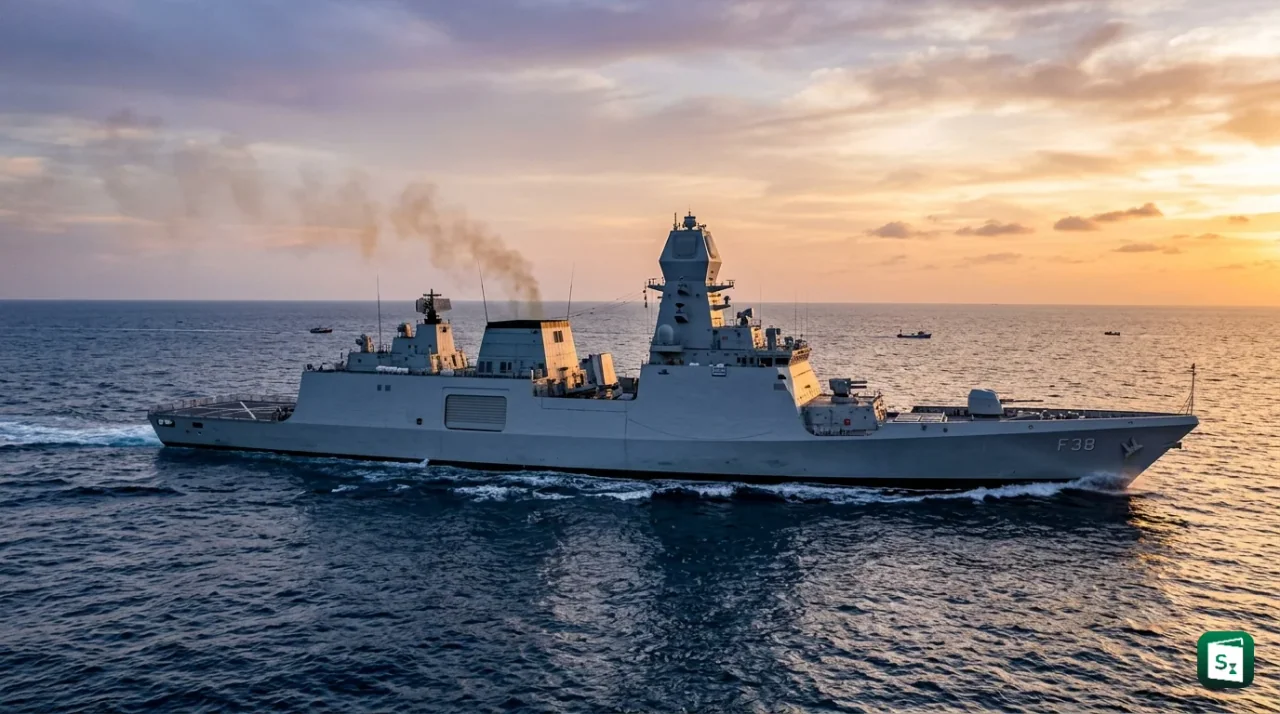
The Indian Navy commissioned INS Mahendragiri (F38), the sixth Project 17A stealth frigate, into its Eastern Fleet on July 11, 2026, at the Naval Dockyard in Visakhapatnam. Defence Minister Rajnath Singh presided over the ceremony, marking the induction of a warship built with over 75% indigenous content by Mazagon Dock Shipbuilders Limited (MDL) in Mumbai. With this commissioning, six of the seven Project 17A frigates have joined the fleet within just 18 months, underscoring India’s rapidly expanding capability to design and build frontline naval combatants.
Project 17A: The Nilgiri Class Stealth Frigates
Project 17A, also known as the Nilgiri class, is a programme to build seven advanced stealth guided-missile frigates for the Indian Navy. It is the successor to the Project 17 (Shivalik class) frigates, which were India’s first stealth warships. The Cabinet Committee on Security approved Project 17A in September 2012, and shipbuilding contracts were signed with two public sector shipyards in February 2015.
The construction is shared between Mazagon Dock Shipbuilders Limited (MDL) in Mumbai, which is building four frigates, and Garden Reach Shipbuilders and Engineers (GRSE) in Kolkata, building the remaining three. The frigates are being built using integrated modular construction, where pre-outfitted blocks are assembled together, significantly reducing build time and cost.
Compared to the Shivalik class, the Nilgiri class features improved stealth characteristics, reduced radar cross-section, lower infrared signature, and a more advanced suite of indigenous weapons and sensors. The class also incorporates a high degree of automation, which reduces crew complement and operational costs. The estimated total cost of the project is approximately ₹50,000 crore.
The seven ships of the class are named after mountain ranges in India: INS Nilgiri (lead ship), INS Udaygiri, INS Himgiri, INS Taragiri, INS Dunagiri, INS Mahendragiri, and INS Vindhyagiri. INS Nilgiri was commissioned in January 2025, followed by Udaygiri and Himgiri in August 2025, Taragiri in April 2026, Dunagiri in June 2026, and Mahendragiri in July 2026. The final frigate, INS Vindhyagiri, is expected to be commissioned later this year.
INS Mahendragiri: Key Specifications and Design
INS Mahendragiri is the sixth vessel of the Nilgiri class and the fourth Project 17A frigate built by MDL. It was launched on September 1, 2023, by Sudesh Dhankhar, wife of the then Vice President Jagdeep Dhankhar, and delivered to the Indian Navy on April 30, 2026. The frigate is named after the Mahendragiri mountain peak in the Eastern Ghats of Odisha, and it is the first Indian naval warship to bear this name.
The frigate was designed in-house by the Indian Navy’s Warship Design Bureau (WDB), which began its journey as the Central Design Office in 1964 and is now India’s premier naval design organisation. The ship’s hull is constructed from indigenous DMR 249A grade steel, developed by the Steel Authority of India (SAIL).
| Parameter | Specification |
|---|---|
| Displacement | 6,670 tonnes |
| Length | 149 metres |
| Beam | 17.8 metres |
| Draft | 5.22 metres |
| Crew | 226 (35 officers, 191 sailors) |
| Indigenous Content | Over 75% |
| Helicopter Capacity | One multi-role helicopter (HAL Dhruv or Sea King) |
Propulsion and Performance
INS Mahendragiri uses a Combined Diesel or Gas (CODOG) propulsion system, a configuration that combines two different types of engines for operational flexibility. For long-range cruising at economical speeds, the ship relies on two MAN Diesel 12V28/33D STC engines, each producing 6,000 kW. When high-speed response is needed, it switches to two General Electric LM2500+ gas turbines, which provide surge power for combat manoeuvres and rapid transit.
The ship can reach a top speed of 28 knots (about 52 km/h) and has an operational range of 5,500 nautical miles (about 10,200 km) at economical speeds of 16 to 18 knots. An Integrated Platform Management System (IPMS) centrally monitors and controls the propulsion, electrical, and auxiliary systems, reducing crew workload and improving efficiency.
Stealth Features
The Nilgiri class represents a generational leap in stealth design over the Shivalik class. The frigate’s superstructure uses radar-absorbent materials (RAM) and features inclined surfaces and flush deck fittings to minimise its radar cross-section (RCS). The distinctive angular mast design integrates sensors to reduce radar “blooming”. The ship also employs infrared suppression systems, including fluid injection and Venturi-effect cooling in the exhaust uptakes, to reduce its thermal signature against heat-seeking threats. These design choices make the frigate significantly harder to detect, track, and target across multiple sensor domains.
Advanced Weaponry and Combat Systems
INS Mahendragiri carries a potent mix of indigenous and integrated weapon systems, making it capable of conducting anti-air, anti-surface, and anti-submarine warfare operations simultaneously.
The ship’s combat capability is orchestrated by an advanced Combat Management System (CMS-17A), which acts as the digital nerve centre. It fuses data from radar, sonar, electronic warfare sensors, and communication links into a unified tactical picture, enabling rapid decision-making.
Anti-Air Warfare: The primary air defence comes from 32 Barak-8 Long-Range Surface-to-Air Missiles (LR-SAM), housed in four 8-cell Vertical Launch Systems (VLS). Developed jointly by DRDO and Israel Aerospace Industries, the Barak-8 has a range of approximately 100 km and can engage multiple aerial threats simultaneously, including fighter jets, drones, and anti-ship missiles.
Anti-Surface Warfare: For striking surface targets, the frigate carries 8 BrahMos supersonic cruise missiles in an 8-cell VLS. The BrahMos, a joint venture between DRDO and Russia’s NPO Mashinostroyeniya, travels at nearly Mach 3 and has a range of over 400 km (extended variants reach up to 900 km). It can engage both naval and land targets with high precision.
Anti-Submarine Warfare: The frigate is equipped with an indigenous rocket launcher (based on the RBU-6000 system), two triple-tube torpedo launchers for Torpedo Advanced Light Shyena (TAL), and an integrated sonar suite. The HUMSA-NG (Hull Mounted Sonar Array - New Generation) provides underwater surveillance and target tracking.
Guns and Close Defence: The forward deck carries an OTO Melara 76 mm Super Rapid naval gun for surface engagement and shore bombardment. Two AK-630M Close-In Weapon Systems (CIWS) provide a last layer of defence against incoming missiles and aircraft. Multiple 12.7 mm stabilised remote-controlled guns handle asymmetric threats.
Electronic Warfare: The DRDO Shakti electronic warfare suite provides electronic support measures (ESM), electronic countermeasures (ECM), and decoy launching capabilities, protecting the ship from radar-guided and infrared-homing threats.
Significance of the Commissioning
The induction of INS Mahendragiri into the Eastern Fleet, headquartered at Visakhapatnam, significantly strengthens India’s naval presence in the Bay of Bengal and the wider Indian Ocean Region (IOR). The Eastern Fleet is responsible for safeguarding India’s eastern seaboard, securing sea lines of communication, and projecting power across the Indo-Pacific.
At the commissioning ceremony, Defence Minister Rajnath Singh highlighted that the frigate would serve as a force multiplier for the Navy’s blue-water operations. He noted that India’s role as a net security provider in the Indo-Pacific demands credible naval capability, and ships like Mahendragiri are central to that mission. The Navy’s recent Operation Urja Suraksha, where it safely escorted 18 merchant vessels carrying cargo worth over ₹9,000 crore during the West Asia conflict, was cited as an example of the Navy’s dual role as a combat force and economic guardian.
The commissioning also marks the rapid progress of the Project 17A programme. Chief of Naval Staff Admiral Krishna Swaminathan noted that MDL and the Navy achieved a 50% reduction in the launch-to-delivery timeline, from 63 months to 31 months, and a 20% reduction in total construction time, from 95 months to 75 months. All technical trials were completed in a single sea trial instead of the usual five to seven, reflecting improved design maturity and construction quality.
Aatmanirbhar Bharat and the Defence Industrial Ecosystem
INS Mahendragiri is a flagship example of the Aatmanirbhar Bharat (Self-Reliant India) initiative in defence manufacturing. Its over 75% indigenous content means that a substantial portion of the materials, equipment, and systems onboard were sourced from Indian manufacturers. The steel for the hull came from SAIL, the combat management system and sensors from BEL and DRDO, and the weapons from Indian joint ventures.
The Project 17A programme has engaged more than 200 Micro, Small, and Medium Enterprises (MSMEs) across India, generating an estimated 4,000 direct and 10,000 indirect jobs. This ecosystem spans steel fabrication, electronics, sensors, propulsion systems, precision engineering, and software development. By creating a sustained pipeline of naval orders, the government has enabled shipyards like MDL and GRSE to invest in modern infrastructure, including 300-tonne Goliath cranes, module workshops with retractable roofs, and advanced robotic welding systems.
MDL, which began as a small dry dock in 1774 and was taken over by the government in 1960, has built over 800 vessels including 31 warships and 8 submarines. It was granted Navratna status in 2024, reflecting its strategic importance to the nation. The shipyard is also constructing Scorpene-class submarines in collaboration with Naval Group of France and has recently signed a technology transfer agreement with Germany’s Thyssenkrupp for advanced submarine design.
The Way Forward
With the commissioning of Mahendragiri, the Project 17A programme is nearing completion. The seventh and final frigate, INS Vindhyagiri, is expected to join the fleet later in 2026, marking the end of the current acquisition cycle and the beginning of the next.
The Indian Navy is already looking beyond Project 17A. The next generation of frigates, tentatively designated Project 17B, is in the planning stage and is expected to feature even higher levels of indigenous content, directed-energy weapons, artificial intelligence-driven data processing, and enhanced network-centric warfare capabilities. Additionally, the Navy is pursuing the Next Generation Destroyer (NGD) project, also referred to as Project 18, and a possible Project 15C follow-on to the Visakhapatnam-class destroyers.
The success of the Project 17A programme has validated India’s ability to design, build, and integrate complex warship systems domestically. This capability is strategic. It reduces dependence on foreign suppliers, ensures faster lifecycle support, and positions India as a potential exporter of naval platforms to friendly foreign nations in the Indo-Pacific and beyond.
Key Takeaways
- INS Mahendragiri (F38), the sixth Project 17A stealth frigate, was commissioned into the Indian Navy’s Eastern Fleet on July 11, 2026, at Visakhapatnam by Defence Minister Rajnath Singh.
- The frigate was built by Mazagon Dock Shipbuilders Limited (MDL) in Mumbai and designed by the Indian Navy’s Warship Design Bureau (WDB).
- The ship has over 75% indigenous content, a displacement of 6,670 tonnes, and a length of 149 metres.
- It is powered by a CODOG (Combined Diesel or Gas) propulsion system, achieving a top speed of 28 knots and an operational range of 5,500 nautical miles.
- The frigate carries 8 BrahMos supersonic cruise missiles and 32 Barak-8 surface-to-air missiles, along with advanced anti-submarine and electronic warfare systems.
- Project 17A (Nilgiri class) comprises seven frigates; six have been commissioned within 18 months and the seventh, INS Vindhyagiri, is expected later in 2026.
- The Warship Design Bureau, established as the Central Design Office in 1964, has designed over 100 warships for the Indian Navy.