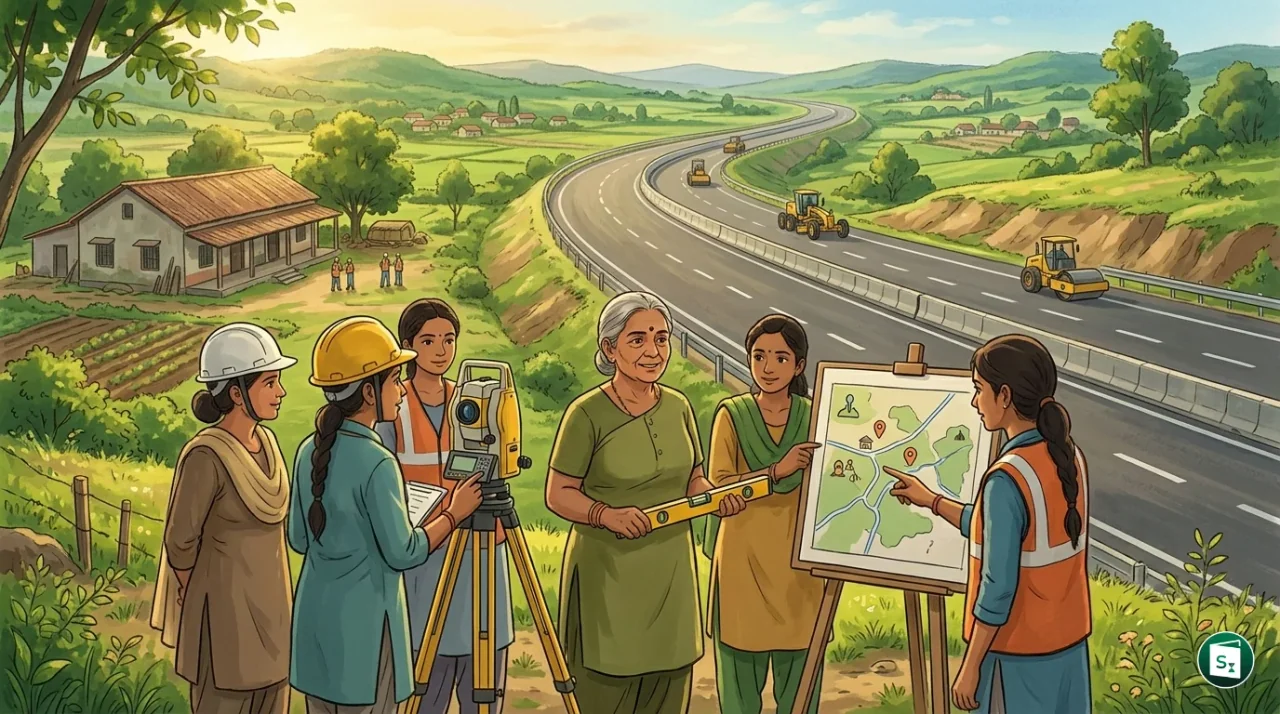
The National Highways Authority of India (NHAI) has partnered with the Vertis Foundation to launch Project Saksham, a dedicated skill development programme for rural women across India. Formally introduced on 26 May 2026, the initiative seeks to convert the economic momentum of national highway corridors into sustainable livelihood opportunities for local communities. By establishing a network of 12 training centres, the project aims to foster financial independence and bridge the gap between rural talent and formal industrial employment.
Empowering Communities Along the Highway Network
The primary objective of Project Saksham is to ensure that the rapid expansion of India’s road infrastructure directly benefits the residents of adjacent rural areas. By focusing on women and underserved youth living near national highways, the program transforms these transit routes into catalysts for inclusive growth. The collaboration leverages the corporate social responsibility (CSR) initiatives of the Vertis Foundation, which is the social arm of the Vertis Infrastructure Trust.
The project specifically addresses the socio-cultural and economic barriers that often prevent rural women from entering the formal workforce. Through on-ground community engagement, the initiative encourages women to participate in structured training programs, many of whom are seeking formal employment for the first time. This approach ensures that the local workforce is prepared to take advantage of the industrial and commercial opportunities that emerge alongside modern highway connectivity.
Key Features of Project Saksham
Project Saksham operates through a decentralized network of 12 training centres located across multiple states, ensuring a broad geographic reach. These centres are strategically positioned along major highway corridors managed by Vertis Infrastructure to maximize local impact.
Strategic Training Network and Vocational Trades
The training centres are operational in states including Uttar Pradesh, Rajasthan, Gujarat, Madhya Pradesh, Telangana, Tamil Nadu, Karnataka, Haryana, and Meghalaya. Key locations such as Ayodhya, Jodhpur, Dewas, and Shillong serve as hubs for providing specialized vocational training. The curriculum is designed to be market-aligned, focusing on trades that are in high demand within the formal industrial sector.
Participants can enroll in various vocational disciplines, including:
| Training Discipline | Focus Areas |
|---|---|
| Technical Services | Electrical work, multi-skill technician training, and plumbing |
| Garment Industry | Tailoring and garment manufacturing |
| Healthcare | General Duty Assistant (GDA) and nursing assistance |
| Maintenance | Appliance repair and facility management |
Each course is structured to provide both theoretical knowledge and practical hands-on experience, preparing candidates for immediate placement in the workforce.
Economic Impact and Social Transformation
The impact of Project Saksham is already visible in the quantifiable results achieved through its training interventions. As of May 2026, the project has successfully trained over 6,000 youth, with more than 4,000 participants securing placements in various sectors. A significant aspect of this initiative is its gender-focused approach, with women making up over 80 percent of the total beneficiaries.
The program has not only provided skills but has also ensured a steady stream of income for rural families. Placed candidates typically earn an average monthly income ranging from ₹13,000 to ₹16,000. For many rural households, this additional income represents a critical step toward escaping the cycle of poverty and achieving long-term financial stability. By linking skill development with the national highway network, the program ensures that infrastructure projects serve as more than just transit routes, acting instead as foundational pillars for local economic resilience.
The National Highways Authority of India: Institutional Context
The National Highways Authority of India (NHAI) is an autonomous body constituted under the National Highways Authority of India Act, 1988. While the Act was passed in 1988, the authority became fully operational on 10 February 1995. It functions under the administrative control of the Ministry of Road Transport and Highways (MoRTH).
Headquartered in New Delhi, NHAI is responsible for the development, maintenance, and management of the National Highways network in India. It manages major national infrastructure projects such as the Golden Quadrilateral and the Bharatmala Pariyojana. As of May 2026, the authority is led by Chairman Santosh Kumar Yadav, an IAS officer whose tenure has been central to integrating social responsibility with large-scale infrastructure development.
The Vertis Foundation, NHAI’s partner in this initiative, serves as the dedicated CSR entity for the Vertis Infrastructure Trust. This trust was formerly known as the Highways Infrastructure Trust and is one of the leading infrastructure investment platforms in India. Through this public-private partnership, the project ensures that the benefits of highway development are distributed equitably among rural populations.
Key Takeaways
- Project Saksham is a collaborative skill development initiative launched by the National Highways Authority of India (NHAI) and the Vertis Foundation.
- The program operates through a network of 12 training centres established across several states including Uttar Pradesh, Rajasthan, and Tamil Nadu.
- Over 80 percent of the project’s beneficiaries are rural women, with more than 6,000 youth trained as of May 2026.
- The vocational training covers diverse fields such as healthcare, electrical services, and garment manufacturing to ensure formal employment.
- NHAI was constituted under the National Highways Authority of India Act, 1988, and became operational in February 1995.
- The authority functions under the Ministry of Road Transport and Highways (MoRTH) and is currently headed by Chairman Santosh Kumar Yadav.