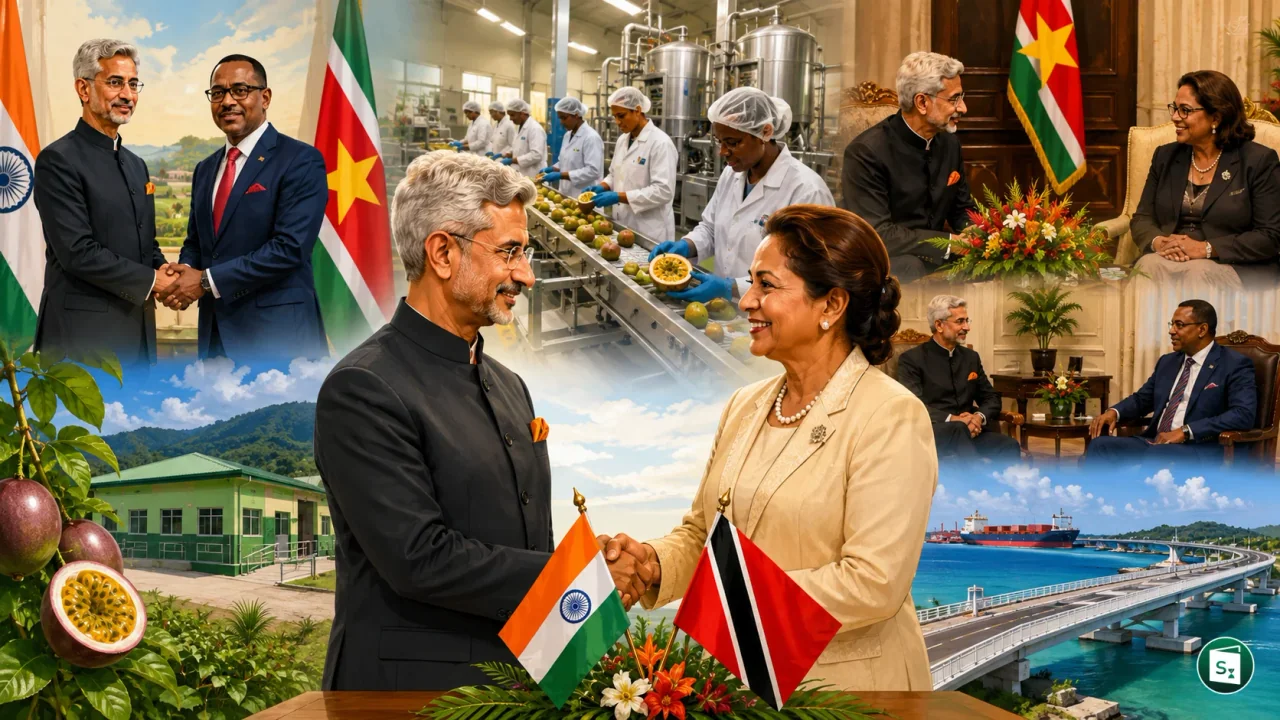
External Affairs Minister S Jaishankar concluded a high-level visit to Suriname and Trinidad and Tobago on May 26, 2026, significantly strengthening India’s strategic footprint in the Caribbean. The visit was highlighted by the co-chairing of the 9th Joint Commission Meeting in Suriname and the signing of eight Memorandums of Understanding with Trinidad and Tobago. These engagements reflect India’s commitment to the Global South and its historical ties with the Indian diaspora in the region.
India-Suriname 9th Joint Commission Meeting: A New Chapter
The 9th Joint Commission Meeting (JCM) between India and Suriname was co-chaired by Union Minister S Jaishankar and the Foreign Minister of Suriname, Melvin Bouva. This meeting served as a pivotal platform to review the entire gamut of bilateral relations, especially as the two nations celebrate the 50th anniversary of their diplomatic establishment. The discussions spanned critical sectors such as trade, energy, healthcare, and digital transformation.
During the visit, Dr. Jaishankar met with the President of Suriname, Jennifer Geerlings-Simons, and the National Assembly Chairman Ashwin Adhin. A major highlight of the trip was the handover of a passion fruit processing facility at MCP Agro N.V. in Paramaribo. This project, completed with a $1 million grant under India’s SEEDS (Supply of Equipment for Efficient Development of SMEs) initiative, is designed to empower local farmers and support rural women in the agricultural supply chain.
India also extended soft loans under its Lines of Credit (LoC) framework to Suriname. These funds are earmarked for the development of strategic sectors and infrastructure, including electrical transmission and water management systems. Such assistance underscores India’s role as a reliable development partner for Caribbean nations.
Strategic Cooperation with Trinidad and Tobago: 8 MoUs Signed
The second leg of the visit took Union Minister S Jaishankar to Trinidad and Tobago, where he held a bilateral meeting with Prime Minister Kamla Persad-Bissessar. The discussions focused on deepening collaboration in technology, healthcare, and sustainable development. A landmark eight Memorandums of Understanding (MoUs) were signed, covering a wide range of sectors to strengthen the bilateral framework.
| Sector | Nature of Agreement |
|---|---|
| Healthcare | Cooperation in medical services and public health management. |
| Solar Energy | Support for solarizing the Ministry of Foreign and CARICOM Affairs building. |
| Traditional Medicine | Establishment of an Indian Chair on Ayurveda at the University of the West Indies. |
| Infrastructure | Collaboration on sustainable urban development and heritage sites. |
| Tourism | Joint initiatives to promote cultural exchange and travel. |
| Digital Education | Framework for enhancing ICT and digital learning for schoolchildren. |
| Vector Control | Public health cooperation to manage mosquito-borne diseases. |
| Public Services | Strengthening institutional capacity and administrative cooperation. |
A significant highlight was the joint inauguration of the National Prosthetics Centre in Penal, which builds on the success of India’s “Jaipur Foot” initiative. Additionally, India handed over the first batch of 2,000 made-in-India laptops to schoolchildren, fulfilling a promise to bridge the digital divide in the region. The visit also included an inauguration of an agro-processing facility in Couva, supported by Indian machinery worth $1 million.
The “Girmitiya” Connection and Strategic Outreach
India’s engagement with Suriname and Trinidad and Tobago is deeply rooted in the shared history of the “Girmitiya” community. This term refers to the descendants of Indian indentured laborers who were brought to the Caribbean in the 19th and early 20th centuries. Today, the Indian diaspora (known as Sarnami Hindustani in Suriname) plays a crucial role in the social and political fabric of these nations. During his visit, Dr. Jaishankar paid tributes at the “Baba and Mai” monument in Paramaribo, which commemorates the arrival of the first Indian immigrants in 1873.
Strategically, these visits reflect India’s proactive diplomacy within the Caribbean Community (CARICOM). By offering technical expertise in agriculture, digital infrastructure, and traditional medicine like Ayurveda, India is positioning itself as a leader of the Global South. These partnerships help Caribbean nations achieve self-reliance while providing India with a stronger diplomatic footprint in the Western Hemisphere. The commitment to solarizing government buildings and supporting public health reflects a holistic approach to sustainable development that goes beyond traditional trade ties.
Key Takeaways
- The 9th Joint Commission Meeting (JCM) between India and Suriname was co-chaired by Dr. S Jaishankar and Melvin Bouva on May 26, 2026.
- India handed over a $1 million passion fruit processing facility to Suriname under the SEEDS initiative to support small and medium enterprises.
- A total of 8 Memorandums of Understanding (MoUs) were signed between India and Trinidad and Tobago across sectors including health, tourism, and solar energy.
- India established an Indian Chair on Ayurveda at the University of the West Indies to promote traditional medicine in the Caribbean.
- A National Prosthetics Centre was inaugurated in Penal, Trinidad and Tobago, as part of India’s development assistance program.
- India distributed 2,000 made-in-India laptops to schoolchildren in Trinidad and Tobago to support digital education.
- The term “Girmitiya” refers to the Indian indentured laborers whose descendants form the significant Indian diaspora in the Caribbean region.