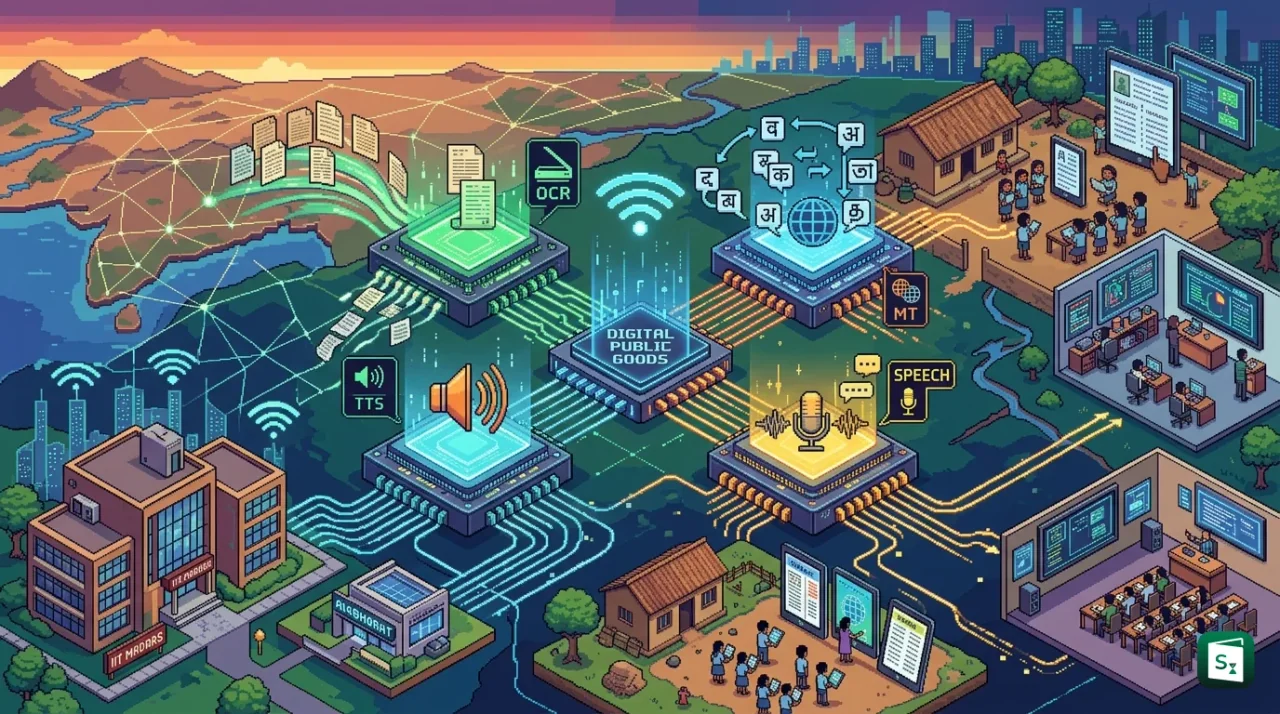
Bodhan AI, the Centre of Excellence in AI for Education at IIT Madras, launched four foundational multilingual AI models as Digital Public Goods on 4 September 2026 in partnership with AI4Bharat. The suite covers automatic speech recognition, text to speech, machine translation and optical character recognition across 22 to 27 Indian languages. Released as open weight models and hosted APIs on sovereign infrastructure, they will form the core of the Bharat EduAI Stack to power inclusive, India first education solutions.
What is Bodhan AI and the Bharat EduAI Stack?
Bodhan AI is the Centre of Excellence (CoE) in AI for Education hosted at the Indian Institute of Technology Madras (IIT Madras). IIT Madras, established in 1959 with assistance from West Germany and declared an Institute of National Importance in 1961, is located in Chennai and is headed by Director Prof. V. Kamakoti. The CoE is run through a not for profit Section 8 company named the IIT Madras Bodhan AI Foundation and is housed within the Wadhwani School of Data Science and AI (WSAI), which was set up in January 2024 with a ₹110 crore endowment from alumnus Sunil Wadhwani.
The Centre was announced in the Union Budget 2025-26 with a dedicated allocation of ₹500 crore for a CoE in AI for Education, with ₹100 crore earmarked for 2026-27. It was formally launched by Union Education Minister Dharmendra Pradhan at the Bharat Bodhan AI Conclave 2026 held on 12 to 13 February 2026 at Bharat Mandapam, New Delhi. The conclave served as the national platform for landscape discovery and partnership building across government, academia, startups and industry.
The core idea of Bodhan AI is to build the Bharat EduAI Stack. The Stack is envisioned as sovereign Digital Public Infrastructure (DPI) for education. DPI refers to open, interoperable and reusable digital building blocks that anyone can plug into, much like Unified Payments Interface (UPI) for payments. Within this architecture, Digital Public Goods (DPG) are the open assets themselves, such as open weight AI models, datasets, code and APIs, that are freely available for reuse and improvement. Bodhan AI aims to provide the foundational layer so that states, schools, edtech firms and researchers do not have to rebuild speech, translation or reading capabilities from scratch.
The initiative is aligned with the National Education Policy (NEP) 2020, which calls for investment in open, interoperable and evolvable public digital infrastructure in education, and with frameworks such as the National Digital Education Architecture (NDEAR) 2021 and National Curriculum Framework. Its principal investigator is Prof. Mitesh Khapra, who also co leads AI4Bharat at IIT Madras.
Four Foundational Multilingual Models as Digital Public Goods
Foundational AI models are large models trained on vast data that can be adapted for many downstream tasks. Instead of building a separate model for every app, one foundational model provides the core capability that others fine tune. Bodhan AI has released four such models as Digital Public Goods, meaning they are available as open weight releases and as hosted Application Programming Interfaces (APIs) on sovereign infrastructure that others can use, adapt and build upon.
The suite was launched on 4 September 2026 and is described as an early flagship output of the Bharat EduAI Stack. It is designed to reduce duplication across the edtech ecosystem and create one common technology layer for Indian languages.
| Model Capability | What It Does | Language Coverage |
|---|---|---|
| Automatic Speech Recognition (ASR) | Converts spoken audio into written text. It allows machines to listen and transcribe, including code mixed speech, regional accents and children’s speech | 27 languages |
| Text to Speech (TTS) or Speech Generation | Converts written text into natural sounding speech. It allows machines to speak in Indian languages and dialects | 23 languages |
| Machine Translation (MT) or Neural Machine Translation | Converts text from one language to another while preserving meaning. Bodhan Translate is the translation model in this suite | 22 Indian languages |
| Optical Character Recognition (OCR) | Extracts editable text from images, scanned pages, printed textbooks and handwritten notebooks. It allows machines to read visual content | 23 languages |
How the Four Capabilities Fit Together
The four tools cover the full listen, speak, read and translate loop needed in classrooms. ASR and OCR both turn non text input into text, while TTS turns text back into speech, and MT moves text across languages. Text acts as the central hub.
For example, speech recognition allows a student to ask a doubt by speaking in Marathi or Tamil instead of typing in English. Machine translation can shift NCERT textbook content from Hindi to Malayalam. OCR can read a photo of a handwritten worksheet and turn it into digital text for assessment. Text to speech can then read the answer aloud for a learner who prefers listening. Together, they enable voice enabled AI tutors, multilingual content pipelines and accessible learning for learners across scripts and language backgrounds.
How the Models Were Built: Partnership with AI4Bharat and Technology Base
What is AI4Bharat? AI4Bharat is a research lab at IIT Madras founded in 2020 by Prof. Mitesh Khapra. Its mission is to ensure AI capabilities for Indian languages are at par with English. The lab is known for open source contributions across translation, transliteration, speech recognition and speech synthesis. It is the Data Management Unit for Bhashini, the National Language Translation Mission under the Ministry of Electronics and Information Technology (MeitY), and provides about 80 percent of the data powering Bhashini. Its portfolio includes datasets like Samanantar with 49.7 million parallel sentence pairs and models such as IndicBERT, IndicBART, IndicTrans2 which supports all 22 Scheduled languages, IndicConformer and IndicWhisper for speech, and IndicTTS.
For Bodhan AI, AI4Bharat brings expertise in multilingual modelling, large scale dataset curation and evaluation. The four Bodhan models were trained and optimised using NVIDIA Nemotron open models and libraries from the NVIDIA NeMo framework for speech recognition, machine translation and OCR. The ASR model was post trained from NVIDIA Nemotron 3.5 ASR to support Indian languages, including regional dialects and accents. The models are served using NVIDIA TensorRT LLM and vLLM inference microservices.
Both NVIDIA and Bodhan AI are collaborating further on datasets, training recipes and evaluations for future foundational models for Indian languages. This includes expanding work on handling code mixed conversations and children’s speech, as demonstrated in their 1.2 billion parameter Indic Transcribe model trained on 1.3 million hours of audio for 26 Indian languages.
The models are deliberately released as open weight and as hosted APIs on sovereign digital infrastructure. This twin approach serves different users. Edtech companies can integrate capabilities through APIs without building models from scratch. Startups can download open weights, adapt and fine tune for new user groups. Researchers and universities can use them as a foundation for further experimentation. Hosted infrastructure includes data anonymisation protocols and alignment with national education data frameworks to keep educational intelligence sovereign and compliant.
The approach mirrors global efforts like Meta’s SeamlessM4T, but is tailored to India’s linguistic diversity. While global models cover about 100 languages, Bodhan AI focuses on depth for Indian languages, scripts and classroom contexts.
Why Sovereign Digital Infrastructure and Digital Public Goods Matter for Education
What are Digital Public Goods? As defined by the United Nations and the Digital Public Goods Alliance (DPGA), Digital Public Goods are open source software, open data, open AI models, open standards and open content that adhere to privacy, human rights and best practices and can be freely reused and improved by anyone. A Digital Public Goods must be listed in the DPG Registry to be formally recognised. What is Digital Public Infrastructure? DPI is the underlying interoperable system built from such goods that delivers services at population scale. A common way to put it is that DPGs are the building blocks, DPI is the highway built from those blocks.
India has used DPI successfully in other sectors. Unified Payments Interface (UPI) built on India Stack with Aadhaar, Jan Dhan accounts and mobile connectivity shows how open rails can enable private innovation while keeping control sovereign. In education, DIKSHA (Digital Infrastructure for Knowledge Sharing), launched in 2017 by the National Council of Educational Research and Training (NCERT) under the Ministry of Education, provides energised textbooks with QR codes, courses, quizzes and credentials in 36 Indian languages. As of early March 2026, DIKSHA had delivered more than 566 crore learning sessions.
Sovereign AI infrastructure builds on this track. Sovereign means the models, data and hosted services run on infrastructure governed within India, with anonymisation and compliance to national education data frameworks. This keeps student data within national boundaries, reduces dependency on foreign closed models, and keeps costs mindful of India’s realities.
Without a shared layer, every edtech startup would collect similar language data, train similar ASR or OCR models and bear high compute costs. That fragments effort and locks smaller players out. By making high quality foundational models a public good, Bodhan AI allows the entire ecosystem to build on one common layer. Government partners can deploy multilingual capabilities for public schools without licensing foreign APIs. Startups can focus on pedagogy, content and user experience rather than core language technology.
The strategy also supports inclusion. India’s school system has more than 265 million students, 1.48 million schools and instruction in more than 20 languages across over 60 boards. Only language aware models that understand dialects, code mixing and handwritten inputs can make AI tutors and assessments usable for learners far from English medium environments.
Bodhan AI in the Larger Policy Landscape
Bodhan AI is not a standalone release. It sits within a sequence of national education and AI policies.
National Education Policy (NEP) 2020 places strong emphasis on competency based learning, multilingual education, inclusion and measurable learning outcomes from foundational stages. It sets a target of achieving a Gross Enrolment Ratio of 50 percent by 2035 in higher education. It also calls for creation of open, interoperable and evolvable public digital infrastructure in education. NIPUN Bharat and Samagra Shiksha are companion schemes focused on foundational literacy and numeracy and holistic school education that Bodhan AI tools aim to support.
National Digital Education Architecture (NDEAR), launched on 29 July 2021, provides the blueprint for federated and interoperable systems where states, boards and private players can build modular solutions. DIKSHA, PM eVidya with its One Nation One Digital Platform approach, and Sunbird, the MIT licensed open source microservices platform behind DIKSHA, already offer building blocks for content, assessment, credentials and analytics. Bodhan AI adds the language intelligence layer on top and is designed to integrate with DIKSHA, APAAR (Automated Permanent Academic Account Registry), Vidya Samiksha Kendras and state Management Information Systems so that insights flow to teachers, parents and administrators.
On the AI side, the IndiaAI Mission under MeitY and the national emphasis on Sovereign AI provide context. Sovereign AI refers to developing foundational capabilities within the country so that models understand Indian languages, contexts and values and remain governed locally. Here the ecosystem has several players. Bhashini is a government mission and app to make digital services available in every Indian language, with AI4Bharat as its data management unit. Sarvam AI, a private AI startup whose CEO spoke at the Bharat Bodhan AI Conclave, builds large language models for Indian languages. AI4Bharat is the open source research lab. Bodhan AI is the education focused application stack that uses AI4Bharat’s research to create public goods for classrooms.
| Entity | Type | Primary Role |
|---|---|---|
| AI4Bharat | Research lab at IIT Madras | Open source datasets, tools and models for Indian languages. Supplies data and models to Bhashini and now Bodhan AI |
| Bhashini | National Language Translation Mission under MeitY | Platform for voice and text translation across Indian languages for governance and citizen services |
| Sarvam AI | Private deep tech startup | Builds India focused large language models and speech models for commercial and public use |
| Bodhan AI | Centre of Excellence at IIT Madras, Section 8 company | Builds Bharat EduAI Stack as DPI for education, releases foundational models as public goods |
All three models of language AI are open source in the Bodhan family, so school facing innovations are not tied to a single vendor. The Digital Public Goods Alliance framework and India Stack Global, which has MoUs with 24 countries as of February 2026, also point to the global relevance of India’s DPI experience.
From Conclave to Classroom: Rollout and Real World Use Cases
The launch is designed as an invitation to build, not just a one time release. Bodhan AI stated it wants to build with the ecosystem, not compete with it.
Two applications already built on the four models show how they will be used:
Student Tutor Bot is aimed at students in Classes 6 to 12 and is aligned to NCERT and State Council of Educational Research and Training (SCERT) curricula and textbooks. Students can interact by text or voice across 22 Indian languages. The bot uses textbook content to provide explanations, examples and assessments, guides students through problems with interactive tools and a digital canvas for diagrams and calculations, and offers personalised practice and continuous feedback.
Teacher Assistant Bot is designed as an AI workspace for teachers to plan, create, assign, assess and refine classroom work. Teachers can generate lesson plans, worksheets, quizzes, homework and revision material by specifying grade, subject, topic, duration and difficulty. They can upload student work for evaluation against marking criteria. The principle is that AI generated material remains subject to teacher review, with educators able to edit, regenerate or discard outputs rather than allowing automatic classroom decisions.
In practice, a language layer like this can personalise at scale. A science explanation can be translated to the child’s home language, a spoken question in a dialect can be transcribed accurately, a photo of a notebook can be read and graded with feedback, and the response can be spoken back to the learner. For administrators, the same infrastructure can provide early signals on learning gaps, system level analytics and multilingual access to content hosted on DIKSHA.
The rollout plan is phased. At the Bharat Bodhan AI Conclave, the leadership indicated piloting of AI tools in two to three states within six months to one year, initially covering 10 to 25 percent of schools in selected regions to measure learning outcomes and system impact. More than 100 edtech startups showcasing at the conclave are being onboarded for co development. Institutional collaborations announced alongside the CoE, such as the IIT Bombay and Columbia University MoU for a Centre of AI for Manufacturing, point to the broader national push for domain specific AI centres following the ₹500 crore budget allocation.
Safety and bias safeguards are built into the design. Models are trained to handle Indian contexts, curricula and scripts, with protocols for data anonymisation and compliance with national education data frameworks. The aim is to deliver personalised practice, assessment diagnostics and teacher support while keeping teachers at the centre and minimising risks such as digital overuse.
Key Takeaways
- Bodhan AI, the Centre of Excellence in AI for Education at IIT Madras, launched four foundational multilingual AI models as Digital Public Goods on 4 September 2026 in partnership with AI4Bharat.
- The four models cover Automatic Speech Recognition (27 languages), Text to Speech (23 languages), Machine Translation or Bodhan Translate (22 languages) and Optical Character Recognition (23 languages).
- Bodhan AI is a Section 8 company named IIT Madras Bodhan AI Foundation housed in the Wadhwani School of Data Science and AI, formally launched at the Bharat Bodhan AI Conclave on 12 to 13 February 2026 at Bharat Mandapam, New Delhi by Education Minister Dharmendra Pradhan.
- The models are part of the Bharat EduAI Stack, envisioned as sovereign Digital Public Infrastructure for Education, and are released as open weight models and hosted APIs built with NVIDIA Nemotron and NeMo framework and served via TensorRT LLM and vLLM.
- AI4Bharat, founded in 2020 at IIT Madras and led by Prof. Mitesh Khapra, is the Data Management Unit for Bhashini and provider of about 80 percent of Bhashini data, known for IndicTrans2, IndicBERT and Samanantar datasets.
- The initiative is aligned with NEP 2020, NDEAR 2021, DIKSHA (2017, NCERT) and the IndiaAI Mission, with plans to pilot in two to three states and onboard over 100 startups, alongside Student Tutor Bot for Classes 6 to 12 and Teacher Assistant Bot applications.