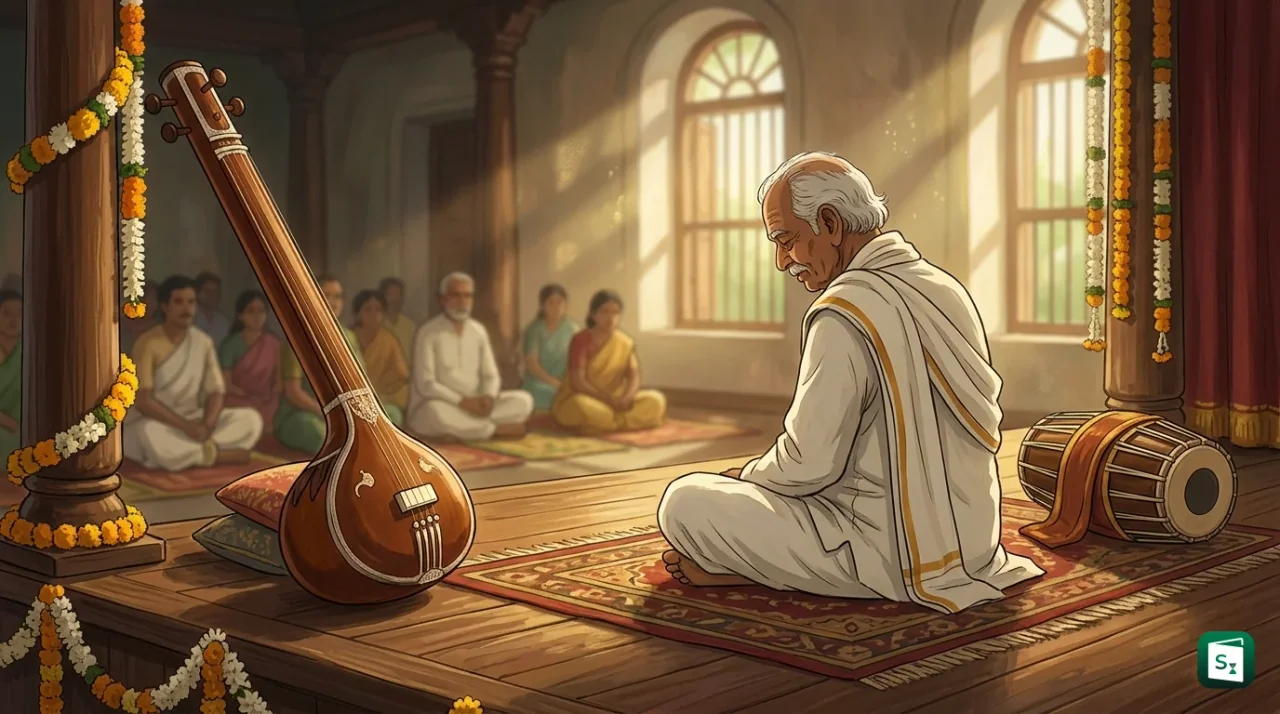
Renowned Carnatic vocalist, teacher and musicologist S R Janakiraman passed away in Chennai on 5 September 2026 at the age of 98. Fondly called S R J in music circles, he was the last surviving disciple of the legendary Tiger Varadachariar. A Padma Shri awardee in 2011, his erudite lec-dems once defined the December music season in Chennai and his scholarship bridged performance, teaching and research.
Who Was S R Janakiraman?
S Rangasamy Janakiraman, widely known as S R Janakiraman and affectionately called S R J, was an Indian Carnatic vocalist and musicologist born on 12 July 1928 in Lalgudi, Tamil Nadu. He died in Chennai on 5 September 2026, a Friday, at the age of 98. Music circles remember him as the last surviving student of Tiger Varadachariar, one of the giants of early 20th century Carnatic music, which gives his passing a symbolic sense of an era closing.
He was not only a performer but also a devoted teacher and researcher who spent decades decoding the grammar of South Indian music for students and rasikas. His work connected the concert stage with the classroom and the library. That rare blend of practice and theory made him a central figure in the Chennai December Music Season, also called the Margazhi festival, the world’s largest classical music festival organised annually by institutions like the Music Academy, Madras, founded in 1928.
Early Life and Musical Training Under the Gurukula System
Janakiraman’s childhood was marked by hardship and resilience. As an infant he was afflicted with smallpox and lost vision in one eye, and he could not attend formal school until the age of 11. His earliest lessons came from Thanneerpalli Krishnamoorthy Iyer and Shaptharishi Iyer in his native region. His formal breakthrough came in 1945 when he joined the Sangita Siromani course at Kalakshetra in Chennai, a rigorous diploma in music and dance.
Learning at Kalakshetra and Association with Tiger Varadachariar
Kalakshetra Foundation, originally the International Centre for Arts, was founded in January 1936 at Adyar, Chennai by Rukmini Devi Arundale (1904 to 1986), dancer, choreographer and theosophist who revived Bharatanatyam and was honoured with the Padma Bhushan in 1956. She was the first woman to be nominated to the Rajya Sabha in 1952. In 1962, the institution moved to its spacious 100-acre campus at Thiruvanmiyur beside the sea, and in January 1994 an Act of Parliament declared it an Institute of National Importance under the Ministry of Culture.
Music historian Lalitharam has noted that Rukmini Devi spotted Janakiraman’s talent early. She placed him in the class of a senior student and then brought him under the direct tutelage of Tiger Varadachariar (1876 to 1950), the revered vocalist from Chidambaram known for his majestic voice and profound vidwat. Janakiraman learnt under the gurukula system, an ancient residential tradition where the student lives with the guru and learns through close observation and service, not just classroom lessons.
Over the years he also trained with Tirupampuram Swaminatha Pillai, Musiri Subramania Iyer, T Brinda, Budalur Krishnamurthy Sastri, T K Ramasami Ayyangar, Kalpagam Swaminathan, Professor P Sambamurthy and P K Rajagopala Iyer. He was initiated into musicology, the scholarly study of music theory and history, by P Sambamurthi and Balakrishna Ayya, which later shaped his research path.
Contribution as Musicologist, Teacher and Researcher
After Kalakshetra, Janakiraman served as a music teacher at Madanapalle in Andhra Pradesh and at the Sri Venkateswara Music College, Tirupati, before joining the Music Academy, Madras. At the Academy he combined teaching with deep research and publication, becoming a bridge between the stage and the archive.
He is best known among scholars for his English translation and critical commentary on the Sangita Sampradaya Pradarsini, a landmark Telugu text on South Indian musicology written by Subbarama Dikshitar and first published in 1904 at Ettayapuram, Tamil Nadu. The text contains theory, biographies of composers and raga lakshanas with notated compositions following the scheme of Venkatamakhin. To mark a century of its publication, a team led by specialists produced an English web edition in 2004, and Janakiraman’s annotated translation remains a key reference for students.
His other scholarly works include Ragas at a Glance, Essentials of Musicology, Sangita Shastra Saramu in Telugu, Raga Lakshanas and Ragas of Saramrta, both published by the Music Academy. In lecture-demonstrations, often called lec-dems, he would sing a phrase, explain its grammar and show how a raga’s character is built note by note. For many young musicians, those lucid sessions during the December season were their first guide to the logic behind the beauty.
What Is Carnatic Music?
Carnatic music, also spelled Karnatic and called Karnataka Sangeetham, is one of the two main traditions of Indian classical music, the other being Hindustani music. It is the classical music of South India, chiefly associated with Tamil Nadu, Karnataka, Andhra Pradesh, Kerala and Telangana. The word Carnatic is linked by musicologists to the region historically known as Karnata or Carnatic, covering much of the Deccan plateau.
The tradition shares roots with Hindustani music in the ancient Sama Veda chants and Bharata Muni’s Natya Shastra. Both use the twin pillars of raga, a melodic framework that sets the mood and notes, and tala, a cyclical rhythmic pattern. The two streams shared a common history until the late 12th and early 13th centuries, when Persian and Islamic influences in the north during the Delhi Sultanate period led Hindustani music to develop separately. Carnatic music remained more closely tied to temple and bhakti movement traditions of the south.
The modern Carnatic system is often traced to two milestones. Purandaradasa (1484 to 1564), a poet and composer from Karnataka, is called the father of Carnatic music for systematising teaching methods and composing foundational exercises. The Musical Trinity of the early 19th century, Tyagaraja, Muthuswami Dikshitar and Syama Sastri, all born in Thiruvarur region of Tamil Nadu, enriched the repertoire with thousands of kritis and kirtanas, devotional compositions that form the core of concerts today. In the 17th century, scholar Venkatamakhin proposed the 72 Melakarta system in his treatise Chaturdandi Prakashika, which still classifies parent ragas.
Carnatic performance is primarily composition based but includes improvisation. A typical concert features vocal music at the centre, even when instruments play they follow a vocal style called gayaki. Common instruments are veena, violin, mridangam, ghatam, kanjira and flute. Unlike Hindustani music, there are no separate instrumental gharanas, and the system uses a structured set of seven basic talas (sapta talas) with varied beat counts.
Carnatic Music vs Hindustani Music
| Aspect | Carnatic Music | Hindustani Music |
|---|---|---|
| Region | South India, relatively untouched by Persian influence | North India, shaped by Persian and Islamic influences after 12th century |
| Emphasis | Vocal centred, even instrumental playing mimics singing | Vocal and instrumental equally developed, solo improvisation central |
| Composition | Strong focus on composed kriti, varnam, tillana by Trinity and others | Focus on improvised forms like khayal, dhrupad, thumri, tarana |
| Raga system | 72 Melakarta parent ragas by Venkatamakhin (17th century) | 10 Thaats classified by Bhatkhande (early 20th century) |
| Rhythm | Sapta tala system, systematic calculations | Tintal, Ektal, Jhaptal etc., more flexible expansion |
| Language of compositions | Mainly Telugu, Sanskrit, Tamil, Kannada | Mainly Hindi, Braj Bhasha, Urdu |
| Major centres | Chennai, Thanjavur, Mysuru | Delhi, Lucknow, Gwalior, Varanasi |
This comparison highlights the bifurcation point, the Melakarta vs Thaat distinction and the role of the Trinity and Purandaradasa.
Understanding the Padma Shri and India’s Civilian Honours
What is the Padma Shri award is a frequent question. The Padma Awards are among India’s highest civilian honours, instituted in 1954 and announced every year on the eve of Republic Day, 26 January. They are given in three categories, in order of precedence: Padma Vibhushan for exceptional and distinguished service, Padma Bhushan for distinguished service of a high order, and Padma Shri for distinguished service in any field. The President of India confers them at ceremonial functions at Rashtrapati Bhavan around March and April.
The awards are administered by the Ministry of Home Affairs. Any person without distinction of race, occupation, position or sex is eligible, except that government servants working in public sector undertakings, except doctors and scientists, are generally not eligible while in service. Nominations are placed before the Padma Awards Committee, constituted by the Prime Minister every year, and the final list is approved by the President. There is no cash prize or monetary benefit attached, only a certificate signed by the President and a medallion. Awards are given in fields including Art, Social Work, Public Affairs, Science and Engineering, Trade and Industry, Medicine, Literature and Education, Sports, Civil Service and Others.
The Bharat Ratna, instituted in 1954, remains the highest civilian award above the Padma series and is limited to a maximum of three recipients in a year.
S R Janakiraman received the Padma Shri in 2011 in the category Art, Music, Carnatic Vocal. That year the President approved 128 awards in total, comprising 13 Padma Vibhushan, 31 Padma Bhushan and 84 Padma Shri, including foreign and posthumous awardees. His name appeared alongside other cultural figures of that year, marking national recognition for decades of work in music.
Padma Shri vs Padma Bhushan vs Padma Vibhushan
| Award | Meaning | Rank | Typical Criterion |
|---|---|---|---|
| Padma Vibhushan | Exceptional and distinguished service | Second highest civilian honour after Bharat Ratna | National level lifetime impact |
| Padma Bhushan | Distinguished service of a high order | Third highest | High order contribution over time |
| Padma Shri | Distinguished service | Fourth highest | Notable achievement in any field |
All three were briefly suspended during 1978 to 1979 and 1993 to 1997 when criteria were reviewed, before being restored. The order of precedence, the 1954 origin, the Republic Day announcement and the no cash prize rule are key facts to remember.
Honours and Legacy of S R Janakiraman
Beyond the Padma Shri, Janakiraman received nearly every major honour for classical music in India. The Sangeet Natak Akademi, India’s National Academy of Music, Dance and Drama established in 1953 and autonomous under the Ministry of Culture with headquarters in New Delhi, honoured him with the Sangeet Natak Akademi Award in 2000 for Carnatic Vocal Music. Later the Akademi conferred its highest distinction, the Sangeet Natak Akademi Fellowship (Akademi Ratna) in 2014, an honour limited to a very small number of living artists at any time. The award carries a purse of ₹1 lakh for the Puraskar and ₹3 lakh for the Fellowship along with a citation, an angavastram and a tamrapatra.
The Music Academy, Madras conferred on him the title Sangita Kala Acharya, given to distinguished teachers and scholars. The Government of Tamil Nadu honoured him with the Kalaimamani, the state’s highest award for arts. He also received several titles from sabhas and cultural bodies across South India.
His legacy lies in three linked roles. As a vocalist he carried forward the style of Tiger Varadachariar with fidelity to traditional patanthara, the line of teaching. As a teacher he trained generations at Madanapalle, Tirupati and the Music Academy. As a musicologist he made complex texts accessible, especially through his translation of the Sangita Sampradaya Pradarsini, helping modern students understand the raga lakshana and notations that earlier generations preserved on palm leaf. Colleagues recall that even well into his nineties he remained a patient explainer, ready to sing a phrase repeatedly until a student grasped the gamaka, the ornament that gives Carnatic music its fluid character.
Key Takeaways
- S R Janakiraman, renowned Carnatic vocalist and musicologist, passed away in Chennai on 5 September 2026 at age 98.
- He was the last surviving disciple of Tiger Varadachariar and was fondly known as S R J in music circles.
- He received the Padma Shri in 2011 in the category Art (Carnatic Vocal Music) among 128 total Padma awardees that year.
- He was honoured with the Sangeet Natak Akademi Award in 2000 and the Sangeet Natak Akademi Fellowship (Akademi Ratna) in 2014, plus Sangita Kala Acharya and Kalaimamani.
- He translated the historic Sangita Sampradaya Pradarsini (1904) by Subbarama Dikshitar into English with critical commentary.
- Carnatic music is South Indian classical music centred on raga and tala, systematised by Purandaradasa and the Trinity (Tyagaraja, Dikshitar, Syama Sastri), with 72 Melakarta ragas by Venkatamakhin.