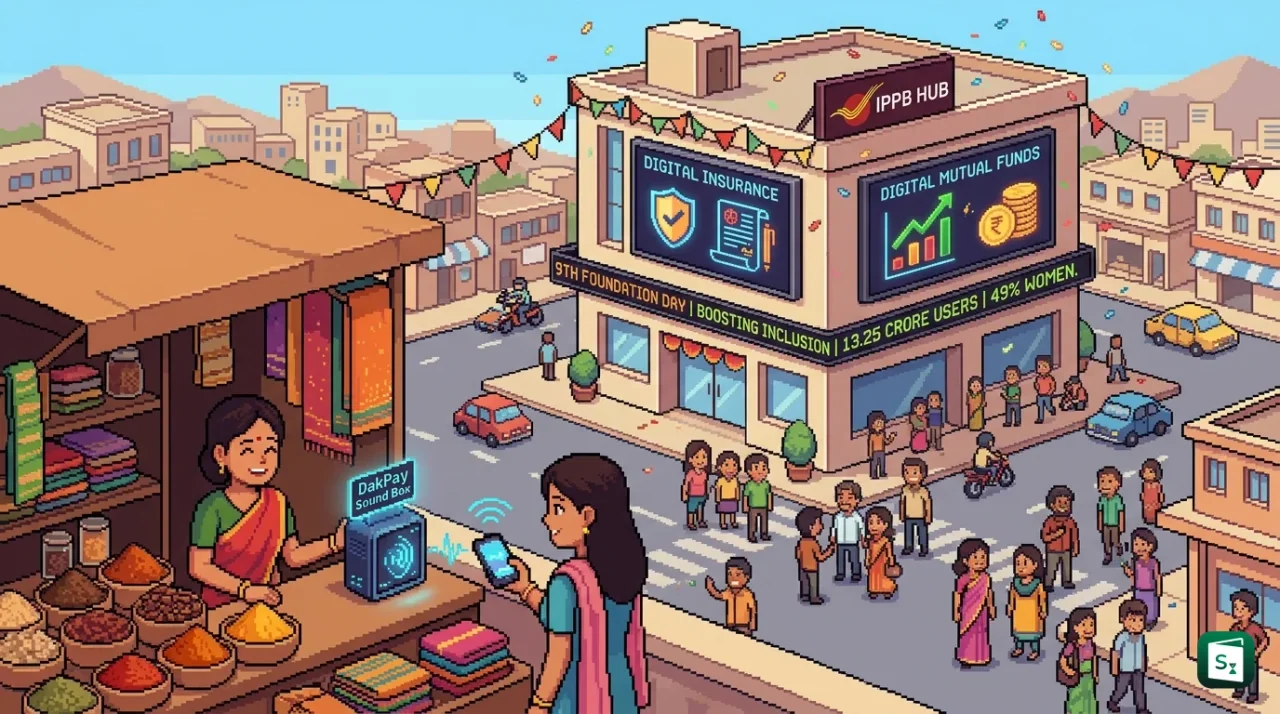
India Post Payments Bank marked its 9th Foundation Day on 1 September 2026 by launching three new digital services, the DakPay Sound Box for merchants, a Digital Insurance Technology Platform and a Digital Mutual Fund Platform. The launches were announced by the Ministry of Communications to expand access to payments, protection and investment through the vast India Post network. As on 31 March 2026, the bank serves a pan India customer base of 13.25 crore, with 49 percent women customers and 77 percent rural users.
What Is India Post Payments Bank?
India Post Payments Bank (IPPB) is a payments bank set up under the Department of Posts, Ministry of Communications, with 100 percent equity owned by the Government of India. The full form of IPPB is India Post Payments Bank, and it operates as a division of India Post with its headquarters in New Delhi. It is governed by the Reserve Bank of India (RBI) under the Banking Regulation Act, 1949.
IPPB is not a full service commercial bank. It is a payments bank, a differentiated bank licence created by the RBI in 2014 to promote financial inclusion. Payments banks can accept savings and current deposits up to ₹2 lakh per customer at the end of the day, offer money transfer, bill payments, and distribution of simple financial products such as insurance and mutual funds, but they cannot issue loans or credit cards.
The journey of the bank started when the Department of Posts received in principle approval from the RBI in September 2015. It was incorporated as a public limited company on 17 August 2016, received the payments bank licence in January 2017, and launched two pilot branches on 30 January 2017 at Ranchi in Jharkhand and Raipur in Chhattisgarh. The nationwide launch took place on 1 September 2018, when Prime Minister Narendra Modi inaugurated the bank at Talkatora Stadium in New Delhi, with 650 branches and 3,250 post offices as access points. That date, 1 September, is now observed as IPPB Day, and the current Managing Director and Chief Executive Officer is R. Viswesvaran.
For customers, the most common touchpoints are the IPPB mobile app, the DakPay UPI app, and the postman at the doorstep. An IPPB account can be opened digitally through paperless e KYC using Aadhaar and PAN, with no initial deposit required for many variants. The IPPB customer ID is the unique number assigned at account opening and is used for login and service requests, while the IPPB IFSC code, IPPMO000001, is the same for all branches because the bank operates on a single branch model with banking outlets across post offices. Many accounts are zero balance in practice, and accounts are available in 13 languages, which makes the bank accessible to first time users in rural India.
Ninth Foundation Day and Three New Digital Launches
IPPB celebrated its 9th Foundation Day on 1 September 2026, also called IPPB Day 2026. On this occasion the bank announced three new initiatives to move beyond everyday banking and payments toward investment, protection and financial security. The Managing Director and Chief Executive Officer R. Viswesvaran said the launches expand technology capabilities to make digital payments, insurance and investments simpler and more accessible to the common citizen.
Together, the three platforms represent an important shift. Instead of limiting the post office network to savings and remittances, IPPB now uses it to deliver merchant payments, insurance choice and mutual fund access at the doorstep.
DakPay Sound Box for Merchants
What is a sound box? A sound box is a small merchant device that gives an instant audio confirmation in the local language when a digital payment is received. It removes the need for the shopkeeper to check the phone repeatedly and builds trust in QR and UPI payments.
What is DakPay? DakPay is the UPI based payments app by IPPB. Full form of DakPay reflects Dak meaning post. The app allows UPI money transfer, scan and pay through QR, bill payments and balance checks across more than 200 banks. The DakPay Sound Box extends this ecosystem to the merchant counter.
The DakPay Sound Box for Merchants is designed to simplify and strengthen everyday digital payment acceptance for small shops, kirana stores and rural merchants. It provides real time voice alerts for payments received through QR code and UPI, which is especially useful in busy shops with low digital literacy. The device complements the existing IPPB Merchant App, where merchants accept payments through customer QR scan, account number plus OTP, or Aadhaar plus OTP, with funds credited to their IPPB current account in real time.
Digital Insurance Technology Platform
The Digital Insurance Technology Platform is a new digital pathway that connects customers with insurance options across Life, Health and General Insurance. Through this single technology layer, a person in a village can explore, compare and purchase insurance products digitally with assistance from the postman or at the post office, rather than visiting multiple insurer branches or agents.
The platform is offered on a distribution basis in partnership with insurance companies. IPPB acts as a corporate agent and does not underwrite risk itself, in line with RBI and Insurance Regulatory and Development Authority of India regulations. For families that previously relied only on Post Office Life Insurance, this creates a wider choice for health cover, term protection and general insurance.
Digital Mutual Fund Platform
The Digital Mutual Fund Platform aims to provide a simple, accessible and seamless digital investment experience. Customers can use it to explore and start investing in mutual funds, which are professionally managed investment schemes that pool money from many investors to buy stocks, bonds and other securities.
The platform brings mutual fund access to the post office network for first time investors outside large cities. At present, selected UTI Mutual Fund schemes are available through designated post offices, and the digital platform is expected to broaden that access. Customers are advised to check the investment objective, risk level, costs and suitability before investing, as mutual fund investments are subject to market risks.
IPPB by the Numbers: Major Milestones as on 31 March 2026
As on 31 March 2026, IPPB shared a detailed performance snapshot that underlines its scale as a financial inclusion network.
| Indicator | Achievement |
|---|---|
| Customer base | 13.25 crore customers, with 77 percent in rural areas and 49 percent women |
| Deposits | ₹29,104 crore held in trust |
| Digital financial transactions | ₹21.61 lakh crore in value, including ₹7.41 lakh crore through UPI remittances |
| Direct Benefit Transfer (DBT) | 6.5 crore beneficiaries received about ₹1.55 lakh crore |
| Aadhaar enabled Payment System (AePS) | 12.06 crore transactions with ₹36,140 crore disbursed |
| Digital Life Certificate | 29.43 lakh certificates issued to pensioners at the doorstep |
| Aadhaar services | 9.47 crore Aadhaar mobile updates and 1.35 crore Bal Aadhaar enrolments |
The DBT channel transfers government benefits such as PM Kisan, MGNREGA wages, scholarships and social security pensions directly into accounts, reducing leakages. AePS allows customers to withdraw or deposit cash using Aadhaar authentication and a micro ATM carried by the postman, while Digital Life Certificate helps pensioners prove they are alive without visiting a bank branch.
During 2025 to 2026, IPPB also introduced three new savings account variants to deepen inclusion:
- SHG Savings Account for Self Help Groups and rural micro entrepreneurs, a zero balance and zero charge account linked to the National Rural Livelihoods Mission and NABARD supported SHG movement.
- Surakshit Savings Account, a premium account offering ₹25,000 cyber insurance against phishing, spoofing and SIM jacking, along with regular premium account benefits, for an opening charge of ₹199 plus GST and annual renewal of ₹149 plus GST.
- Sampoorna Savings Account, which combines Aarogya wellness benefits such as tele and video consultation with cyber protection and premium account features.
How IPPB Takes Banking to the Doorstep
The core strength of IPPB is its delivery model. It leverages the India Post network of about 1,65,000 post offices, including about 1,40,000 in rural areas, and a field force of about 3,00,000 postal employees comprising postmen and Gramin Dak Sevaks. The bank operates with 1 controlling branch and 649 banking outlets in a hub and spoke model, where post offices act as access points and the postman acts as a mobile banking correspondent.
Banking is provided on the key pillars of India Stack in a paperless, cashless and presence less manner. Services are delivered through a Core Banking System integrated smartphone and biometric device that functions as a micro ATM. With e KYC using Aadhaar, an account can be opened in minutes without paperwork. Customers can transact using QR card, virtual RuPay debit card, UPI, Immediate Payment Service (IMPS), National Electronic Funds Transfer (NEFT), Bharat BillPay, AePS and DBT credit with doorstep cash withdrawal.
Interfaces are available in 13 languages and reach more than 13 crore customers across 5.57 lakh villages and towns. This assisted model helps people who are not comfortable with self service apps. The postman provides help to operate the app, explain products and complete Aadhaar mobile updates or Bal Aadhaar enrolment at home. For merchants, the same trust based doorstep link now carries the sound box and digital investment guidance.
How Is a Payments Bank Different from a Regular Bank?
A payments bank is a special category of bank licensed by the RBI to further financial inclusion through small savings and payments services. The Guidelines for Licensing of Payments Banks were issued on 27 November 2014, followed by Operating Guidelines in October 2016. In November 2025, the RBI updated the framework through the Reserve Bank of India (Payments Banks) Directions, 2025.
The key differences matter for conceptual clarity:
| Feature | Payments Bank | Traditional Commercial Bank |
|---|---|---|
| Lending | Cannot give loans to anyone except its own staff from its own funds | Can give loans and advances |
| Deposit limit | Maximum ₹2 lakh per customer at end of day, excess swept to linked Post Office Savings Account or other bank with consent | No such per customer ceiling |
| Products | Savings and current deposits, remittances, bill payments, distribution of mutual fund units and insurance on a non risk sharing fee basis | Full range including loans, credit cards and investment banking |
| Investment rule | Must keep at least 75 percent of demand deposit balances in Government securities or Treasury Bills up to one year and not more than 25 percent with other scheduled commercial banks | Standard Cash Reserve Ratio and Statutory Liquidity Ratio rules apply |
| Capital | Minimum paid up capital ₹100 crore, minimum capital adequacy 15 percent | Different capital requirements |
This explains two common questions. Is IPPB a public sector bank? Yes, it is a public sector payments bank because it is fully owned by the Government of India. Is IPPB a scheduled commercial bank? No, it is a payments bank, a differentiated bank, and it cannot create credit. It also cannot issue credit cards and cannot accept NRI deposits. Amounts beyond ₹2 lakh are transferred through a sweep in and sweep out arrangement to the linked Post Office Savings Account (POSA) after taking the customer’s written consent.
Is IPPB the Same as the Post Office Savings Account?
No. This is one of the most searched doubts and needs clear distinction.
Department of Posts (DOP) runs the Post Office Savings Bank (POSB), which includes the Post Office Savings Account (POSA) and other small savings schemes such as Sukanya Samriddhi, Public Provident Fund and Time Deposits. POSB operates under small savings rules framed by the Ministry of Finance.
IPPB is a separate payments bank under the Department of Posts, Ministry of Communications, regulated by the RBI. It offers its own savings and current accounts, UPI and AePS services, and now distributes insurance and mutual funds.
The two are linked but not identical:
| Aspect | IPPB Account | POSA or POSB Account |
|---|---|---|
| Operator | IPPB, a payments bank | Department of Posts as agent for Government small savings |
| Regulator | RBI | Ministry of Finance small savings framework |
| Deposit limit | ₹2 lakh at end of day | Higher limits as per scheme rules |
| Interest | About 2.00 percent up to ₹1 lakh and 2.25 percent between ₹1 lakh and ₹2 lakh paid quarterly | Declared by Government, generally higher for small savings |
| Features | UPI through DakPay, QR card, virtual debit card, doorstep banking | Passbook based, can be linked to IPPB for sweep facility |
| Linking | Customers can link POSA with IPPB to allow automatic sweep in and sweep out and easy money transfer | Linking enables seamless movement between the two |
In simple terms, is IPPB different from Post Office Savings Account? Yes. IPPB is a bank for digital transactions and payments, while POSA is a small savings account. Customers often keep both and link them, so money above the IPPB ceiling moves safely to POSA.
Why This Expansion Matters for Financial Inclusion
The expansion from payments to protection and investment addresses the last gap in inclusion. Financial inclusion means every household can access useful and affordable financial products for saving, paying, borrowing, insuring and investing. IPPB started with the first two and now adds the next two.
Three impacts stand out. First, merchant digitisation in small towns and villages. A sound box that speaks the payment confirmation builds confidence among small merchants who fear failed transactions. With more merchants accepting QR and UPI, villagers spend less time and money travelling to withdraw cash.
Second, protection for vulnerable families. Rural households face health costs, crop risks and digital fraud. Access to life, health and general insurance through a trusted postman, combined with the existing ₹25,000 cyber insurance in Surakshit and Sampoorna accounts, creates a safety net that was earlier limited to urban buyers.
Third, investment access. Mutual fund participation in India is still concentrated in top cities. A digital mutual fund platform delivered through 5.57 lakh villages and explained in local languages can introduce first time savers to regulated, long term investing without depending on distant cities or unregulated agents.
The numbers underline inclusion intent. With 77 percent rural customers and 49 percent women, IPPB reaches groups that traditional branch networks missed. Linking 6.5 crore DBT beneficiaries to about ₹1.55 lakh crore of transfers shows the post office network has become a pillar for subsidy delivery. For the wider economy, every digital payment through UPI or AePS strengthens the less cash and digitally enabled economy envisaged under Digital India.
Key Takeaways
- IPPB marked its 9th Foundation Day on 1 September 2026 by launching the DakPay Sound Box for Merchants, a Digital Insurance Technology Platform and a Digital Mutual Fund Platform.
- India Post Payments Bank was incorporated on 17 August 2016, piloted on 30 January 2017 at Ranchi and Raipur, and launched nationwide on 1 September 2018 by Prime Minister Narendra Modi, under the Department of Posts, Ministry of Communications with 100 percent Government of India ownership and headquarters in New Delhi.
- As on 31 March 2026, IPPB has 13.25 crore customers with 77 percent rural and 49 percent women, holding ₹29,104 crore in deposits and handling ₹21.61 lakh crore of digital transactions including ₹7.41 lakh crore of UPI remittances.
- A payments bank can accept only savings and current deposits up to ₹2 lakh per customer per day and cannot give loans or issue credit cards, and must invest at least 75 percent of demand deposit balances in Government securities up to one year.
- DakPay is the UPI app by IPPB and the DakPay Sound Box provides audio confirmation of QR and UPI payments for merchants, while the new insurance and mutual fund platforms operate on a distribution fee basis without risk participation.
- IPPB is not the same as Post Office Savings Bank (POSB), POSB runs Post Office Savings Account (POSA) small savings schemes, while IPPB is an RBI regulated payments bank, the two can be linked for sweep in and sweep out when the IPPB balance exceeds ₹2 lakh.