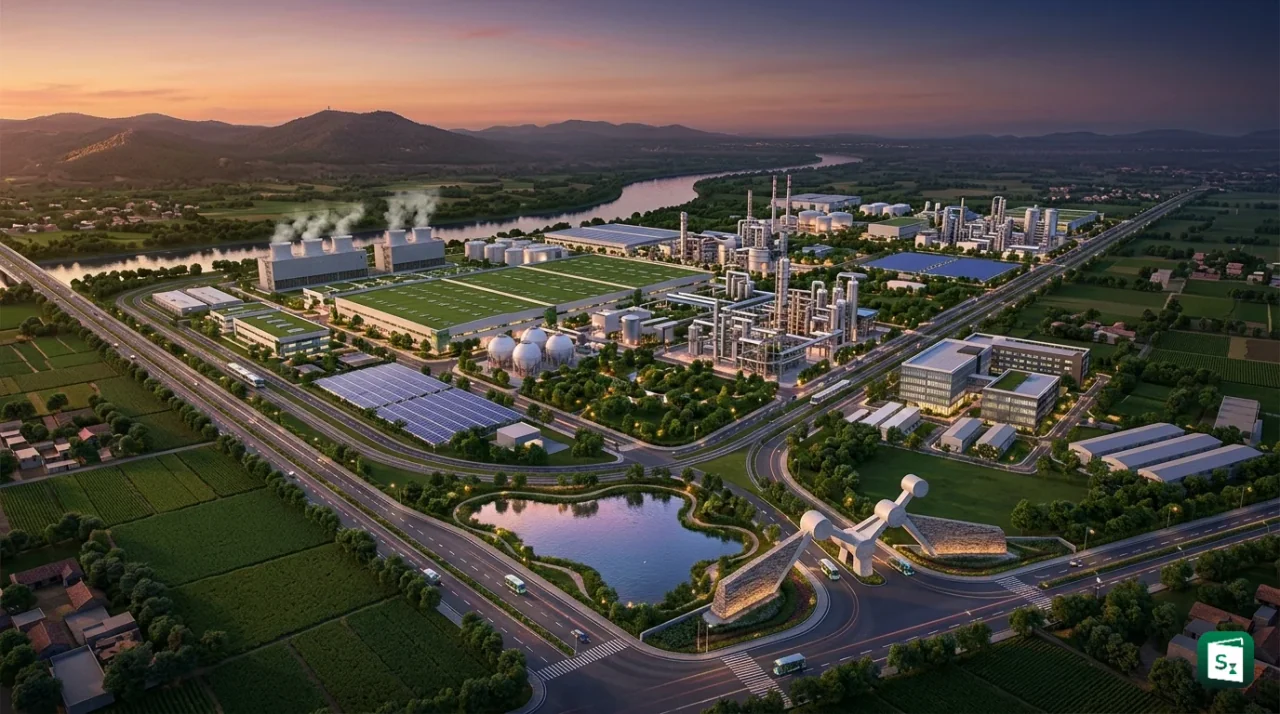
The Union Cabinet has approved the Bharat Audyogik Vikas Yojana Rasayan (BHAVYA Rasayan) Scheme, a ₹3,030 crore initiative to establish three dedicated chemical parks across India. Announced in the Union Budget 2026-27, the scheme will run for five years from FY2026-27 to FY2030-31. It aims to transform India’s chemical manufacturing landscape through world-class shared infrastructure, positioning the sector as a cornerstone of the Viksit Bharat @ 2047 vision.
What Is BHAVYA Rasayan Scheme?
The BHAVYA Rasayan Scheme is a central sector scheme designed to promote cluster-based development of the chemical industry. Of the total outlay of ₹3,030 crore, ₹3,000 crore is earmarked for creating common infrastructure facilities and basic utilities inside the parks, while ₹30 crore is set aside for administrative expenses.
The scheme is implemented through a challenge route, where state governments compete to host the parks. Each park must sit on a minimum 8 square kilometres (2,000 acres) of contiguous, encumbrance-free land. The Centre will provide a grant of up to ₹1,000 crore per park, conditional on the concerned state government contributing a minimum of ₹500 crore. Union Minister for Information and Broadcasting Ashwini Vaishnaw emphasised that the Centre’s support is limited to shared infrastructure, meaning the total investment in each park will be significantly higher than the grant amount.
The scheme is administered by the Department of Chemicals and Petrochemicals under the Ministry of Chemicals and Fertilizers. The ministry, headed by the Minister of Chemicals and Fertilizers, oversees India’s chemical, petrochemical, and fertiliser sectors from its headquarters in New Delhi.
Infrastructure and Features of the Chemical Parks
The chemical parks are designed as plug-and-play industrial hubs, offering a full suite of shared utilities that individual companies would find too expensive to build on their own. Common infrastructure includes a Common Effluent Treatment Plant (CETP) for collective wastewater treatment, a Treatment, Storage, and Disposal Facility (TSDF) for hazardous waste management, water supply and distribution systems, solvent recovery and distillation facilities, steam generation and distribution networks, interconnected pipeline networks for raw material and product transfer, and logistics and warehousing facilities.
These shared facilities serve a dual purpose. They drastically lower the capital cost for individual firms setting up units inside the park, and they ensure centralised compliance with environmental regulations. The TSDF and CETP, in particular, help units meet strict norms such as Zero Liquid Discharge without each factory having to install its own treatment infrastructure.
Why Chemical Parks? The State of India’s Chemical Industry
India’s chemical industry is the sixth largest in the world and the third largest in Asia, producing over 80,000 chemical products across bulk chemicals, specialty chemicals, agrochemicals, petrochemicals, polymers, and fertilisers. The sector contributes roughly 7% to India’s GDP and 8.1% to manufacturing Gross Value Added (GVA). Production of major chemicals and petrochemicals grew from 45.6 million tonnes in FY16 to 58.6 million tonnes in FY25, recording a CAGR of 2.8%.
Despite these numbers, the sector faces serious structural challenges.
| Challenge | Description |
|---|---|
| Import dependence | India imported chemicals worth $75 billion in 2023 against exports of $44 billion, creating a trade deficit of around $31 billion |
| High logistics costs | Fragmented industrial clusters with outdated infrastructure raise costs and reduce global competitiveness |
| Low R&D spend | Investment in research and development remains low, limiting innovation in high-value specialty chemicals |
| Environmental compliance burden | Complex, overlapping central and state regulations with norms like Zero Liquid Discharge increase operational costs |
| Skill shortage | Significant gap in skilled professionals in niche areas such as green chemistry and advanced process engineering |
| Feedstock cost disadvantage | High domestic prices of natural gas and naphtha make Indian chemical products less competitive internationally |
The NITI Aayog report released in July 2025 titled “Chemical Industry: Powering India’s participation in Global Value Chains” specifically recommended establishing chemical hubs and developing port-infrastructure clusters. The report envisions India becoming a global chemical powerhouse with a 12% share in global value chains and $1 trillion output by 2040. The BHAVYA Rasayan Scheme directly addresses this vision by tackling the infrastructure and cost disadvantages that hold the sector back.
Existing Government Initiatives for Chemical Clusters
The BHAVYA Rasayan Scheme is not the first cluster-based approach for the chemical sector. The government has already implemented several related schemes:
Petroleum, Chemicals and Petrochemical Investment Regions (PCPIRs)
The PCPIR Policy, notified in 2007, was the first major effort to create integrated investment regions for petroleum, chemicals, and petrochemicals. Four PCPIRs were approved in Andhra Pradesh (Visakhapatnam), Gujarat (Dahej), Odisha (Paradeep), and Tamil Nadu (Cuddalore-Nagapattinam). These regions combine manufacturing zones with SEZs, free trade zones, and logistics hubs. However, the PCPIR policy did not provide direct grants, only viability gap funding, which limited infrastructure development.
Plastic Parks Scheme
Launched in 2013-14 by the Department of Chemicals and Petrochemicals, the Plastic Parks Scheme provides a one-time grant of up to 50% of project cost, capped at ₹40 crore per park. So far, 10 plastic parks have been approved across various states.
Scheme for Promoting Bulk Drug Parks
Announced in 2020 as part of the Atmanirbhar Bharat package, this scheme provides ₹1,000 crore per park for common infrastructure. Three bulk drug parks were established in Gujarat, Himachal Pradesh, and Andhra Pradesh.
The BHAVYA Rasayan Scheme is significantly larger in scale than these earlier efforts. At ₹1,000 crore per park in central grant alone, it represents a step change in the government’s financial commitment to chemical cluster development.
Expected Benefits and Strategic Significance
The scheme is designed to create impact across multiple dimensions.
Value Chain Integration: By clustering upstream, downstream, and ancillary industries in one location, the parks will promote efficient resource utilisation and lower logistics costs. Chemical products serve as critical inputs for agriculture, textiles, pharmaceuticals, nutraceuticals, construction, automobiles, and electronics. A stronger chemical base will therefore strengthen these downstream sectors as well.
Global Competitiveness: Shared infrastructure will significantly reduce the capital and operational costs for individual firms, making Indian chemical products more price-competitive in global markets. The scheme aims to help the Indian chemical industry better integrate into Global Value Chains (GVCs), boosting exports and enabling import substitution.
Environmental Sustainability: The centralised waste treatment and hazardous waste management infrastructure will ensure stricter compliance with environmental regulations. This creates an eco-friendly industrial ecosystem that individual small and medium units could not afford to build on their own.
Employment Generation: Development of the chemical sector has a cascading effect on downstream industries, leading to higher employment generation across the manufacturing value chain.
Atmanirbharta and Viksit Bharat: The scheme directly supports the goals of Atmanirbhar Bharat by reducing import dependence in chemicals, and aligns with the Viksit Bharat @ 2047 vision of making India a developed nation with a strong, self-reliant manufacturing base.
Key Takeaways
- The BHAVYA Rasayan Scheme was approved by the Union Cabinet in July 2026 with a total outlay of ₹3,030 crore for establishing three dedicated chemical parks.
- The Centre will provide a grant of up to ₹1,000 crore per park, subject to a minimum state government contribution of ₹500 crore.
- Each chemical park must have a minimum contiguous area of 8 sq. km. (2,000 acres) of encumbrance-free land, and parks will be selected through a challenge route.
- The scheme is implemented by the Department of Chemicals and Petrochemicals under the Ministry of Chemicals and Fertilizers over a five-year period from FY2026-27 to FY2030-31.
- India is the sixth largest chemical producer globally and the third largest in Asia, contributing 7% to India’s GDP, but faces a $31 billion trade deficit in chemicals.
- The scheme complements existing cluster initiatives such as the PCPIR Policy (2007), Plastic Parks Scheme (2013-14), and Bulk Drug Parks Scheme (2020).