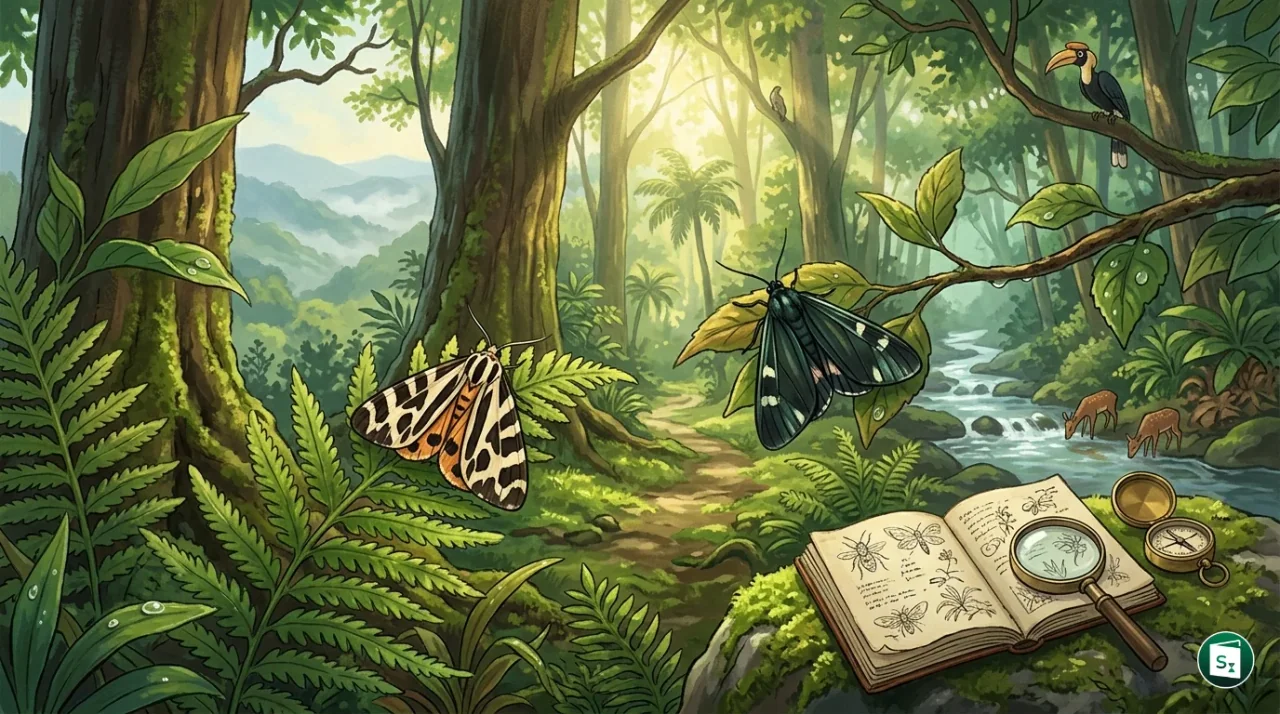
Scientists from the Zoological Survey of India (ZSI), Pune, in collaboration with the Natural History Museum, London, have discovered two new moth species from different parts of the Western Ghats. A new genus and species of tiger moth named Antaram idukki was found in Kerala’s Idukki district, while a new forester moth species Mimeusemia kali was discovered in the Kali Tiger Reserve in Karnataka. Both discoveries highlight the exceptional but largely undocumented insect diversity of the Western Ghats, one of the world’s most important biodiversity hotspots.
What Are Tiger Moths and Forester Moths?
Moths belong to the order Lepidoptera, the same group that includes butterflies. They are found in nearly every habitat on Earth and play vital roles as pollinators, especially for night-blooming plants, and as a food source for birds, bats, and other wildlife.
Tiger moths belong to the subfamily Arctiinae within the family Erebidae. There are about 11,000 species of tiger moths worldwide. They are known for their bright coloration, which serves as a warning to predators about their distastefulness. Many have dense, hairy caterpillars popularly called woolly bears. Tiger moths also possess unique defence mechanisms, including the ability to produce ultrasonic clicks that interfere with bat echolocation.
Forester moths belong to the family Zygaenidae, a group of day-flying moths found across Asia, Europe, and Africa. Unlike most moths that are nocturnal, forester moths are active during daylight hours. They typically have a metallic sheen and bright red or yellow spots on dark wings. Like tiger moths, they also use chemical defences, storing hydrogen cyanide throughout their life cycle as protection against predators.
Antaram idukki: A New Genus of Tiger Moth from Kerala
The discovery of Antaram idukki is particularly significant because it represents not just a new species but an entirely new genus. Researchers from ZSI’s Western Regional Centre in Pune, led by Dr. Aparna Kalawate, along with former Natural History Museum London curator Dr. Alberto Zilli, ZSI Kozhikode scientist M.D. Jaffer Palot, and independent moth researcher Balakrishnan Valappil, described the species in the Journal of the Lepidopterists’ Society.
The genus name Antaram is derived from a Sanskrit word meaning “difference”, reflecting the distinct morphological features that set this moth apart from all known related genera. The species name idukki refers to the district in Kerala where it was found. Detailed examination of its wing patterns, genital structures, and DNA confirmed that it did not fit into any existing genus.
So far, the species has been recorded only from the Idukki district of Kerala, part of the southern Western Ghats. Despite extensive surveys across different parts of the range, the moth has not been found elsewhere, indicating that it may be extremely rare and highly localised. Scientists are yet to determine details about its larval host plant and life history.
Idukki, a mountainous region known for its dense forests and rich biodiversity, is facing growing threats from unregulated tourism, habitat degradation, climate change, and increasing landslides. The discovery of a new genus so soon in a region under pressure underscores the urgency of documenting and conserving insect biodiversity before species are lost.
Mimeusemia kali: A Rare Forester Moth from Karnataka
The second discovery, Mimeusemia kali, is a new species of forester moth found in the Kali Tiger Reserve in Karnataka’s Uttara Kannada district. Described by Dr. Aparna Kalawate of ZSI Pune in collaboration with Gyula M. Laszlo of the Natural History Museum, London, the species was published in the international journal Zootaxa.
This discovery marks the first addition to the genus Mimeusemia in nearly 30 years. The genus now includes 30 taxa worldwide, comprising 23 species and 7 subspecies. Mimeusemia kali was distinguished from related species through a combination of physical characteristics, reproductive structures, and genetic features.
The Kali Tiger Reserve, formerly known as the Dandeli-Anshi Tiger Reserve, was renamed in December 2015 after the Kali River that flows through it. Spread over 1,345 square kilometres, the reserve is part of the Western Ghats landscape and provides habitat for Bengal tigers, black panthers, Indian elephants, and numerous other species. The Kali River serves as the lifeline of this ecosystem, and the reserve itself hosts several hydroelectric dams and a nuclear power station.
The discovery of a new moth species from within a well-protected tiger reserve demonstrates that even established protected areas harbour undocumented biodiversity. It also reinforces the importance of insects as indicators of ecosystem health.
The Western Ghats: A Cradle of Hidden Biodiversity
The Western Ghats, also known as the Sahyadri mountain range, run for about 1,600 kilometres along India’s western coast, spanning six states: Gujarat, Maharashtra, Goa, Karnataka, Kerala, and Tamil Nadu. Inscribed as a UNESCO World Heritage Site in 2012, the range is recognised as one of the world’s eight “hottest” biodiversity hotspots.
Older than the Himalayas, the Western Ghats are among the most ancient mountain systems on Earth. Their age and geographical isolation have resulted in exceptionally high levels of endemism (species found nowhere else). The region is home to over 7,000 species of flowering plants, 139 mammal species, 508 bird species, and 179 amphibian species, a significant proportion of which are endemic. At least 325 globally threatened species occur in the Western Ghats.
Despite this richness, the insect diversity of the Western Ghats remains poorly documented. Scientists estimate that India may be home to approximately 10,000 species of moths, but many more remain undiscovered. In November 2025, for instance, 90 new moth species were documented in Maharashtra’s Melghat region alone, taking the total recorded moth species in that district to 250.
The two discoveries in quick succession from the Western Ghats point to a larger pattern: vast stretches of India’s forests remain unexplored from an entomological perspective, and many species await formal scientific description.
Significance of the Discoveries
These discoveries are important for several reasons. First, the creation of a new genus Antaram represents a rare event in taxonomy, indicating that the Western Ghats still harbour evolutionary lineages unknown to science. Second, the discovery of Mimeusemia kali after a gap of three decades in the same genus highlights how infrequently insect surveys are conducted even in well-known protected areas.
The research also demonstrates the value of international collaboration. The partnership between the Zoological Survey of India and the Natural History Museum, London, which houses one of the world’s largest Lepidoptera collections with over 12.5 million specimens, brings together complementary expertise in taxonomy, morphology, and molecular analysis.
From a conservation perspective, these discoveries draw attention to the often-overlooked insect world. While conservation efforts in India have traditionally focused on large charismatic species such as tigers and elephants, insects form the foundation of ecosystems. They are essential for pollination, nutrient cycling, and as a food source for higher animals. Moths, in particular, are sensitive indicators of environmental change, making their documentation valuable for monitoring habitat health.
The Zoological Survey of India, established on 1 July 1916, operates under the Ministry of Environment, Forest and Climate Change. Headquartered in Kolkata, it has 16 regional centres across the country, including the Western Regional Centre in Pune that led both discoveries. Dr. Dhriti Banerjee serves as the current Director of ZSI, the first woman to hold this position in the institution’s history.
Key Takeaways
- The Zoological Survey of India (ZSI), Pune, in collaboration with the Natural History Museum, London, discovered two new moth species from the Western Ghats.
- Antaram idukki, a new genus and species of tiger moth, was discovered in Idukki district, Kerala, and published in the Journal of the Lepidopterists’ Society.
- The genus name Antaram is derived from Sanskrit meaning “difference”, and the species is currently known only from its type locality in Idukki.
- Mimeusemia kali, a new species of forester moth, was discovered in the Kali Tiger Reserve, Karnataka, and published in the journal Zootaxa. This is the first addition to the genus Mimeusemia in 30 years.
- The research was led by Dr. Aparna Kalawate of ZSI’s Western Regional Centre, Pune, a recipient of the Fellowship of the Royal Entomological Society, UK.
- The Western Ghats, a UNESCO World Heritage Site inscribed in 2012, is one of the world’s eight hottest biodiversity hotspots.
- The Zoological Survey of India was established on 1 July 1916, operates under the Ministry of Environment, Forest and Climate Change, and is headquartered in Kolkata.