India has become the world’s leading ship recycling nation in 2025, with its global market share rising to 35.4%, according to the latest Review of Maritime Transport report released by the United Nations Conference on Trade and Development (UNCTAD). Ship recycling volumes in India jumped nearly 60% to 2.99 million gross tons (GT), up from 1.86 million GT in 2024. With this achievement, India has met the ship recycling target set under the Maritime India Vision (MIV) 2030 a full five years ahead of schedule.
What the UNCTAD Report Says
The Review of Maritime Transport is an annual flagship publication of UNCTAD. Established in 1964 and headquartered in Geneva, Switzerland, UNCTAD promotes the interests of developing countries in global trade and development. The 2025 edition, titled “Staying the Course in Turbulent Waters”, provides comprehensive data on global shipping trends including fleet composition, freight rates, port traffic, and ship recycling.
The report shows that India recycled 2.99 million GT of ships in 2025, a sharp jump from 1.86 million GT in 2024. This represents a year-on-year increase of nearly 60%. India’s global market share climbed from 30.1% in 2024 to 35.4% in 2025, placing the country firmly ahead of all other ship recycling nations.
Union Minister for Ports, Shipping and Waterways Sarbananda Sonowal stated that India’s rise to the top reflects sustained policy reforms, industry efforts, and adherence to international environmental and safety standards. The minister said the achievement reinforces India’s position as a global hub for responsible and sustainable ship recycling.
India’s Ship Recycling Ecosystem: The Alang Hub
The backbone of India’s ship recycling industry is the Alang-Sosiya Ship Recycling Yard in Gujarat’s Bhavnagar district. Located on the Gulf of Khambhat, the yard was established in 1983 and is today the world’s largest ship recycling facility. It spans roughly 10 kilometres of coastline and houses over 130 individual recycling plots.
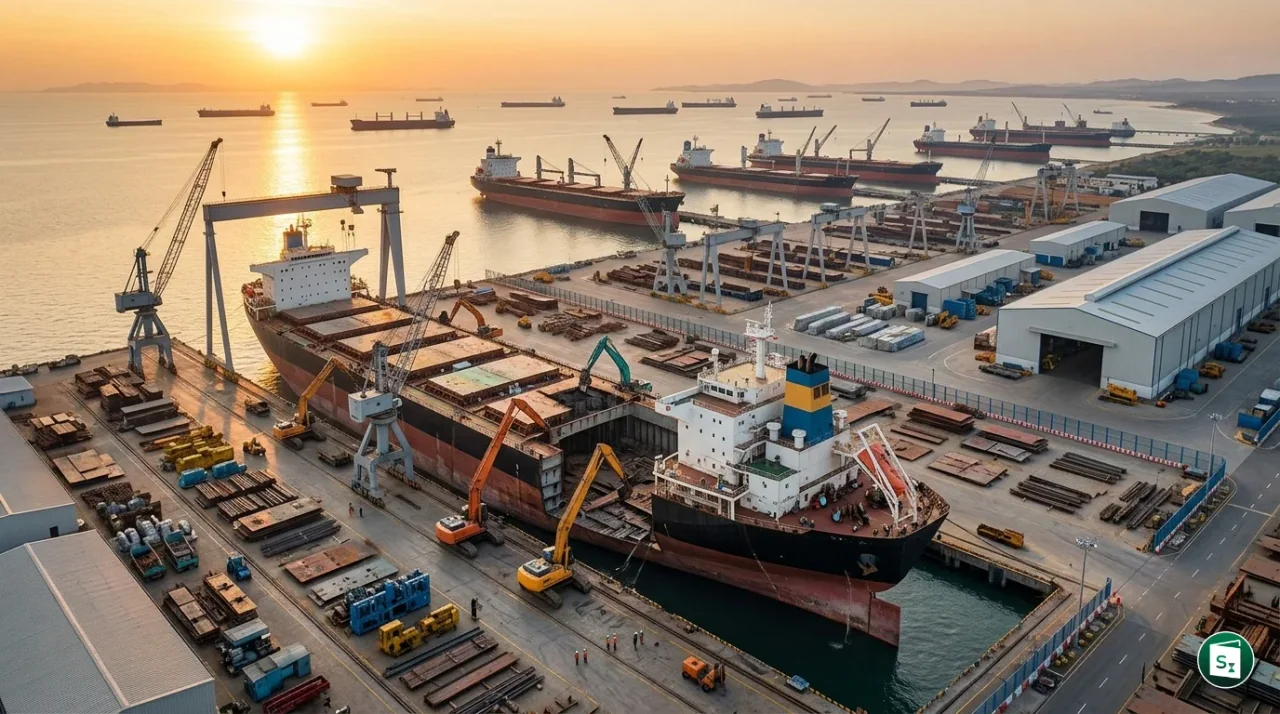
Alang’s geography is central to its operations. The yard uses the tidal beaching method, where end-of-life ships are driven onto the mudflats at high tide. As the tide recedes, workers on the beach cut the vessels into sections for recovery of steel, non-ferrous metals, and reusable equipment. The scrap steel recovered from Alang meets a significant portion of India’s domestic demand and reduces the country’s reliance on imported raw materials.
The yard generates direct employment for tens of thousands of workers, many of them from across India. It also sustains a vast downstream ecosystem of steel rerolling mills, foundries, and ancillary industries. The Gujarat Maritime Board, along with the Ministry of Ports, Shipping and Waterways, oversees the regulatory and infrastructure functions at the yard.
Key Policy Reforms Driving Growth
India’s leap to the top of global ship recycling rankings is the result of a coordinated suite of policy interventions rolled out over the past several years. These reforms were designed to align Indian recycling practices with international environmental and safety standards while creating economic incentives for ship owners to choose Indian yards.
| Reform | Description | Impact |
|---|---|---|
| Recycling of Ships Act, 2019 | Domestic legislation aligned with the Hong Kong Convention (HKC) | Created a legal framework for safe, environmentally sound recycling |
| HKC Ratification (2019) | India became the first South Asian country to ratify the HKC | Signalled commitment to global standards, attracting international vessels |
| Ship-breaking Credit Note Scheme | Credit notes worth 40% of scrap value, redeemable up to 5% of new vessel cost | Incentivises both recycling and domestic shipbuilding |
| Modernisation Support | ₹53.5 crore in financial assistance | Enabled 115 facilities to achieve HKC compliance |
| Stakeholder Engagement | Regular consultations with Gujarat Maritime Board, industry associations, classification societies | Addressed operational challenges and improved ease of doing business |
The government has also been actively pursuing the inclusion of Indian ship recycling yards in the European Union’s approved list of recycling facilities under the EU Ship Recycling Regulation (EUSRR) . This would open access to a larger pool of end-of-life vessels from European shipping lines.
The Ship-breaking Credit Note Scheme
The Ship-breaking Credit Note Scheme (SbCN) is one of India’s most innovative policy instruments in the maritime sector. It was launched as part of the Shipbuilding Financial Assistance Scheme (SBFAS) 2.0, making India the first country in the world to introduce a credit note mechanism linking ship recycling with new shipbuilding.
Under the scheme, a ship owner who scraps an eligible vessel at a certified Indian recycling yard receives a credit note equivalent to 40% of the scrap value of the recycled ship. This credit note can then be redeemed against the cost of a new vessel built at an Indian shipyard, subject to a ceiling of 5% of the new vessel’s contract value. The credit note is valid for three years from the date of scrapping.
Analogy · Ship Recycling Credit Note Expand analogy
Think of it like a trade-in programme for cars. When you scrap your old car at an authorised facility, you get a discount certificate that you can use when buying a new car. The SbCN does the same for ships: scrap an old vessel at an Indian yard, get credit towards building a new one in India. This creates a circular loop that benefits both recycling and shipbuilding.
Several operational rules govern the scheme. The scrap value is determined as the lowest among the contract price, fair price, and actual price received by the recycling yard, certified by a chartered accountant. Only one credit note is issued per vessel scrapped, but ship owners can stack multiple credit notes from different recycling contracts and combine them for a single shipbuilding order. The government pays the credit note value directly to the shipyard upon delivery of the new vessel.
Aligning with Hong Kong Convention Standards
A key driver behind India’s rise has been its early and determined alignment with the Hong Kong International Convention for the Safe and Environmentally Sound Recycling of Ships (HKC) . The HKC was adopted by the International Maritime Organization (IMO) in 2009 and entered into force on 26 June 2025.
India ratified the HKC in November 2019, becoming the first South Asian country to do so. To implement the convention’s requirements domestically, Parliament enacted the Recycling of Ships Act, 2019. This law mandates that every ship brought to India for recycling must carry an Inventory of Hazardous Materials (IHM) , and all recycling facilities must obtain authorisation from the central government.
The government provided ₹53.5 crore in financial assistance to help recycling yards upgrade their infrastructure. As a result, 115 facilities at Alang and elsewhere have become HKC-compliant. These yards feature impermeable concrete flooring, proper drainage systems, hazardous waste management facilities, and safety equipment for workers. Compliance with HKC standards has been critical in attracting international ship owners who require environmentally responsible recycling under regulations like the EU Ship Recycling Regulation.
The Road Ahead
India is not resting on this achievement. The Ministry of Ports, Shipping and Waterways has outlined plans to nearly double the country’s ship recycling capacity to about 9 million light displacement tons (LDT) through the expansion of the Alang Ship Recycling Yard. The Gujarat government has prepared a comprehensive master plan to support future demand, improve infrastructure, and enhance India’s global competitiveness.
The market outlook is strongly favourable. According to the Baltic and International Maritime Council (BIMCO) , more than 16,000 vessels are expected to be recycled worldwide over the next decade as the global fleet ages and new environmental regulations force older, inefficient ships out of service. With a current market share of 35.4%, India is well positioned to recycle 500 to 600 vessels annually.
India is also pursuing inclusion of its recycling yards in the European Union’s approved list under the EU Ship Recycling Regulation (EUSRR) . Getting on this list would allow Indian yards to dismantle EU-flagged vessels, opening a major new source of business. Continuous engagement with EU authorities is underway to facilitate these approvals.
The combination of growing global supply of end-of-life vessels, strong policy support, increasing HKC compliance, and innovative financial incentives like the Ship-breaking Credit Note Scheme places India in a commanding position to consolidate and expand its leadership in global ship recycling. This also advances the objectives of the circular economy by turning decommissioned ships into valuable raw materials for domestic industry.
Key Takeaways
- India became the world’s leading ship recycling nation in 2025 with a global share of 35.4% , according to the UNCTAD Review of Maritime Transport 2025.
- India recycled 2.99 million GT of ships in 2025, a nearly 60% increase from 1.86 million GT in 2024.
- The target under Maritime India Vision (MIV) 2030 was achieved five years ahead of schedule.
- The Alang-Sosiya Ship Recycling Yard in Gujarat’s Bhavnagar district, established in 1983, is the world’s largest ship recycling facility.
- The Recycling of Ships Act, 2019 aligns Indian practices with the Hong Kong International Convention (HKC) , which India ratified in 2019 and which entered into force on 26 June 2025.
- The government provided ₹53.5 crore in modernisation support, creating 115 HKC-compliant facilities.
- The Ship-breaking Credit Note Scheme (SbCN) offers credit notes worth 40% of scrap value, redeemable up to 5% of a new vessel’s cost built at an Indian shipyard.
- BIMCO projects that over 16,000 vessels will need recycling globally in the next decade, with India positioned to recycle 500 to 600 vessels annually.