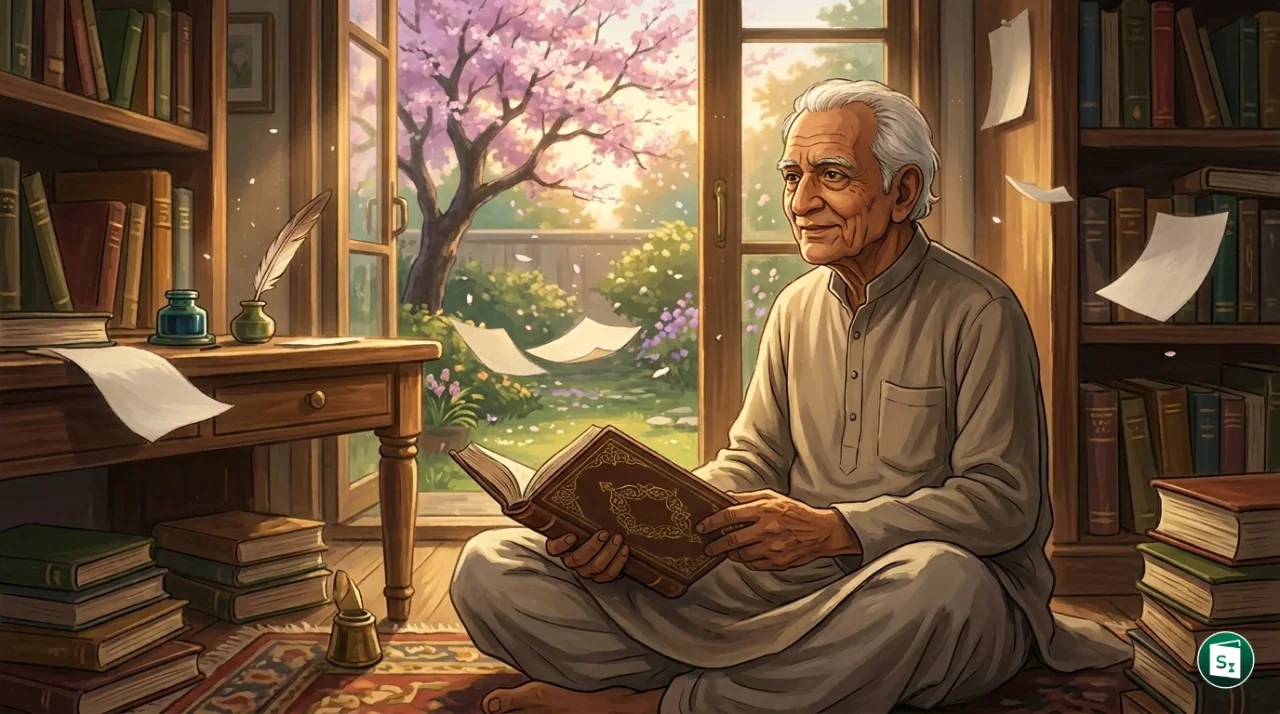
Dr. Bashir Badr, one of India’s most celebrated Urdu poets and a recipient of the Padma Shri, passed away in Bhopal at the age of 91. A titan of literature, Badr was instrumental in revolutionizing the Urdu ghazal by introducing a simple, conversational style that resonated with the common masses. His passing marks the end of a significant chapter in the history of modern Indian poetry.
A Life Dedicated to Letters and Academia
Born as Syed Muhammad Bashir on February 15, 1935, in Ayodhya, Uttar Pradesh, Dr. Badr’s journey in literature began at a young age. He pursued his higher education at the prestigious Aligarh Muslim University (AMU), where he completed his B.A., M.A., and later a Ph.D. His doctoral thesis focused on the evolution of the Urdu ghazal, a subject he would later transform through his own creative genius.
Dr. Badr spent several decades in academia, sharing his passion for the language with students. He served as a lecturer at AMU before moving to Meerut College, where he headed the Urdu Department for over 17 years. His academic rigor and deep understanding of classical Urdu literature provided the foundation for his later experiments with modern poetic forms.
Pioneering the Modern Urdu Ghazal
Dr. Bashir Badr is widely credited with “humanizing” the Urdu ghazal. Before his influence, the ghazal was often associated with complex Persianized vocabulary and abstract romanticism that was difficult for the general public to grasp. Badr broke this tradition by employing Hindustani, a blend of Hindi and Urdu, which reflected the everyday speech of the common person.
This shift to a more accessible language made him an immensely popular figure in Mushairas (poetic symposiums) both in India and abroad. His poetry dealt with contemporary themes, social realities, and universal human emotions, making it relatable to a broad audience. He believed that for poetry to survive, it must speak the language of the people it seeks to represent.
Major Literary Works and Academic Contributions
Over his illustrious career, Dr. Badr authored over 20 books, including poetry collections and works of literary criticism. His most celebrated work, Aas, is a collection of 69 ghazals that showcased his mastery over the form. Beyond poetry, his critical analysis of the development of the Urdu ghazal in the 20th century remains a vital resource for scholars.
| Category | Notable Works |
|---|---|
| Poetry Collections | Aas, Ikai, Image, Aamad, Bisat, Udasi |
| Hindi/Devnagari | Ujaale Apni Yaadon Ke |
| Literary Criticism | Azadi Ke Bad Urdu Ghazals Ka Tanqidi Mutala |
His work was not limited to the Urdu script. Recognizing the broad appeal of his verses, many of his collections were published in the Devnagari script to reach Hindi-speaking audiences. His couplets were frequently quoted in political speeches, films, and television, testifying to their cultural penetration.
National Honours and Recognitions
The Government of India and various literary institutions recognized Dr. Badr’s monumental contributions with several prestigious awards. In 1999, he was conferred with the Padma Shri, the fourth highest civilian award in India, for his distinguished service to literature. In the same year, he received the Sahitya Akademi Award in the Urdu category for his poetry collection Aas.
The Sahitya Akademi, established in 1954, is India’s National Academy of Letters and is headquartered in New Delhi. In addition to these national honours, Dr. Badr was a four-time recipient of the Uttar Pradesh Urdu Academy Award and also served as the Chairman of the Bihar Urdu Academy. His international acclaim was further solidified when he was named the “Poet of the Year” in New York in 1980.
The Legacy of the Common Man’s Poet
Dr. Badr’s influence extended far beyond the pages of his books. He was a poet who witnessed and articulated the complexities of Indian society. One of his most famous couplets, written in the context of the 1972 Shimla Agreement, emphasized the importance of maintaining dignity even in enmity. His ability to capture profound truths in simple words made him a household name across the subcontinent.
After his home and several unpublished manuscripts were lost in the communal violence in Meerut in 1987, he moved to Bhopal, which became his home for the rest of his life. Despite battling health issues and dementia in his later years, his poetic legacy remained vibrant. He is remembered as the poet who brought the Urdu ghazal out of the ivory towers of the elite and into the hearts of the common people.
Key Takeaways
- Renowned Urdu poet Dr. Bashir Badr passed away in Bhopal at the age of 91.
- He was awarded the Padma Shri, India’s fourth highest civilian honour, in 1999 for his contribution to literature.
- He received the Sahitya Akademi Award in 1999 for his poetry collection titled Aas, which contains 69 ghazals.
- Badr is credited with pioneering the modern Urdu ghazal by using simple Hindustani language instead of complex Persianized vocabulary.
- He earned his Ph.D. from Aligarh Muslim University (AMU) and served as the Head of the Urdu Department at Meerut College.
- Some of his other famous works include Ikai, Image, and the Hindi collection Ujaale Apni Yaadon Ke.