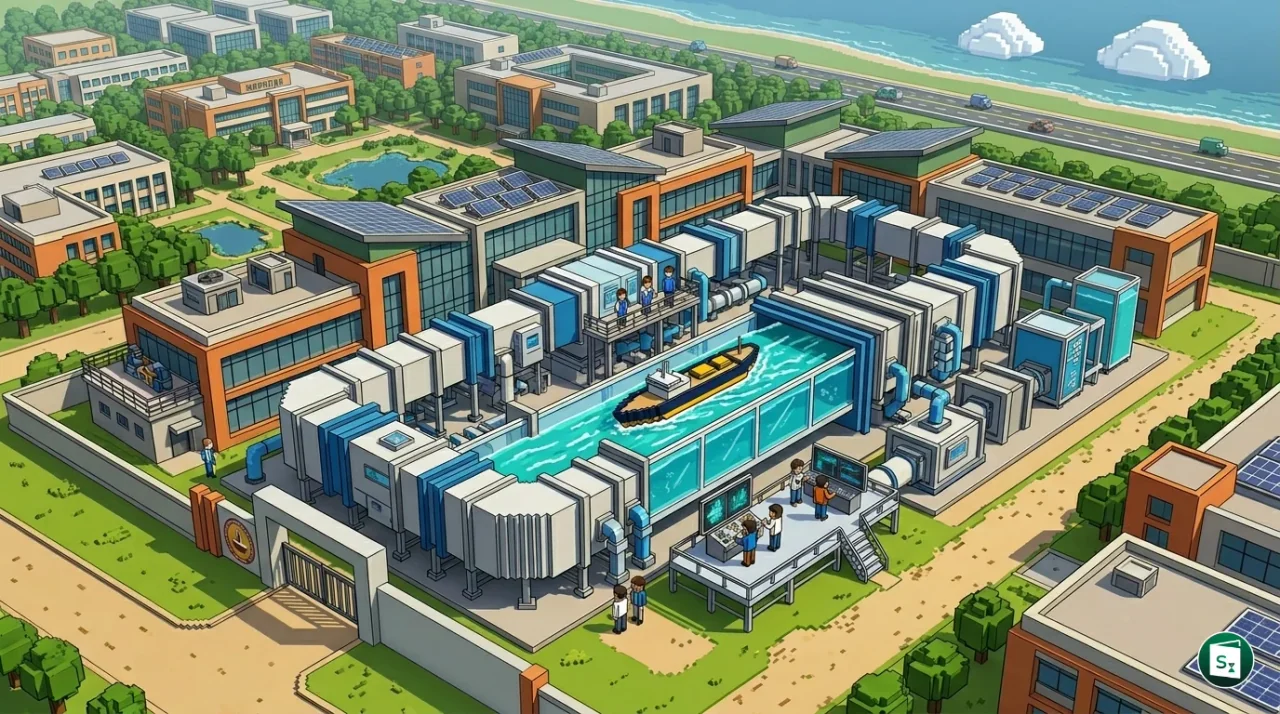
The Indian Institute of Technology Madras (IIT Madras) has inaugurated a state-of-the-art Circulating Water Tunnel Facility at its Discovery Campus in Thaiyur, Chennai. This advanced hydrodynamic testing center, developed in collaboration with Mazagon Dock Shipbuilders Limited (MDL), aims to revolutionize indigenous ship design and ocean engineering research in India. By providing high-precision testing capabilities, the facility marks a significant step toward achieving self-reliance in the country’s maritime and defense sectors.
What is the Circulating Water Tunnel Facility?
The Circulating Water Tunnel (CWT) is a specialized experimental facility used primarily in the field of hydrodynamics. Unlike a traditional towing tank where a ship model is pulled through stationary water, a CWT operates on a different principle. In this facility, the model remains stationary while water is circulated past it at controlled and uniform speeds. This allows researchers to conduct long-duration observations and measurements of steady-state phenomena that are difficult to capture in short-duration towing runs.
The newly launched facility at IIT Madras is a hybrid system that combines both wind and circulating water channels. It features a stable, uniform-flow test section designed for high-fidelity investigations. This setup is particularly effective for studying cavitation, which is the formation of vapor bubbles on propeller blades. Controlling cavitation is essential for enhancing the speed, efficiency, and stealth of naval vessels by reducing underwater noise signatures.
Researchers at the facility utilize advanced optical measurement techniques such as Particle Image Velocimetry (PIV) and Laser Doppler Velocimetry (LDV). These tools allow for precise mapping of the wake field around the hull and propellers. Such high-fidelity data is crucial for optimizing the design of ship hulls, submarines, and autonomous underwater vehicles (AUVs), ensuring they can withstand complex oceanic conditions.
Strategic Partnership: The Role of Mazagon Dock Shipbuilders
The establishment of the Circulating Water Tunnel Facility was made possible through a strategic partnership between IIT Madras and Mazagon Dock Shipbuilders Limited (MDL). MDL provided ₹4.5 crore in Corporate Social Responsibility (CSR) funding for the project. This collaboration represents a strong synergy between a premier academic institution and one of India’s leading defense public sector undertakings.
Mazagon Dock Shipbuilders Limited, headquartered in Mumbai, Maharashtra, is often referred to as the Ship Builder to the Nation. Founded in 1934 and nationalized in 1960, it operates under the Ministry of Defence. In 2024, it was conferred with the Navratna status. MDL is renowned for building sophisticated warships and submarines for the Indian Navy, including the Kalvari-class (Scorpene) submarines and Visakhapatnam-class destroyers. This partnership allows MDL to leverage academic research to enhance the performance and stealth of future naval platforms.
Boosting India’s Indigenous Ship Design Capabilities
For decades, India relied heavily on international facilities in Europe and elsewhere for complex hydrodynamic testing of large ship models. The launch of the CWT facility at IIT Madras significantly reduces this dependence, supporting the government’s Aatmanirbhar Bharat (Self-Reliant India) vision. By providing a domestic platform for advanced research, the facility helps in:
- Reducing Costs and Timelines: Indigenous testing eliminates the need to ship models abroad and pay high fees in foreign currency.
- Enhanced Data Security: Sensitive naval designs can be tested within the country, ensuring better security for critical defense data.
- Optimization of Marine Vehicles: Engineers can rapidly iterate designs for propellers and hulls to improve fuel efficiency and speed.
- Training Future Naval Architects: The facility serves as a hands-on laboratory for students in the Department of Ocean Engineering, preparing them for leadership roles in the maritime sector.
The facility also aligns with India’s Blue Economy policy and the SAGAR (Security and Growth for All in the Region) initiative, which emphasizes sustainable development and security in the Indian Ocean region.
IIT Madras Discovery Campus: A Hub for Maritime Innovation
The Discovery Campus at Thaiyur, spread over 163 acres, was established by IIT Madras to house large-scale research facilities that could not be accommodated at its main Guindy campus. Virtually inaugurated by Prime Minister Narendra Modi in February 2021, the campus has quickly become a focal point for maritime and propulsion technology.
Apart from the Circulating Water Tunnel, the Thaiyur campus hosts the National Technology Centre for Ports, Waterways and Coasts (NTCPWC). This center operates some of the world’s most advanced marine engineering laboratories, including Asia’s largest Shallow Water Basin and a 360-degree Bridge Simulator for training ship captains. These facilities collectively position IIT Madras as a global leader in maritime research and coastal engineering.
The campus also features a Solid Propellant Combustion Modelling Facility, funded by the Defence Research and Development Organisation (DRDO). By concentrating such diverse and high-tech research centers in one location, the Discovery Campus serves as a catalyst for “Make in India” innovations across both civilian and defense sectors.
Key Takeaways
- IIT Madras has launched an advanced Circulating Water Tunnel (CWT) Facility at its Discovery Campus in Thaiyur, Chennai.
- The facility was developed with ₹4.5 crore in Corporate Social Responsibility (CSR) funding from Mazagon Dock Shipbuilders Limited (MDL).
- The CWT is a hybrid wind and water channel used for testing ship models, propellers, and underwater vehicles through stationary-model and moving-water principles.
- Mazagon Dock Shipbuilders Limited, a Navratna PSU headquartered in Mumbai, is India’s leading shipyard under the Ministry of Defence.
- The facility strengthens India’s indigenous hydrodynamic testing capabilities, supporting the Aatmanirbhar Bharat and Blue Economy initiatives.
- The Discovery Campus at Thaiyur was inaugurated in 2021 and also houses the National Technology Centre for Ports, Waterways and Coasts (NTCPWC).