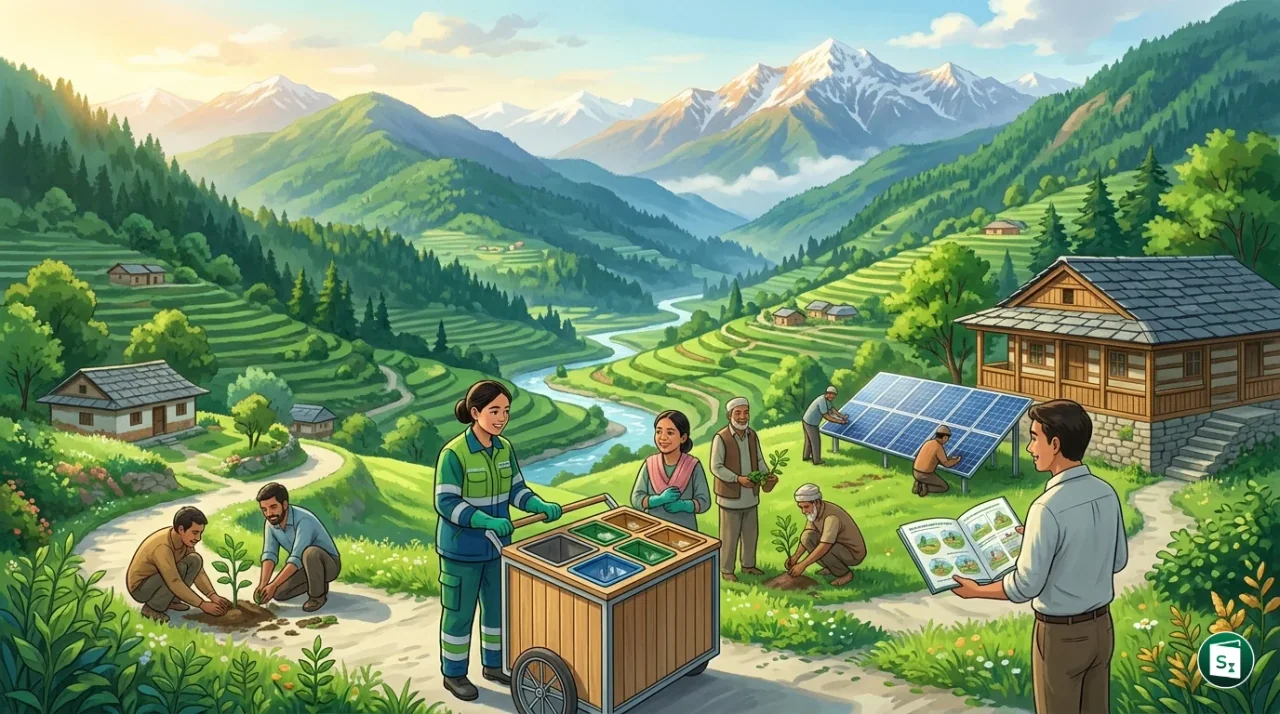
The Himachal Pradesh government signed a Memorandum of Understanding (MoU) with the United Nations Development Programme (UNDP) on June 10, 2026, to advance climate-resilient development and biodiversity conservation. Alongside this agreement, Chief Minister Thakur Sukhvinder Singh Sukhu launched the Safai Mitra Scheme to provide socio-economic empowerment and dignified working conditions for informal waste management workers. These initiatives mark a significant step toward the state’s vision of transforming into a sustainable and environmentally resilient mountain economy.
Advancing Climate Resilience: The HP-UNDP Partnership
The Memorandum of Understanding was formally signed in Shimla by Sushil Singla, Secretary of Environment, Science, Technology, and Climate Change for the Himachal Pradesh government, and Dr. Angela Lusigi, the Resident Representative of the UNDP in India. This strategic collaboration is designed to address the unique ecological challenges of the Himalayan region while promoting inclusive growth through the adoption of global best practices.
The partnership focuses on strengthening the state’s capacity to handle climate-induced disasters, such as flash floods and landslides, which have become increasingly frequent in the high-altitude terrain. By integrating international expertise with local traditional knowledge, the initiative seeks to build a robust framework for environmental sustainability and landscape restoration.
Key Focus Areas of the MoU
The agreement outlines several critical pillars of collaboration that will guide the state’s environmental policy over the coming years:
- Circular Economy and Waste Management: Implementing scientific protocols for waste segregation and recycling to minimize the environmental footprint of urban and rural areas.
- Biodiversity Conservation: Restoring degraded landscapes and protecting critical biodiversity corridors to ensure the survival of native species and healthy ecosystems.
- Electric Mobility: Promoting the use of electric vehicles for public services, particularly in waste collection, to reduce carbon emissions in the fragile mountain atmosphere.
- Nature-Based Solutions: Utilizing natural ecosystems to mitigate the impact of climate change and enhance the resilience of local communities.
- Green Livelihoods: Creating employment opportunities in sectors like eco-tourism and sustainable agriculture that contribute to conservation goals.
Empowering Frontline Warriors: The Safai Mitra Scheme
The launch of the Safai Mitra Scheme by Chief Minister Sukhvinder Singh Sukhu represents a core social component of the state’s environmental strategy. The scheme is dedicated to the socio-economic empowerment of informal waste pickers and sanitation workers, who are often the most marginalized stakeholders in the waste management value chain. By recognizing them as “Safai Mitras,” the government aims to integrate them into the formal economy, ensuring they receive the dignity and protection they deserve.
Key features of the Safai Mitra Scheme include the provision of specialized safety equipment and regular health check-ups to mitigate the occupational hazards associated with handling waste. The initiative also focuses on providing social security through insurance coverage and access to government welfare programs. By formalizing their roles, the state not only improves the lives of thousands of workers but also enhances the overall efficiency of its waste management systems.
The Chief Minister emphasized that Safai Mitras are the frontline warriors in protecting the state’s pristine environment. Their integration into the planning and execution of municipal waste projects ensures that environmental policies are grounded in social justice and inclusivity. This model of “green employment” is expected to set a precedent for other Himalayan states struggling with the dual challenges of waste accumulation and social inequality.
Strategic Vision: Himachal Pradesh as a Green State
The collaboration with the UNDP is part of a broader ambitious agenda to make Himachal Pradesh a global model for sustainable mountain development. The state has set a goal to increase its forest cover from the current 29.5% to 32% by 2030 through flagship programs like the Rajiv Gandhi Green Adoption Yojana and the Mukhyamantri Van Vistaar Yojana. These initiatives focus on landscape restoration and the transformation of barren hills into green belts.
Furthermore, the state is aggressively pursuing a transition to become a “Green Energy State.” This involves scaling up solar and hydroelectric power generation while reducing dependence on fossil fuels. The UNDP partnership will specifically support the SECURE Himalaya project, which focuses on conserving high-altitude ecosystems and protecting endangered species like the Snow Leopard and the Western Tragopan (the state bird of Himachal Pradesh).
By leveraging international climate finance and technical support, the state aims to achieve its Sustainable Development Goals (SDGs) well ahead of national timelines. The focus on a circular economy, coupled with social welfare schemes like Safai Mitra, ensures that the state’s transition to a green economy is both ecologically sound and socially equitable.
Static GK: UNDP and Himachal Pradesh
Understanding the institutional background of this partnership provides essential context for the state’s development trajectory.
| Aspect | Details |
|---|---|
| UNDP Establishment | Formed in 1965 by the merger of the Expanded Programme of Technical Assistance and the Special Fund. |
| UNDP Headquarters | New York City, United States (India office is in New Delhi). |
| UNDP Resident Representative | Dr. Angela Lusigi (India). |
| Himachal Pradesh Chief Minister | Sukhvinder Singh Sukhu. |
| Himachal Pradesh Governor | Shiv Pratap Shukla. |
| State Capitals | Shimla (Summer) and Dharamshala (Winter). |
| State Biodiversity | Snow Leopard (State Animal) and Western Tragopan (State Bird). |
| Forest Cover Goal | Target to reach 32% by 2030 under Mission 32%. |
The United Nations Development Programme (UNDP) has been a partner to India since 1951, supporting various initiatives in poverty reduction, democratic governance, and environmental sustainability. In Himachal Pradesh, the UNDP’s role has evolved from basic disaster management support to complex climate-resilience projects like the SECURE Himalaya initiative. This project is a global effort to protect high-altitude biodiversity while ensuring sustainable livelihoods for local communities across the Himalayan belt.
Key Takeaways
- Himachal Pradesh signed a Memorandum of Understanding with the UNDP on June 10, 2026, focusing on climate-resilient development and biodiversity conservation.
- Chief Minister Sukhvinder Singh Sukhu launched the Safai Mitra Scheme to empower informal waste management workers through social security and safety measures.
- The state has set an ambitious target to increase its total forest cover to 32% by 2030 as part of its Mission 32% strategy.
- The SECURE Himalaya project remains a central pillar of the partnership, aimed at protecting high-altitude ecosystems and the Snow Leopard.
- The UNDP, which is headquartered in New York, has been operating in India since 1951 and was globally established in 1965.
- Dr. Angela Lusigi serves as the Resident Representative of the UNDP in India and was a key signatory to the new agreement.