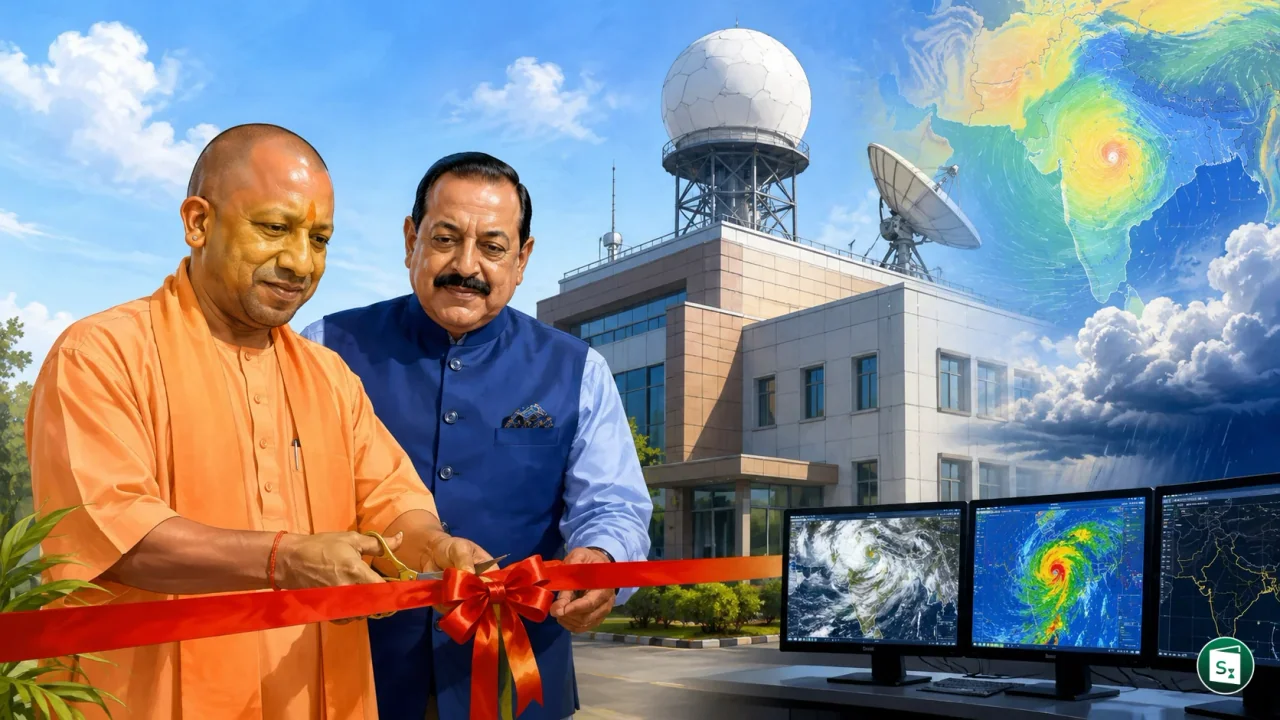
Uttar Pradesh Chief Minister Yogi Adityanath and Union Minister of State for Science and Technology Dr. Jitendra Singh inaugurated the 8th Regional Meteorological Centre (RMC) in Lucknow on June 10, 2026. This new facility upgrades the existing state-level centre into a major regional hub, significantly boosting India’s capability for hyper-local and high-resolution weather forecasting. The establishment of this centre marks a strategic expansion of the India Meteorological Department (IMD) network to better serve the populous Indo-Gangetic plains.
Upgrading Lucknow to a Regional Hub
The transition of the Lucknow Meteorological Centre into a Regional Meteorological Centre represents a significant shift in operational autonomy and technical capability. Previously, the Lucknow centre functioned as a state-level unit under the jurisdiction of RMC New Delhi. As an independent RMC, it now holds the authority to coordinate weather services across Uttar Pradesh and Uttarakhand, effectively decentralizing the monitoring of one of India’s most meteorologically sensitive regions.
This upgrade is part of a broader national initiative to modernize weather services. The centre is now equipped with advanced high-resolution numerical weather prediction models. These models allow for hyper-local forecasting, which can predict weather patterns at the level of specific towns or city blocks. Such precision is essential for urban planning and for issuing nowcasts, which are short-range forecasts that warn of localized events like sudden thunderstorms or cloudbursts within hours of their occurrence.
The Expanding Network of Regional Meteorological Centres
With the inauguration of the Lucknow facility, the India Meteorological Department now operates eight Regional Meteorological Centres. These centres act as regional hubs that bridge the gap between the national headquarters in New Delhi and the various state-level Meteorological Centres. The expansion reflects a growing emphasis on regional specificity in weather monitoring.
| RMC Location | Primary Region of Responsibility |
|---|---|
| New Delhi | North India (Delhi, Haryana, Punjab) |
| Mumbai | West India (Maharashtra, Gujarat, Goa) |
| Chennai | South India (Tamil Nadu, Karnataka, Kerala, AP) |
| Kolkata | East India (West Bengal, Odisha, Bihar, Jharkhand) |
| Guwahati | North-East India (Seven Sister States) |
| Nagpur | Central India (Madhya Pradesh, Chhattisgarh) |
| Jammu | North-Western Himalayas (J&K, Ladakh, Himachal Pradesh) |
| Lucknow | Central Indo-Gangetic Plains (UP, Uttarakhand) |
The addition of RMC Jammu (the 7th RMC) and RMC Lucknow (the 8th RMC) in June 2026 highlights the government’s focus on addressing the unique climatic challenges of the Himalayan foothills and the northern plains.
Mission Mausam and Technological Integration
The upgradation of RMC Lucknow is a key component of the Union Government’s flagship “Mission Mausam”. This initiative aims to make India a global leader in weather services through the deployment of cutting-edge technology. Under this mission, the network of Doppler Weather Radars (DWR) is being rapidly expanded across Uttar Pradesh. While the state had only one radar in 2014, it now has three operational units, with six more currently being commissioned in districts like Varanasi, Jhansi, and Aligarh.
Beyond radars, the RMC integrates data from Automatic Weather Stations (AWS) and lightning sensors. Uttar Pradesh has seen a significant increase in lightning-related casualties in recent years; hence, the deployment of seven new lightning sensors is a life-saving measure. These sensors provide real-time tracking of electrical activity in the atmosphere, allowing the centre to issue specific warnings to rural communities where the risk is highest.
Significance for Uttar Pradesh and Uttarakhand
As an agrarian powerhouse, Uttar Pradesh contributes approximately 21% of India’s food grain production. The precision of RMC Lucknow is expected to be a force multiplier for the state’s agricultural sector. By providing localized Agromet Advisory Bulletins, the centre helps farmers optimize irrigation, sowing, and harvesting schedules. The shift towards impact-based forecasting, which explains what the weather will do rather than just what it will be, is a critical advancement for protecting livelihoods.
For Uttarakhand, the centre provides essential support in monitoring mountain meteorology. The state is prone to flash floods, cloudbursts, and landslides. RMC Lucknow will coordinate with the State Disaster Management Authority (SDMA) to provide early warnings that are vital for safeguarding both residents and pilgrims visiting high-altitude shrines. Furthermore, CM Yogi Adityanath highlighted that the state government is exploring the possibility of a dedicated satellite for Uttar Pradesh in collaboration with ISRO to further refine these monitoring capabilities.
India Meteorological Department: A Legacy of 150 Years
The India Meteorological Department (IMD), established in 1875, is the primary national agency responsible for meteorological observations, weather forecasting, and seismology. Headquartered in New Delhi, it functions under the Ministry of Earth Sciences (MoES). The department is led by the Director General of Meteorology and plays a pivotal role in ensuring the safety of lives and property through timely weather warnings.
As IMD completes 150 years of its journey, the addition of the Lucknow and Jammu RMCs signifies its evolution from a centralized agency into a decentralized, technology-driven network. The IMD is also one of the six Regional Specialized Meteorological Centres of the World Meteorological Organization (WMO), showcasing its international standing in the field of global weather monitoring.
Key Takeaways
- Lucknow was officially inaugurated as India’s 8th Regional Meteorological Centre (RMC) on June 10, 2026.
- The centre was jointly inaugurated by Uttar Pradesh CM Yogi Adityanath and Union Minister Dr. Jitendra Singh.
- India now operates eight RMCs located in Mumbai, Chennai, New Delhi, Kolkata, Nagpur, Guwahati, Jammu, and Lucknow.
- The Lucknow RMC will provide localized and high-resolution weather services for Uttar Pradesh and Uttarakhand.
- This expansion is part of the “Mission Mausam” initiative, which aims to modernize India’s weather infrastructure including Doppler Weather Radars.
- The India Meteorological Department (IMD) was established in 1875 and functions under the Ministry of Earth Sciences (MoES).