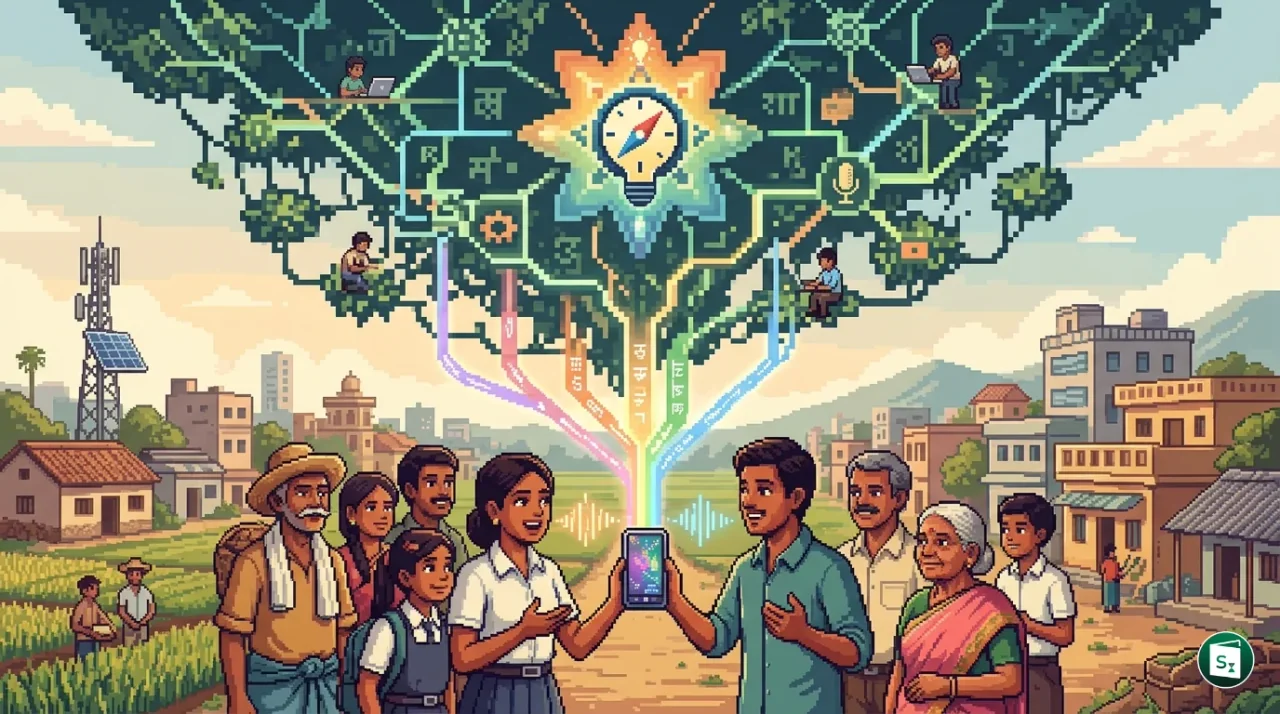
The Digital India BHASHINI Division launched the VYOMA Innovation Challenge on June 10, 2026, to accelerate the development of multilingual and voice-first Artificial Intelligence solutions. This initiative, organized in collaboration with Current AI and Kalpa Impact, focuses on creating AI systems that function effectively in offline and low-connectivity environments. The challenge aims to democratize access to technology for millions of Indians by utilizing the open-source Sunno Sutra handheld device.
What is the VYOMA Innovation Challenge?
The VYOMA Innovation Challenge is a strategic government initiative designed to foster a robust ecosystem of human-centric AI applications in India. It invites participation from startups, individual researchers, and academic teams to build innovative software solutions on top of the Sunno Sutra platform. The primary objective is to ensure that cutting-edge AI services reach citizens in the remotest parts of the country where internet access is often unreliable.
The challenge is structured to provide significant support to participants. From the initial applications, 20 teams will be shortlisted to receive specialized Developer Kits and technical mentorship from experts at BHASHINI and Current AI. These teams will compete for prizes totaling ₹80 lakh, with additional opportunities to pilot their successful solutions within various central and state government departments. The focus areas for development include critical sectors such as Education, Healthcare, Agriculture, and Governance, ensuring the solutions have a direct social impact.
The Sunno Sutra: A New Frontier in Voice-First AI
At the heart of the VYOMA Challenge is the Sunno Sutra, a pioneering handheld AI reference device. Jointly developed by BHASHINI and Current AI, this device was first unveiled at the IndiaAI Impact Summit 2026. Unlike traditional AI tools that require a constant internet connection to communicate with remote servers, the Sunno Sutra is designed for offline local inference. This means the AI models run directly on the device’s hardware, ensuring faster response times and greater data privacy for users.
Technical Capabilities and Offline Inference
The Sunno Sutra platform is entirely open-source, allowing developers to customize and remix both its hardware and software components. It is powered by high-performance compute modules that enable complex multimodal Large Language Model (LLM) tasks in a compact form factor.
| Feature | Specification |
|---|---|
| Compute Module | NVIDIA Jetson Orin Nano 8GB |
| Performance | Up to 67 TOPS (INT8) |
| Processor | 6-Core ARM Cortex-A78AE CPU |
| I/O Controller | Raspberry Pi RP2350 (Dual Core ARM Cortex-M33) |
| Display | 2.8 inch TFT Capacitive Touchscreen |
| Software | Embedded Linux with Python Hardware Abstraction Layer |
The device features specialized controls including a trigger button for voice interaction and navigation buttons with customizable backlighting. By enabling edge AI, the Sunno Sutra provides a reference architecture for the next generation of portable, multilingual assistants that can serve India’s diverse linguistic landscape without internet dependency.
Strategic Partnerships: Current AI and Kalpa Impact
The launch of the VYOMA Challenge is supported by a collaborative network of technology and social impact organizations. Current AI provides the foundational hardware and software expertise required for the Sunno Sutra device, advocating for “hackable” and adaptable AI infrastructure. Meanwhile, Kalpa Impact, led by CEO Sushant Kumar, contributes a vision of AI for public good.
Kalpa Impact focuses on democratizing AI by promoting smaller, purpose-built models that are affordable and respect user privacy. This partnership ensures that the challenge is not just about technical innovation but also about creating meaningful social change. By prioritizing privacy-by-design and local community needs, the initiative aims to build trust in AI technologies among the “last mile” citizens of the Global South.
The Bhashini Mission: Bridging the Digital Language Divide
The Bhasha Interface for India (BHASHINI) mission is India’s flagship AI-powered language technology initiative. Operating under the National Language Translation Mission (NLTM), BHASHINI is an independent division within the Digital India Corporation (DIC) under the Ministry of Electronics and Information Technology (MeitY). By 2026, the mission has scaled significantly, supporting 36 text languages and 23 voice languages, including several tribal dialects.
BHASHINI’s primary goal is to ensure that the internet and digital governance services are accessible to all Indians in their own mother tongues. The mission leverages its AI Sovereign Cloud to process over 15 million daily inferences, powering more than 800 government websites and applications such as DigiLocker and UMANG. Through crowdsourcing initiatives like Bhasha Daan, citizens contribute voice and text data to train and improve the accuracy of these AI models, making technology truly inclusive.
Key Takeaways
- The VYOMA Innovation Challenge was launched by the Digital India BHASHINI Division to develop open-source, voice-first AI solutions for offline use.
- The challenge is built around the Sunno Sutra, a handheld AI reference device powered by the NVIDIA Jetson Orin Nano platform.
- Total prize money for the challenge is ₹80 lakh, and 20 teams will be shortlisted to receive specialized developer kits and technical mentorship.
- BHASHINI operates under the National Language Translation Mission (NLTM) within the Ministry of Electronics and Information Technology (MeitY).
- Key partners for the initiative include Current AI, which focuses on open-source hardware, and Kalpa Impact, which specializes in AI for social good.
- The BHASHINI mission currently supports 36 text languages and 23 voice languages, enabling digital inclusion for millions of non-English speaking citizens.