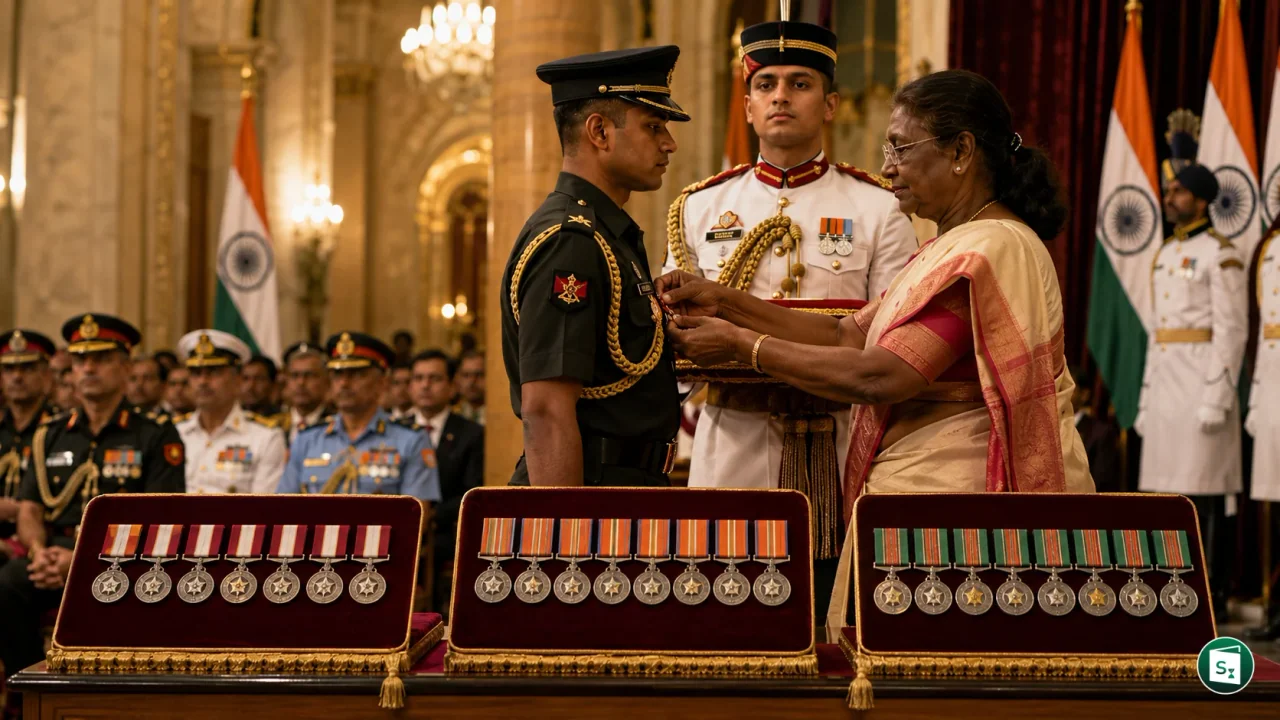
President Droupadi Murmu conferred 51 gallantry awards upon personnel from the Armed Forces and Central Armed Police Forces during Phase-I of the Defence Investiture Ceremony 2026 at Rashtrapati Bhawan on June 8, 2026. The ceremony honored acts of exceptional bravery with 7 Kirti Chakras, 15 Vir Chakras, and 29 Shaurya Chakras, including several posthumous recognitions. These awards highlight the supreme sacrifice and tactical brilliance displayed by India’s defenders across various operations, including the strategic Operation Sindoor.
Highlights of the Phase-I Defence Investiture Ceremony 2026
The ceremony, held at the historic Durbar Hall of Rashtrapati Bhawan, was attended by a galaxy of dignitaries, including Vice President C.P. Radhakrishnan, Prime Minister Narendra Modi, and Union Defence Minister Rajnath Singh. This Phase-I event is part of the annual investiture series where the President, as the Supreme Commander of the Armed Forces, recognizes the gallantry and distinguished service of the personnel. Out of the 51 awards presented, a significant number were conferred posthumously, underscoring the high stakes and bravery involved in modern security challenges.
The awards recognize operations conducted across diverse terrains, from the high-altitude regions of Jammu and Kashmir to the innovative frontiers of space exploration. The ceremony also marked the transition to a two-phase investiture process, with Phase-II scheduled to focus on the Ashok Chakra and other distinguished service medals. This structured approach allows for a more detailed celebration of each hero’s contribution to national security and prestige.
Summary of Gallantry Awards Presented (Phase-I)
| Award Category | Total Recipients | Posthumous Awards |
|---|---|---|
| Kirti Chakra | 7 | 2 |
| Vir Chakra | 15 | 3 |
| Shaurya Chakra | 29 | 1 |
| Total | 51 | 6 |
The Kirti Chakra: Recognizing Peacetime Bravery and Space Pioneers
The Kirti Chakra is India’s second-highest peacetime gallantry award, conferred for conspicuous gallantry otherwise than in the face of the enemy. In this ceremony, 7 personnel were honored, including two posthumous awards to Lieutenant Shashank Tiwari and Sepoy Janjal Pravin Prabhakar. These officers displayed selfless courage in counter-insurgency and high-risk security operations, maintaining the highest traditions of the Indian Army.
A notable recipient in this category was Air Commodore Prasanth Balakrishnan Nair, a seasoned pilot of the Indian Air Force and one of the primary astronauts selected for India’s ambitious Gaganyaan mission. His recognition reflects the expanding definition of bravery, encompassing the extreme risks and technical excellence required in space exploration. Other recipients included Major Arshdeep Singh (Assam Rifles), Naib Subedar Doleshwar Subba (2 Para SF), Lance Naik Meenatchi Sundaram A (Rashtriya Rifles), and Captain Lalrinawma Sailo (4 Para SF), each cited for their role in eliminating high-value targets and neutralizing threats to national stability.
Operation Sindoor and the Valor of Vir Chakra Awardees
The Vir Chakra is typically a wartime gallantry award, but its inclusion in the 2026 investiture highlights the intensity of recent cross-border operations. A total of 15 Vir Chakras were conferred, many related to Operation Sindoor, a major military response launched in May 2025 following security breaches in the Pahalgam region. The operation targeted terrorist infrastructure and hostile positions along the International Border and Line of Control, requiring a high degree of synergy between the Army and the Border Security Force (BSF).
Among the 15 recipients, three were honored posthumously: Rifleman Sunil Kumar, Sub Inspector Mohd Imteyaj, and Constable Deepak Chingakham. The latter two, hailing from the BSF, demonstrated superhuman courage at the Kharkola Border Outpost in the Jammu sector. During an intense night of shelling and drone attacks, SI Imteyaj and Constable Chingakham engaged enemy drones and mortar positions even after sustaining grievous injuries. Their citations record a refusal to be evacuated, choosing instead to lead their men and neutralize the threat until their final breath. Other notable awardees included Colonel Koshank Lamba, who led tactical strikes during the same operation.
Shaurya Chakra: Honoring Extraordinary Courage and Naval Feats
The Shaurya Chakra, awarded for valor, courageous action, or self-sacrifice while not engaged in direct action with the enemy, was conferred upon 29 personnel. A poignant moment during the ceremony was the posthumous award to Lance Dafadar (L/DFR) Baldev Chand, who made the ultimate sacrifice during a counter-terrorism operation in a high-altitude zone. His award was received by his family, representing the enduring legacy of courage passed down through generations of Indian soldiers.
This category also featured significant representation from the Indian Navy, reflecting India’s maritime security ambitions. Lieutenant Commander Dilna K. and Lieutenant Commander Roopa A. were among the recipients, honored for their extraordinary skill and bravery during the Navika Sagar Parikrama II. This mission involved the circumnavigation of the globe by a multi-member crew on a sailing vessel, navigating treacherous weather and uncharted waters. Their inclusion in the gallantry list emphasizes the diverse domains, including land, air, sea, and space, where Indian personnel are proving their mettle. The remaining awardees, including Major Ashish Kumar, were recognized for their decisive actions in neutralizing insurgent networks and ensuring the safety of civilian populations.
Understanding India’s Gallantry Awards System
India’s gallantry awards are categorized into two main groups based on the nature of the operation. The first group includes Wartime Gallantry Awards, consisting of the Param Vir Chakra (highest), Maha Vir Chakra, and Vir Chakra. These are typically awarded for acts of bravery in the presence of the enemy. The second group comprises Peacetime Gallantry Awards, which include the Ashok Chakra (highest), Kirti Chakra, and Shaurya Chakra. While peacetime awards are often conferred for counter-insurgency and anti-terrorist operations, wartime awards like the Vir Chakra are reserved for active conflict scenarios, such as those witnessed during Operation Sindoor.
The awards are announced twice a year, specifically on the occasion of Republic Day and Independence Day. The final list is curated by the Gallantry Awards Committee, which operates under the Ministry of Defence. The President of India, who is the ceremonial head of the state and the Supreme Commander of the Armed Forces, confers these medals during the Defence Investiture Ceremony held at Rashtrapati Bhawan. This ceremony is not just a formal event but a profound national recognition of the “bravest of the brave,” serving to inspire future generations and maintain the morale of the country’s security forces.
Key Takeaways
- President Droupadi Murmu presented 51 gallantry awards, including Kirti, Vir, and Shaurya Chakras, during Phase-I of the Defence Investiture Ceremony 2026.
- The Kirti Chakra (India’s second-highest peacetime award) was conferred on 7 personnel, including Air Commodore Prasanth Balakrishnan Nair of the Gaganyaan mission.
- 15 Vir Chakras were awarded, many recognizing bravery during Operation Sindoor, a 2025 military response in the Jammu and Kashmir region.
- Two BSF personnel, SI Mohd Imteyaj and Constable Deepak Chingakham, received the Vir Chakra posthumously for their defense of the Kharkola BOP.
- The Shaurya Chakra was awarded to 29 individuals, including naval officers Lt Cdr Dilna K. and Lt Cdr Roopa A. for the Navika Sagar Parikrama II.
- Gallantry awards are administered by the Ministry of Defence and are traditionally announced on Republic Day and Independence Day.