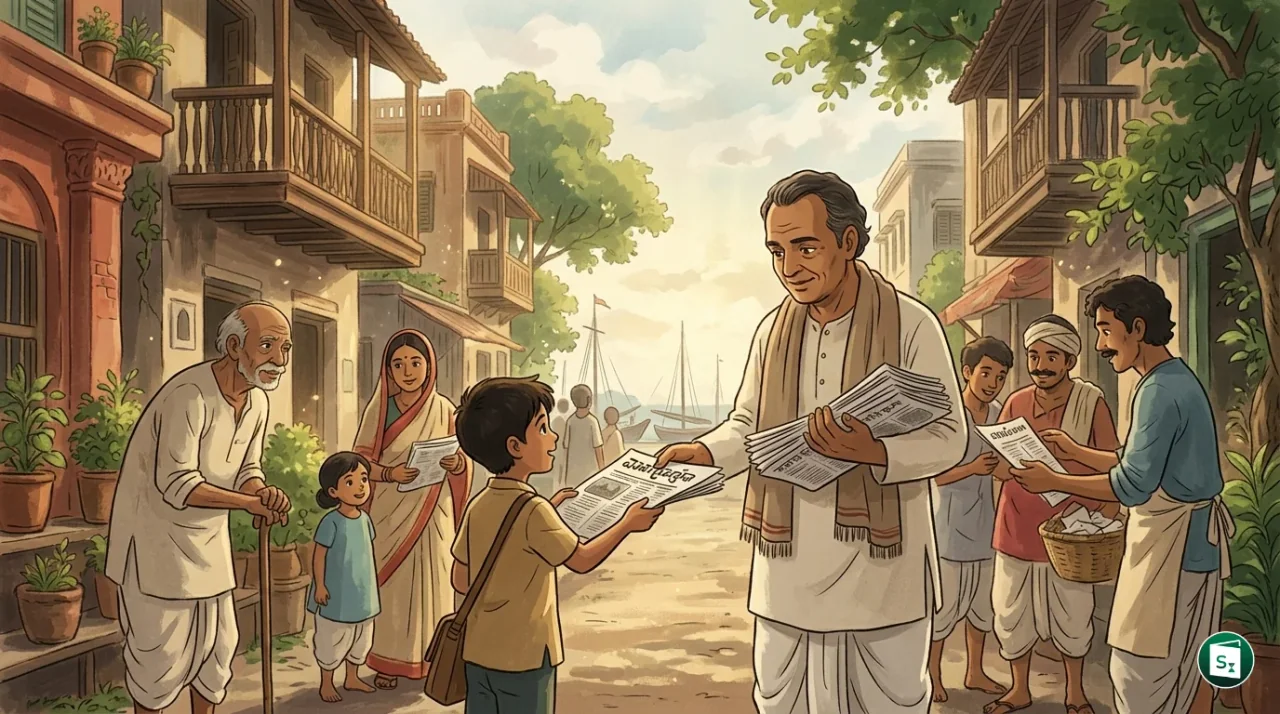
India celebrated Hindi Journalism Day, known as Hindi Patrakarita Diwas, on May 30, 2026, marking the 200th anniversary of the birth of the Hindi press. This significant day commemorates the launch of Udant Martand, the first-ever Hindi newspaper, which began its journey in 1826 from Kolkata. The observance honours the pioneers who used the power of the written word to ignite the spirit of nationalism and social reform across the country.
The Legacy of Udant Martand: India’s First Hindi Weekly
The first issue of Udant Martand (The Rising Sun) was published on May 30, 1826, at a time when Kolkata was the administrative and cultural hub of British India. Although several newspapers existed in English, Bengali, and Persian, there was no publication catering to the vast Hindi-speaking population. Udant Martand was a weekly journal printed in the Devanagari script every Tuesday. It used a unique blend of Khari Boli and Braj Bhasha, which the editor described as “Madhyadeshiya Bhasha.”
Despite its historic significance, the newspaper faced immense challenges. The British government refused to grant it postal concessions, making it expensive to reach readers in the northern parts of India. Faced with rising costs and a limited subscriber base of around 500 copies, the publication ceased operations on December 4, 1827, after publishing only 79 issues. However, its brief existence proved that a Hindi-speaking public sphere was not only possible but necessary.
Pandit Jugal Kishore Shukla: The Visionary Behind the Rising Sun
Pandit Jugal Kishore Shukla is revered as the father of Hindi journalism. Originally from Kanpur, he moved to Kolkata to work as a pleader at the Sadr Diwani Adalat (Civil Court). Driven by a desire to educate the Hindi-speaking masses and bridge the information gap, he used his own resources to launch Udant Martand. He believed that the people of North and Central India needed a medium to understand the social and political developments of their time.
Shukla’s commitment was evident in his persistent petitions to the colonial government for lower postage rates to reach readers in the “Hindi belt.” Even when his requests were repeatedly ignored and he faced financial ruin, he did not waver in his mission. His pioneering spirit paved the way for future legends of Hindi journalism and established the press as a vital instrument for social advocacy and national awakening.
Hindi Journalism’s Crucial Role in India’s Freedom Movement
Following the path cleared by Udant Martand, Hindi journalism became a formidable force in India’s struggle for independence. Leaders and thinkers realized that Hindi was the most effective language for reaching the rural masses and building a unified national identity. Bharatendu Harishchandra, often called the father of modern Hindi, used journals like Kavi Vachan Sudha to critique colonial economic policies.
Later, editors like Mahavir Prasad Dwivedi used the monthly journal Saraswati to standardize Hindi grammar and prose, providing a shared linguistic platform for the nation. During the height of the freedom movement, fearless journalists like Ganesh Shankar Vidyarthi published Pratap from Kanpur, which became a voice for peasants and workers. Other significant publications like Aaj, founded by Shiv Prasad Gupta, and Karmaveer, edited by Makhanlal Chaturvedi, were instrumental in mobilizing public opinion against British rule. The Hindi press not only reported on the movement but also served as its intellectual and emotional backbone.
Standardisation and Growth: The Evolution of Modern Hindi Media
The growth of the Hindi press continued with the launch of Samachar Sudha Varshan in 1854, which was the first Hindi daily newspaper, edited by Shyam Sundar Sen. Over the decades, Hindi journalism transitioned from a tool of resistance to a mainstream medium of information and entertainment. Post-independence, the Hindi press played a key role in democratic deepening, bringing governance and policy debates to the doorsteps of millions.
Today, Hindi newspapers like Dainik Jagran and Dainik Bhaskar consistently rank among the most read publications globally. The digital revolution has further expanded the reach of Hindi journalism, with online portals and social media ensuring that news in Hindi is accessible to the global diaspora. Despite the proliferation of diverse media formats, the core values of fearless reporting and social responsibility established by Pandit Jugal Kishore Shukla continue to guide the Hindi press in the 21st century.
Milestones in Early Hindi Journalism
| Newspaper | Year | Editor/Founder | Significance |
|---|---|---|---|
| Udant Martand | 1826 | Pandit Jugal Kishore Shukla | First Hindi weekly newspaper |
| Banaras Akhbar | 1845 | Raja Shiv Prasad Singh | First Hindi paper from the Hindi heartland |
| Samachar Sudha Varshan | 1854 | Shyam Sundar Sen | First Hindi daily newspaper |
| Kavi Vachan Sudha | 1867 | Bharatendu Harishchandra | Pioneered modern Hindi literary journalism |
| Saraswati | 1900 | Mahavir Prasad Dwivedi | Standardised modern Hindi prose |
| Pratap | 1913 | Ganesh Shankar Vidyarthi | Fearless voice during the freedom struggle |
Key Takeaways
- Hindi Journalism Day is observed annually on May 30 to commemorate the launch of the first Hindi newspaper, Udant Martand.
- The year 2026 marks the bicentenary or the 200th anniversary of the founding of the Hindi press in India.
- Pandit Jugal Kishore Shukla launched Udant Martand from Kolkata on May 30, 1826, as a weekly journal to serve the Hindi-speaking population.
- The newspaper’s name translates to “The Rising Sun” and it was printed entirely in the Devanagari script.
- Samachar Sudha Varshan, edited by Shyam Sundar Sen in 1854, was India’s first Hindi daily newspaper.
- Key journals like Saraswati, Pratap, and Aaj were instrumental in standardising the Hindi language and supporting the Indian freedom movement.