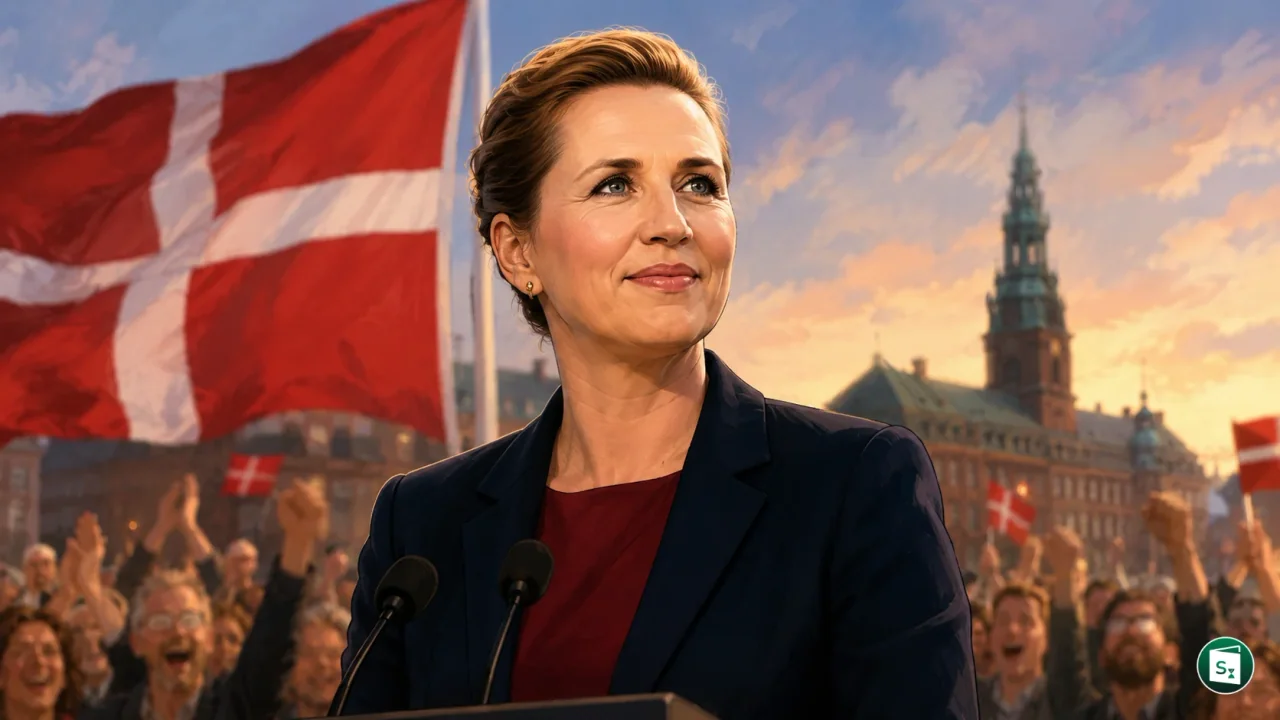
Mette Frederiksen, the leader of the Social Democrats, has secured a historic third consecutive term as the Prime Minister of Denmark following the 2026 general elections. Her victory reinforces her position as one of Europe’s most enduring leaders and the youngest individual ever to hold the highest office in Denmark. This new term is expected to focus on welfare expansion, environmental sustainability, and the deepening of Denmark’s strategic global partnerships.
A Historic Third Term for Mette Frederiksen
Prime Minister Mette Frederiksen officially commenced her third consecutive term in June 2026, following a fragmented general election held on March 24, 2026. Despite the Social Democrats recording their lowest vote share in over a century, the party remained the largest in the Folketing, Denmark’s unicameral parliament. After two months of intensive negotiations, Frederiksen successfully formed a left-leaning minority coalition consisting of four parties: the Social Democrats, the Socialist People’s Party (SF), the Social Liberal Party, and the centrist Moderates.
This new government, formally presented to King Frederik X, holds 82 of the 179 seats in the parliament. To pass legislation, the coalition will rely on the support of other left-wing and green parties, a common practice in Denmark’s “negative parliamentarism” model where a government only needs to avoid a majority against it. The Frederiksen III Cabinet has pledged a robust social agenda, including measures to halve VAT on food, provide free public transport for youth under 22, and implement a long-term plan for free dental care.
Breaking Barriers: Legacy of Female Leadership in Denmark
Mette Frederiksen’s tenure is marked by several historic milestones. She is only the second woman to serve as the Prime Minister of Denmark, following in the footsteps of Helle Thorning-Schmidt, who held the office from 2011 to 2015. However, Frederiksen carved her own unique path by becoming the youngest person in Danish history to be appointed Prime Minister, taking office for the first time in 2019 at the age of 41.
Known popularly as the “Children’s Prime Minister,” Frederiksen has consistently prioritized child welfare and the rights of vulnerable youth in her political agenda. Her rise to leadership was steady; she was first elected to the Folketing in 2001 at the age of 24. Before assuming the top post, she served as the Minister of Employment and later as the Minister of Justice. Her leadership has also seen a significant shift in the Social Democrats’ stance on immigration, a move that is widely credited with broadening the party’s appeal across the country.
India-Denmark Green Strategic Partnership
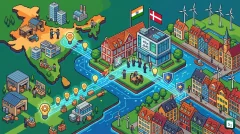
Denmark holds a unique position in India’s foreign policy as the first and only country with which India has established a Green Strategic Partnership (GSP). Launched in September 2020 during a virtual summit between Prime Minister Narendra Modi and Mette Frederiksen, this partnership focuses on sustainable development and climate action. It serves as a framework for cooperation in critical sectors such as Green Hydrogen, offshore wind energy, water management, and the circular economy.
In May 2026, the bond between the two nations was further strengthened during the 3rd India-Nordic Summit held in Oslo, Norway. During the summit, the two leaders reviewed the progress of the GSP and identified new frontiers for collaboration, including Artificial Intelligence (AI), Semiconductors, and Space technology. Additionally, the success of the Smart Laboratory on Clean Rivers (SLCR), a joint initiative involving IIT-BHU, was highlighted as a model for river rejuvenation. Denmark’s ongoing role as a non-permanent member of the UN Security Council (2025 to 2026) also provides a platform for both nations to collaborate on global security and sustainability issues.
Overview of Denmark’s Political Framework
Denmark is a constitutional monarchy and a parliamentary democracy with a political system characterized by consensus-seeking. The current monarch is King Frederik X, who ascended the throne on January 14, 2024, following the abdication of his mother, Queen Margrethe II. While the monarch is the formal Head of State, their role is primarily ceremonial and non-political. The executive power is exercised through the government, led by the Prime Minister.
The Danish parliament, known as the Folketing, is a unicameral chamber consisting of 179 members. Out of these, 175 members represent Denmark proper, while two seats each are reserved for the autonomous territories of Greenland and the Faroe Islands. Elections are held at least once every four years under a system of proportional representation. One of the defining features of Danish politics is “negative parliamentarism,” which means a government does not necessarily need a majority to support it, but it must not have a majority against it. This principle often leads to the formation of minority coalition governments, a hallmark of Danish governance.
Key Takeaways
- Mette Frederiksen secured her third consecutive term as the Prime Minister of Denmark in June 2026, leading a left-leaning minority coalition.
- She is the second female Prime Minister in Denmark’s history and remains the youngest individual to hold the office, having first been appointed at the age of 41 in 2019.
- The Social Democrats, the party led by Frederiksen, was founded in 1871 and remains the largest political force in the Danish parliament.
- India and Denmark established a unique Green Strategic Partnership in September 2020, the first of its kind for both nations, focusing on climate and renewable energy.
- The Danish parliament, known as the Folketing, is a unicameral body with 179 members, including representatives from the autonomous territories of Greenland and the Faroe Islands.
- King Frederik X ascended the throne on January 14, 2024, serving as the formal Head of State of the Kingdom of Denmark.