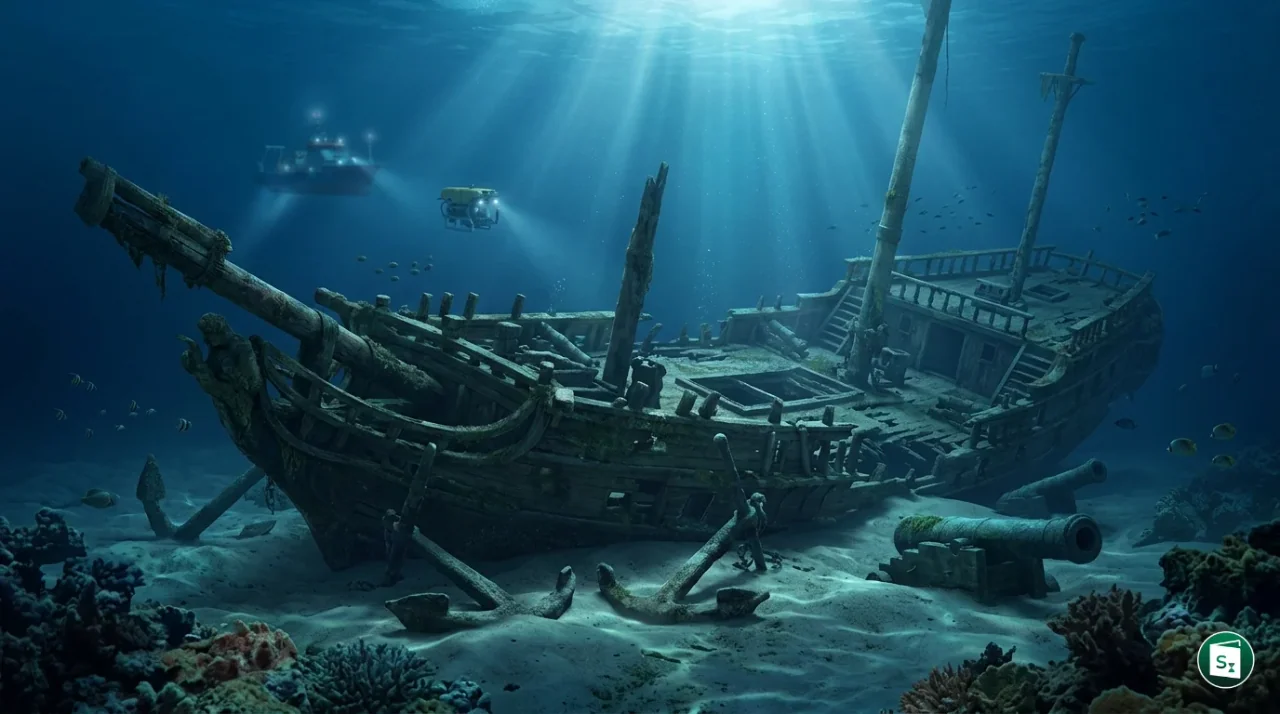
The Archaeological Survey of India (ASI) recently signed a Memorandum of Understanding (MoU) with the National Museum of Denmark to initiate a collaborative underwater archaeological project. This partnership aims to locate and document the remains of the Oresund, the first Danish vessel to reach Indian shores in 1619. The project marks a significant milestone as the first-ever international field collaboration for ASI’s dedicated Underwater Archaeology Wing.
The Indo-Danish Underwater Archaeological Project
The agreement was signed between the Archaeological Survey of India (ASI) and the Njord - Center for Maritime and Underwater Cultural Heritage, which is part of the National Museum of Denmark in Copenhagen. This joint venture focuses on the search for the shipwreck of the Oresund, believed to be located off the coast of Karaikal in the Union Territory of Puducherry.
Experts from both nations will employ advanced, non-invasive archaeological survey techniques to identify the vessel’s remains. These scientific methods include the use of remote sensing and sonar technology, ensuring that the seabed and the cultural heritage remain undisturbed during the exploration phase. This collaboration is part of a broader commitment to protect and study shared maritime legacies through global scientific cooperation.
History of the ‘Oresund’: The First Danish Link to India
The Oresund (or Øresund) was a small vessel, often described as a yacht, dispatched as a scout for the first Danish East India Company expedition. Commanded by Roelant Crappé, the ship departed from Copenhagen in August 1618, several months ahead of the main fleet led by Admiral Ove Gjedde.
The ship reached the Coromandel Coast in 1619, making it the first Danish ship known to have arrived in India. However, the mission met a tragic end when the vessel was attacked by the Portuguese near Karaikal. The resulting shipwreck occurred just a year before the Danes established their first official colonial settlement at Tranquebar (now Tharangambadi) in Tamil Nadu in 1620. The survival of Crappé and his crew led to crucial negotiations with Raghunatha Nayak, the Nayak of Tanjore, which facilitated the founding of Fort Dansborg and the Danish presence in India for the next two centuries.
ASI’s Underwater Archaeology Wing: A New Chapter
The Underwater Archaeology Wing (UAW) of the Archaeological Survey of India (ASI) was formally established in 2001 to institutionalize the study of submerged cultural heritage. This dedicated department focuses on exploring shipwrecks, submerged ports, and ancient settlements along India’s vast coastline. After being largely inactive for nearly a decade, the wing was reactivated in 2022.
The current collaboration with Denmark is a major step in the wing’s revitalization, following other recent high-profile projects such as the exploration of the submerged city of Dwarka off the Gujarat coast. This project is particularly significant as it represents the UAW’s first-ever international field partnership. By collaborating with the Njord Center, the ASI aims to enhance its technical expertise in maritime archaeology and set a precedent for future global collaborations. The UAW operates under the Ministry of Culture and is headquartered in New Delhi.
Indo-Danish Relations and Maritime Heritage
The archaeological project is situated within the larger framework of Indo-Danish relations, which have seen a steady upward trajectory in recent years. In 2020, both nations launched a Green Strategic Partnership, the first of its kind for India, focusing on green growth, energy transition, and climate action. This partnership has since expanded to include significant cooperation in cultural and academic domains.
Cultural cooperation remains a vital pillar of this partnership. The National Museum of Denmark has long-standing ties with India through the Tranquebar Initiative, which has overseen the restoration of historic structures such as the Danish Governor’s Bungalow and Fort Dansborg in Tharangambadi. The study of the Oresund wreck adds a new scientific dimension to this shared history, deepening the understanding of the early maritime interactions that shaped the colonial history of the Indian Ocean region.
Key Takeaways
- The Archaeological Survey of India (ASI) has signed an MoU with the National Museum of Denmark to locate the remains of the historic ship Oresund.
- The Oresund was the first Danish ship known to have reached India, arriving on the Coromandel Coast in 1619.
- The vessel was wrecked off the coast of Karaikal in Puducherry after an encounter with the Portuguese.
- This project is the first international field collaboration for the ASI’s Underwater Archaeology Wing (UAW), which was established in 2001.
- The exploration will use non-invasive techniques such as remote sensing and sonar technology to document the underwater site.
- The collaboration follows the Green Strategic Partnership launched between India and Denmark in 2020.