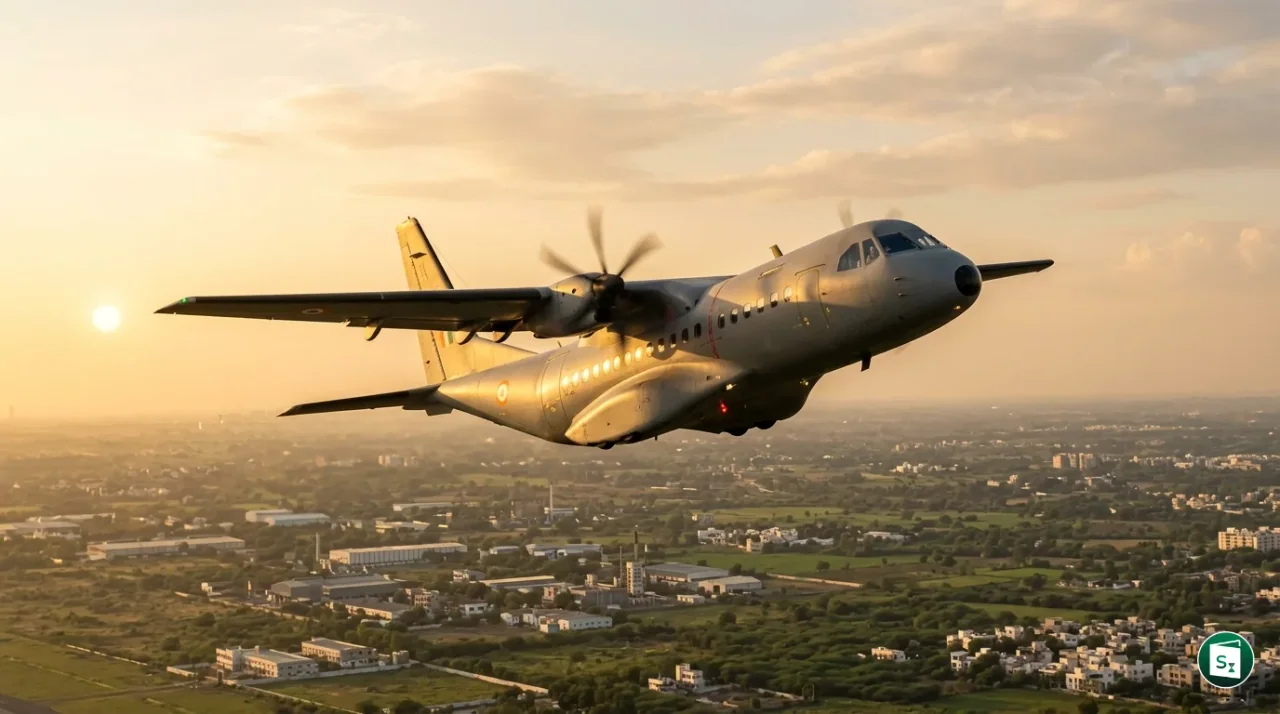
India achieved a historic milestone in defence manufacturing on June 17, 2026, with the successful maiden test flight of the first domestically produced C295 military transport aircraft. The flight took off from the Final Assembly Line (FAL) in Vadodara, Gujarat, marking the first time a private sector company has manufactured a military aircraft in India. This achievement is a major boost to the government’s Aatmanirbhar Bharat initiative in the high-technology aviation sector.
The C295 Programme: A Private Sector Milestone
The C295 aircraft programme is a pioneering initiative executed under a ₹21,935 crore contract signed between the Ministry of Defence and Airbus Defence and Space in September 2021. It represents the first time in Indian history that a private company, Tata Advanced Systems Limited (TASL), is manufacturing a complete military aircraft within the country. Previously, such large-scale aerospace manufacturing was the exclusive domain of the state-owned Hindustan Aeronautics Limited (HAL).
Under the terms of the agreement, the Indian Air Force (IAF) will receive a total of 56 C295MW transport aircraft. The delivery schedule is split into two phases:
- 16 aircraft are being delivered in “fly-away” condition directly from the Airbus final assembly line in Seville, Spain.
- 40 aircraft are being manufactured and assembled at the Tata Aircraft Complex in Vadodara, Gujarat.
The successful test flight in Vadodara confirms the operational readiness of the Indian assembly line. All 40 locally manufactured aircraft are expected to be delivered to the IAF by August 2031. This partnership not only strengthens India’s defence capabilities but also positions the country as a potential regional hub for aerospace manufacturing and maintenance.
Modernising the IAF: Replacing the Avro and An-32 Fleets
The induction of the C295MW is a critical step in modernising the IAF’s ageing transport infrastructure. The primary objective is to replace the Hawker Siddeley HS 748 Avro fleet, which has been the backbone of the IAF’s medium-lift operations since the early 1960s. The Avro aircraft are now considered vintage and lack the advanced avionics and fuel efficiency required for modern tactical missions.
Beyond the Avro replacement, the C295 is also positioned to eventually succeed the Antonov An-32 fleet. The An-32 has been a workhorse for the IAF, particularly in the high-altitude regions of Ladakh and the Northeast. However, as these aircraft approach their retirement age after 2030, the C295 offers a more versatile and technologically superior alternative.
| Feature | HS 748 Avro | Airbus C295MW |
|---|---|---|
| Maximum Payload | ~7 tonnes | 9.25 tonnes |
| Troop Capacity | 40 troops | 71 troops |
| Technology | Analogue Cockpit | Digital Glass Cockpit |
| Runway Requirement | Prepared strips | Unpaved/Semi-prepared strips |
The C295MW’s ability to take off and land on short, unpaved runways makes it exceptionally suited for tactical airlift missions. It can transport troops and cargo directly to Advanced Landing Grounds (ALGs) near India’s borders, ensuring rapid deployment and logistics support in challenging terrains.
Technical Capabilities of the C295MW Aircraft
The C295MW is a highly versatile tactical transport aircraft designed to operate in “hot and high” conditions. Powered by two Pratt & Whitney Canada PW127G turboprop engines, each capable of producing 2,645 shaft horsepower, the aircraft can reach a maximum speed of 480 km/h. It is equipped with a modern digital glass cockpit, which reduces pilot workload and enhances situational awareness during complex missions.
One of the standout features of the Indian C295 fleet is the high degree of indigenization in its electronic systems. The aircraft is equipped with an indigenous Electronic Warfare Suite (EWS) developed by Bharat Electronics Ltd (BEL) and Bharat Dynamics Ltd (BDL). This suite provides the aircraft with defensive capabilities against surface-to-air and air-to-air missile threats.
The aircraft is designed for multi-role versatility:
- Troop Transport: It can carry up to 71 troops or 50 paratroopers.
- Medical Evacuation (MEDEVAC): It can be configured to hold 24 stretchers with seven medical attendants.
- Logistics: The rear ramp door allows for the quick loading and unloading of heavy cargo and palletised loads.
With a maximum takeoff weight of 23.2 tonnes and a payload capacity of 9.25 tonnes, the C295MW provides the IAF with the necessary lift capability for tactical operations while maintaining high fuel efficiency. Its Short Take-Off and Landing (STOL) performance allows it to operate from strips as short as 670 metres, making it ideal for reaching remote border areas.
Strategic Significance of the Vadodara Final Assembly Line
The Tata Aircraft Complex in Vadodara, spread over 50 acres in the Harni area, is more than just an assembly line. It represents a shift in India’s defence acquisition strategy from “Buyer” to “Manufacturer.” The facility is the first of its kind in the private sector and serves as the anchor for a massive aerospace ecosystem in the country.
A key highlight of the programme is the high level of indigenization. Approximately 13,000 parts out of the 14,000 required for each aircraft will be manufactured within India. This involves a complex supply chain consisting of more than 125 Indian MSMEs (Micro, Small and Medium Enterprises) across various states.
The strategic impact of this project extends beyond manufacturing:
- Job Creation: The project is expected to generate 3,000 direct high-skill jobs and over 3,000 indirect employment opportunities.
- Technology Transfer: The partnership with Airbus ensures that global aerospace manufacturing standards and technologies are transferred to the Indian private sector.
- Regional Hub: The facility is designed to become a regional hub for the C295. In the future, it may cater to export orders from other countries and provide Maintenance, Repair, and Overhaul (MRO) services for the global C295 fleet.
By successfully flight-testing the first domestically produced aircraft, India has demonstrated its capability to handle complex aerospace projects. This pave the way for future programmes, including the potential indigenous development of fighter jets and larger transport aircraft in the private sector.
Key Takeaways
- The first domestically manufactured C295 military transport aircraft successfully completed its maiden test flight in Vadodara, Gujarat, on June 17, 2026.
- The aircraft is produced at the Tata Aircraft Complex, India’s first large-scale private-sector final assembly line for military aircraft.
- The programme is part of a ₹21,935 crore contract between the Ministry of Defence and Airbus Defence and Space for 56 aircraft.
- Out of the total 56 aircraft, 16 are being delivered from Spain, while 40 are being manufactured in India by Tata Advanced Systems Limited (TASL).
- The C295MW is designed to replace the Hawker Siddeley HS 748 Avro fleet and modernise the IAF transport fleet.
- The aircraft is equipped with an indigenous Electronic Warfare Suite developed by Bharat Electronics Ltd (BEL) and Bharat Dynamics Ltd (BDL).
- Approximately 13,000 out of 14,000 parts for each aircraft are manufactured in India, involving a supply chain of over 125 MSMEs.
- The C295MW has a payload capacity of 9.25 tonnes and is powered by two Pratt & Whitney Canada PW127G turboprop engines.