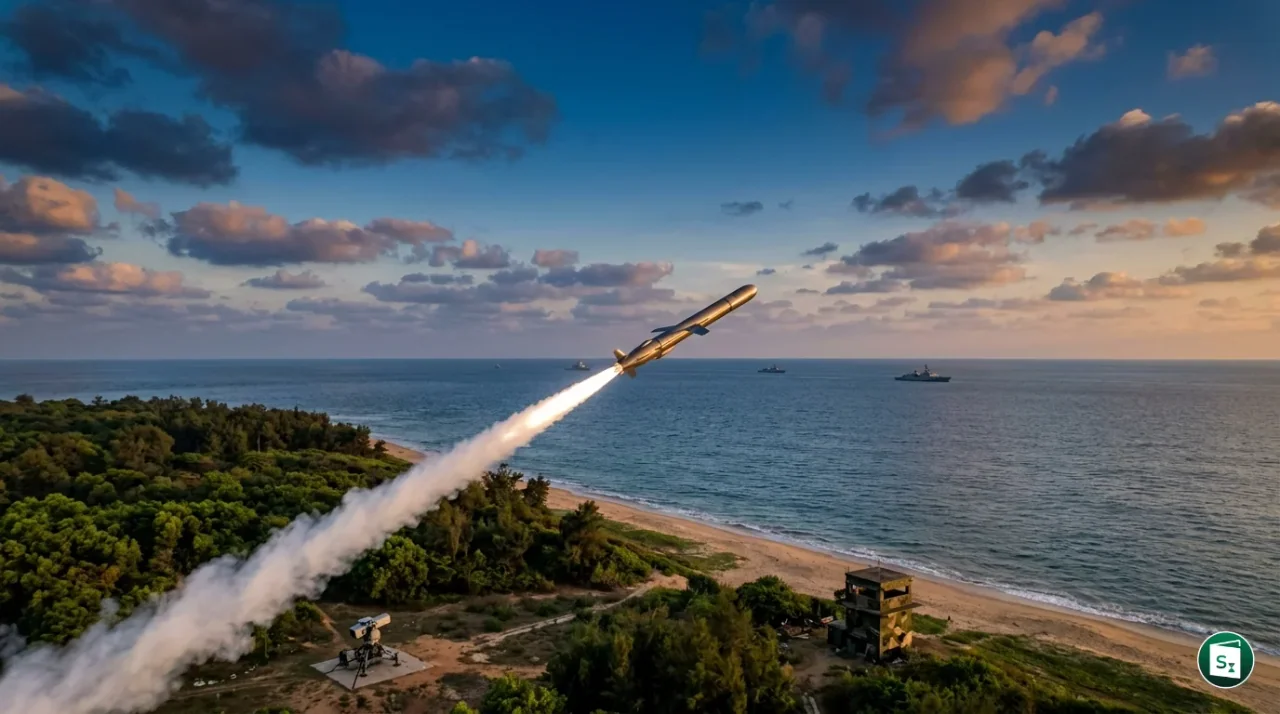
The Defence Research and Development Organisation (DRDO) successfully flight-tested the indigenous Long Range Land Attack Cruise Missile (LRLACM) from Dr APJ Abdul Kalam Island off the Odisha coast on 17 June 2026. This test validated the missile’s advanced propulsion and guidance systems, proving India’s capability to develop high-precision, long-range subsonic weapons. The achievement marks a significant step toward Aatmanirbhar Bharat in the critical domain of cruise missile technology.
Technical Specifications of the LRLACM
The LRLACM is a sophisticated subsonic cruise missile designed to strike high-value targets with extreme precision. It features a terrain-hugging capability, allowing it to fly at very low altitudes to evade enemy radar detection. The missile is powered by the indigenous Manik Small Turbofan Engine (STFE), which was developed by the Gas Turbine Research Establishment (GTRE) in Bengaluru.
| Feature | Details |
|---|---|
| Range | 1,000 km to 1,500 km |
| Speed | Subsonic (approximately Mach 0.8) |
| Propulsion | Manik Small Turbofan Engine (STFE) |
| Launch Mode | Vertical or Inclined launch using a solid booster |
| Warhead | Conventional (approximately 400 kg) |
| Guidance | INS augmented by GPS/NavIC with terminal seeker |
The missile uses an advanced Inertial Navigation System (INS) coupled with satellite-based navigation for mid-course corrections. Its ability to follow complex waypoints and fly through mountainous terrain makes it a versatile tool for modern warfare. During the launch phase, a solid-fuel rocket booster provides the initial thrust before the turbofan engine takes over for the cruising phase.
Indigenous Development and the Role of ADE
The development of the LRLACM is a major collaborative effort within India’s defence ecosystem. The Aeronautical Development Establishment (ADE), a premier laboratory under the DRDO based in Bengaluru, serves as the nodal agency for this project. ADE is responsible for the overall design, integration, and development of the missile’s flight control and guidance systems.
Several other DRDO laboratories, including the Research Centre Imarat (RCI) in Hyderabad and the Terminal Ballistics Research Laboratory (TBRL), contributed critical sub-systems. The project also features deep involvement from the Indian industry, specifically Bharat Dynamics Limited (BDL) and Bharat Electronics Limited (BEL). These organizations serve as the primary development-cum-production partners, ensuring that the missile can be seamlessly transitioned from the testing phase to mass production.
This “Mission Mode” project emphasizes the use of 100% indigenous components, ranging from the propulsion system to the advanced avionics. By integrating private and public sector partners early in the design cycle, the government aims to shorten the development timeline and build a robust domestic supply chain for long-range precision weapons.
Evolution from the Nirbhay Missile Programme
The LRLACM is the direct technological successor to the Nirbhay cruise missile programme, which was India’s first successful attempt at developing a long-range subsonic cruise missile. While the Nirbhay served as a critical technology demonstrator, the LRLACM represents the matured, production-ready version of that technology.
A key intermediate step in this evolution was the Indigenous Technology Cruise Missile (ITCM) project. The primary goal of the ITCM was to replace the foreign-sourced engines used in early Nirbhay prototypes with the indigenous Manik turbofan engine. The successful integration and testing of the Manik engine provided the foundation for the LRLACM.
Compared to its predecessors, the LRLACM features significantly upgraded avionics, a more reliable navigation suite, and enhanced terminal seekers for greater accuracy. It also incorporates a modular design, allowing it to be adapted for launch from different platforms, including mobile ground launchers, naval warships, and potentially combat aircraft. This evolution ensures that India now possesses a reliable, home-grown alternative to international systems like the American Tomahawk.
Strategic Significance and Deep-Strike Capability
The induction of the LRLACM will significantly enhance India’s strategic deterrence by providing a reliable deep-precision strike capability. Unlike the supersonic BrahMos missile, which is designed for speed and rapid response, the LRLACM offers a longer range and the ability to loiter or follow complex flight paths. This makes it ideal for striking high-value targets deep within hostile territory while staying outside the range of enemy air defences.
One of the most critical aspects of the LRLACM is its compatibility with the Universal Vertical Launch Module (UVLM). This system is already in use on frontline Indian Navy warships like the Visakhapatnam-class destroyers and Project 17A frigates. The ability to launch the LRLACM from these platforms provides the Navy with a powerful stand-off strike option, allowing it to hit land targets from hundreds of kilometres away at sea.
Furthermore, the LRLACM project strengthens India’s stance on Aatmanirbhar Bharat in defence manufacturing. By developing the engine, navigation, and seeker technologies indigenously, India reduces its dependence on foreign suppliers and ensures the security of its strategic weapon systems. The missile is being developed as a tri-service weapon, ensuring that the Army, Navy, and Air Force all possess a versatile and unified long-range strike platform.
Key Takeaways
- The Long Range Land Attack Cruise Missile (LRLACM) was successfully flight-tested by DRDO from Dr APJ Abdul Kalam Island in Odisha.
- The missile has a strategic strike range of 1,000 km to 1,500 km and operates at subsonic speeds of approximately Mach 0.8.
- The Aeronautical Development Establishment (ADE) in Bengaluru is the nodal laboratory, with BDL and BEL serving as production partners.
- It is powered by the indigenous Manik Small Turbofan Engine, which was developed by the Gas Turbine Research Establishment (GTRE).
- The missile features advanced terrain-hugging and waypoint navigation capabilities to strike high-value targets with precision.
- The LRLACM is designed for tri-service use and can be launched from land-based mobile launchers and naval warships using the UVLM system.