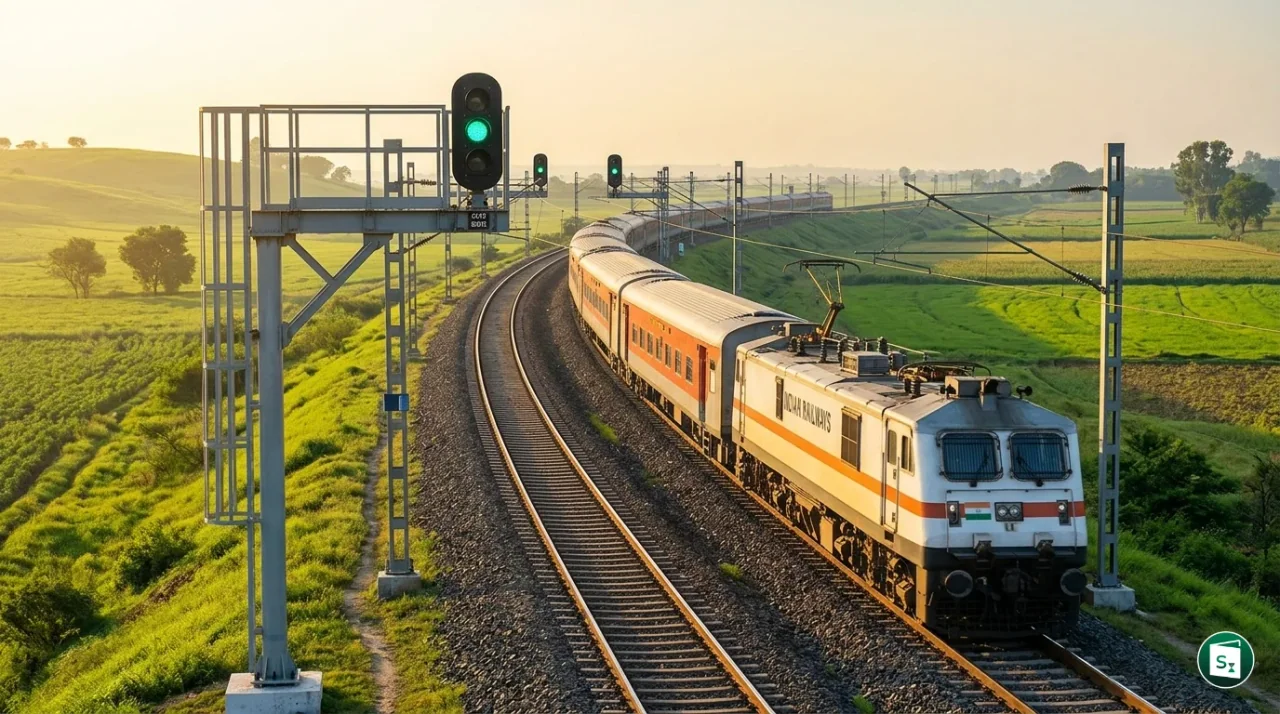
Indian Railways has approved the installation of the indigenous Kavach automatic train protection system across 1,409 route kilometres in the Ambala and Ahmedabad divisions. Costing approximately ₹341 crore, the project includes the deployment of the latest Version 4.0 in the Ahmedabad division to enhance real-time monitoring and collision prevention. This move is part of a broader national strategy to eliminate accidents caused by human error and signal passing at danger.
Expanding the Safety Shield: Ambala and Ahmedabad Divisions
The recent approvals by the Railway Board target key high-traffic corridors in Northern and Western India. In the Ambala Division of the Northern Railway, the system will be implemented across 811 route kilometres (RKM). This project, sanctioned at ₹201 crore, covers the remaining Broad Gauge sections, including critical routes such as Ambala Cantonment to Ludhiana, Kalka to Chandigarh, and Rajpura to Bathinda.
In the Ahmedabad Division of the Western Railway, the installation will span 598 route kilometres across 48 block sections. This phase of the project, valued at ₹140 crore, is significant as it deploys the latest Kavach Version 4.0. The following table summarizes the scope and cost of the newly approved projects:
| Division | Railway Zone | Coverage (RKM) | Sanctioned Cost | Key Implementation |
|---|---|---|---|---|
| Ambala | Northern Railway | 811 | ₹201 crore | Balance Broad Gauge sections |
| Ahmedabad | Western Railway | 598 | ₹140 crore | 48 block sections (Version 4.0) |
The project in Ahmedabad is expected to bring the entire division under the protection of the Kavach system, building on previous sanctions that covered approximately 702 RKM.
What is the Kavach Protection System?
Kavach, which translates to Armour, is an indigenous Automatic Train Protection (ATP) system developed by the Research Designs and Standards Organisation (RDSO). Headquartered in Lucknow, Uttar Pradesh, RDSO serves as the primary research and development wing of the Indian Railways. The system was originally initiated in 2011 as the Train Collision Avoidance System (TCAS) and was officially rebranded as Kavach in 2021 to reflect its role as a protective shield for trains.
The system is certified to Safety Integrity Level 4 (SIL-4), which is the highest global safety standard for railway signalling. This means the probability of a system error is less than one in 10,000 years. Kavach was developed to provide a cost-effective alternative to expensive international technologies like the European Train Control System (ETCS). It was created in collaboration with Indian industry partners, including Medha Servo Drives, Kernex Microsystems, and HBL Power Systems.
Technical Breakthroughs in Kavach Version 4.0
The latest iteration, Kavach Version 4.0, was approved by RDSO in July 2024. This version is designed to handle the complexities of large railway yards and high-density networks with greater precision. A key advancement in Version 4.0 is the transition to an LTE (4G/5G) based communication backbone, providing a more reliable and real-time data link compared to the older UHF radio-based systems.
The core functionality of the system involves four main safety pillars:
- SPAD Protection: Automatically stops the train if it passes a signal at ‘Danger’ (Red), preventing potential accidents.
- Collision Avoidance: Utilizes direct radio communication between locomotives to prevent head-on and rear-end collisions.
- Continuous Speed Monitoring: Regulates the train’s speed based on signal aspects and track profiles, automatically applying brakes if the speed limit is exceeded.
- Enhanced Awareness: Includes features like auto-whistling at level crossing gates and an SOS emergency signal that can stop all trains within a five-kilometre radius.
The system relies on a network of Radio Frequency Identification (RFID) tags installed on the tracks and communication towers placed at intervals of 7 to 10 kilometres. Version 4.0 is optimized for speeds up to 160 km/h, which is essential for India’s premier trains like the Vande Bharat Express.
Analogy · A Digital Co-Pilot Expand analogy
Think of Kavach as a high-tech digital co-pilot that never blinks. While the human pilot (loco pilot) is in command, Kavach “sees” signals and “knows” the speed limits of the track ahead through a network of sensors. If the pilot accidentally misses a red signal or goes too fast, the digital co-pilot immediately takes over the controls and applies the brakes, acting as an invisible armor for the entire train.
Strategic Importance for Indian Railways
The expansion of Kavach is a cornerstone of the Mission Zero Accidents initiative of the Ministry of Railways. By automating signal observance and speed regulation, the system addresses the primary cause of major rail accidents: human error. The current deployment strategy prioritizes the Golden Quadrilateral and other high-density passenger and freight corridors to maximize impact.
Financially, the indigenous development of Kavach provides a significant advantage. The installation costs are approximately ₹50 lakh per route kilometre for trackside infrastructure and ₹80 lakh per locomotive for onboard equipment. This is a fraction of the cost required for comparable international systems. Beyond domestic safety, this technological self-reliance positions India as a potential exporter of affordable, world-class train protection solutions to other nations with similar rail networks.
Key Takeaways
- Kavach is an indigenous Automatic Train Protection (ATP) system developed by the RDSO, which is headquartered in Lucknow.
- Indian Railways has approved the installation of the system across 1,409 route kilometres in the Ambala and Ahmedabad divisions at a cost of ₹341 crore.
- The project in the Ahmedabad division will deploy the advanced Kavach Version 4.0, which utilizes an LTE-based communication backbone for real-time data.
- The system is certified to SIL-4, the highest global safety standard, ensuring a failure probability of less than one in 10,000 years.
- Core safety functions include protection against Signal Passing At Danger (SPAD), head-on and rear-end collision avoidance, and automatic speed control.
- Originally developed as the Train Collision Avoidance System (TCAS), the technology was officially rebranded as Kavach in 2021.