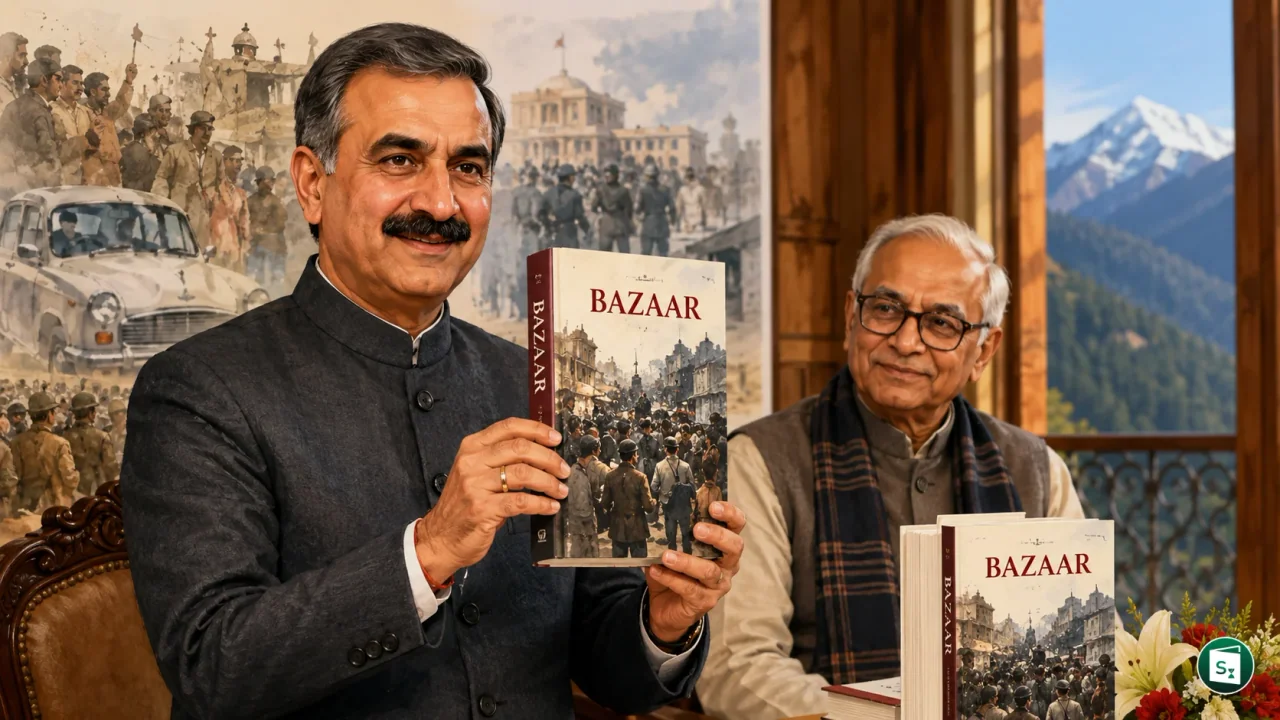
Himachal Pradesh Chief Minister Sukhvinder Singh Sukhu launched the second edition of the novel Bazaar in Shimla on May 23, 2026. Authored by Niranjan Dev Sharma, the book provides a narrative account of India’s transformative social and political landscape between 1971 and 1992. The publication serves as a literary record of the era when Himachal Pradesh transitioned into full statehood and India moved toward economic liberalization.
A Chronicle of a Transformative Era: 1971–1992
The novel Bazaar meticulously documents two critical decades of modern Indian history. This period began with Himachal Pradesh achieving full statehood on January 25, 1971, becoming the 18th state of the Indian Union. The narrative arc concludes in 1992, a year marked by significant communal shifts and the early results of India’s economic opening. By focusing on these 21 years, Sharma captures the pulse of a nation undergoing rapid change, from the euphoria of the 1971 Indo-Pak War to the complex social tensions of the Mandal Commission era in 1990.
The book uses the metaphor of the “Bazaar” to represent the heartbeat of society. In the Indian context, the bazaar is not merely a place of trade but a social hub where political ideologies, regional news, and economic shifts converge. The novel explores how the transition from a traditional agrarian economy to a consumer-driven urban culture fundamentally altered the social fabric of the Himalayan region and the country at large.
About the Author and Publication
The author, Niranjan Dev Sharma, is a native of Kullu, Himachal Pradesh. He possesses an impressive academic background, having studied at Himachal Pradesh University (HPU) and Jawaharlal Nehru University (JNU) in New Delhi. This academic exposure to both regional and national intellectual centers is reflected in his writing, which balances local Himalayan nuances with broader national perspectives.
The second edition of Bazaar is published by Aadhar Prakashan Private Limited. The publishing house, directed by Desh Nirmohi, is known for promoting literature that engages with social reality and regional history. The release event in Shimla was attended by prominent figures, including Rakesh Kanwar, Secretary to the Chief Minister, and the author’s family, highlighting the book’s status as a significant cultural contribution to the state.
Major Historical Milestones (1971–1992)
The novel covers a span of 21 years, encompassing some of the most defining moments of the late 20th century in India. The following milestones serve as the significant historical backdrop for the book’s narrative:
| Year | Event | Significance |
|---|---|---|
| 1971 | HP Statehood | Himachal Pradesh became the 18th state of India on January 25. |
| 1971 | Indo-Pak War | Leading to the liberation of Bangladesh and a surge in national sentiment. |
| 1975–77 | The Emergency | A period of suspension of civil liberties that impacted local governance. |
| 1980s | Regional Unrest | Insurgency in neighboring Punjab and its social effects on the hilly state. |
| 1990 | Mandal Commission | Reservation policies that reshaped the caste and political landscape. |
| 1991 | Liberalization | Introduction of LPG (Liberalization, Privatization, and Globalization) reforms. |
| 1992 | Babri Masjid Event | A major turning point in India’s communal and secular history. |
Through these events, Bazaar portrays how national policy shifts and geopolitical changes filter down to the local level, affecting the daily lives and aspirations of people in the “Bazaar.”
Key Takeaways
- Chief Minister Sukhvinder Singh Sukhu launched the second edition of the novel Bazaar in Shimla.
- The book is authored by Niranjan Dev Sharma, a resident of Kullu and an alumnus of HPU and JNU.
- The narrative chronicles significant social and political events in India over a 21-year period from 1971 to 1992.
- The novel begins in the year Himachal Pradesh achieved full statehood to become the 18th state of India on January 25, 1971.
- The book is published by Aadhar Prakashan Private Limited, under the directorship of Desh Nirmohi.
- The transition from a traditional economy to a modern “bazaar” culture and the impact of the 1991 economic reforms are central themes of the work.