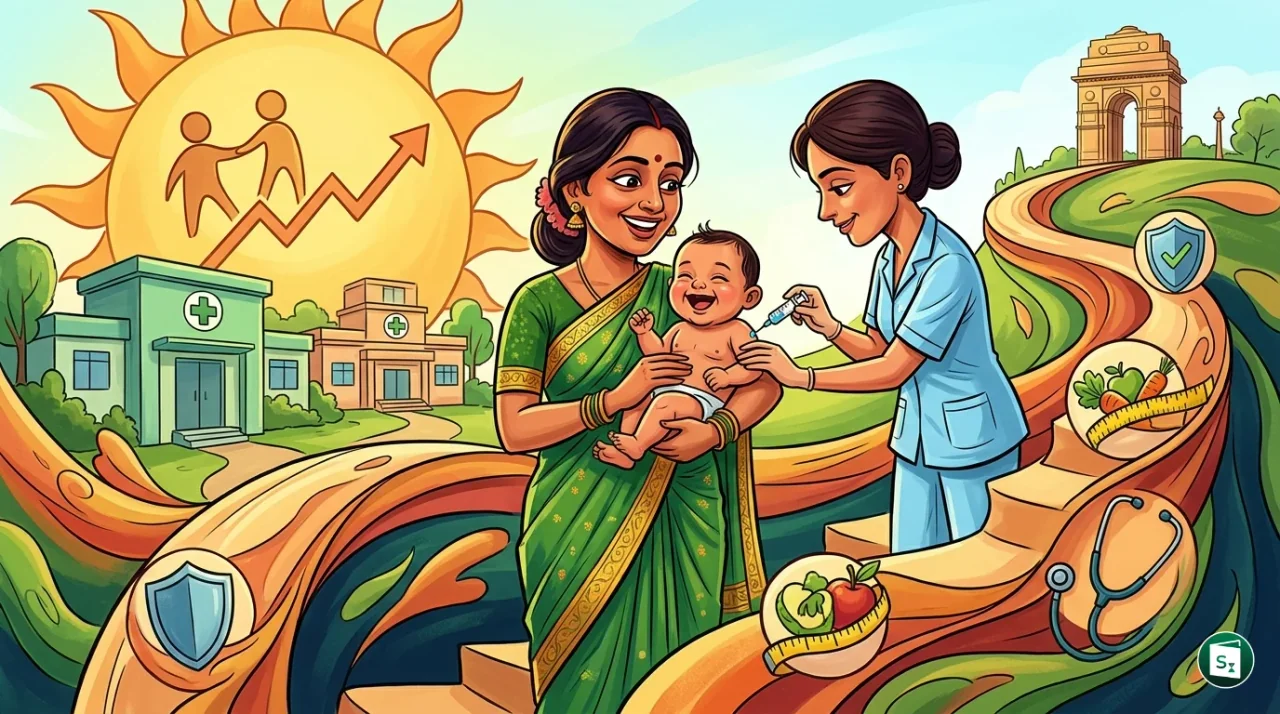
The Ministry of Health and Family Welfare released the latest findings from the National Family Health Survey (NFHS-6) on May 29, 2026, showcasing a transformative shift in India’s demographic and health landscape. The report highlights critical improvements in maternal care and childhood nutrition, with institutional deliveries crossing the 90% mark for the first time. These findings underscore the effectiveness of targeted public health interventions and a robust push toward universal health coverage.
Overview of the NFHS-6 Findings
The National Family Health Survey (NFHS-6), conducted during 2023-24, is the most comprehensive health and demographic survey in India. This round is particularly significant as it was fully funded by the Government of India and coordinated by the International Institute for Population Sciences (IIPS), Mumbai. The survey covered approximately 6.79 lakh households across 715 districts, providing a granular view of the country’s health status. IIPS Mumbai, established in 1956, serves as the nodal agency for the survey under the administrative control of the Ministry of Health and Family Welfare (MoHFW).
| Feature | Details |
|---|---|
| Survey Period | 2023-24 |
| Nodal Agency | IIPS Mumbai |
| Total Households | 6.79 Lakh |
| Number of Districts | 715 |
| Funding | 100% Government of India |
Significant Progress in Maternal Care
Maternal healthcare has witnessed a steady upward trajectory, driven by schemes like Janani Suraksha Yojana (JSY) and Pradhan Mantri Matru Vandana Yojana (PMMVY). Institutional deliveries in India have now reached 90.6%, up from 88.6% in NFHS-5. This progress ensures that a vast majority of births are attended by skilled health personnel, significantly reducing the risks associated with childbirth.
Antenatal Care (ANC) coverage, which involves the systemic medical supervision of women during pregnancy, has improved from 92.6% to 95.9%. More importantly, registration for ANC in the first trimester has increased to 76.2%, up from 70.0% in the previous round. Early registration is crucial for identifying potential complications and ensuring the administration of essential supplements like Iron Folic Acid (IFA).
Fertility Trends and Family Planning
The Total Fertility Rate (TFR) in India remains stable at 2.0, which is below the replacement level fertility of 2.1. TFR is the average number of children a woman would have in her lifetime. Maintaining this rate below the replacement level indicates that India’s population is on a path toward stabilization.
Simultaneously, the Contraceptive Prevalence Rate (CPR) among married women aged 15-49 has increased to 69.1%, up from 66.7%. The survey also shows a positive trend in the use of modern contraceptive methods. These figures reflect better awareness and improved access to family planning services across both rural and urban areas.
Transforming Child Health and Nutrition
Child health indicators have shown remarkable improvement, particularly in immunization and nutrition. Full vaccination coverage for children aged 12-23 months has improved to 87.1%, up from 83.8%. Public health facilities continue to be the backbone of India’s immunization drive, with 95.6% of children receiving their vaccinations through these channels.
On the nutrition front, India has achieved a significant reduction in chronic and acute malnutrition. Stunting (low height-for-age) has been reduced by 17%, dropping from 35.5% in NFHS-5 to 29.3% in NFHS-6. Similarly, severe wasting (low weight-for-height) has seen a sharp decline of 32%, reaching 5.2%. These improvements highlight the success of nutrition-focused initiatives like Mission POSHAN 2.0.
| Nutrition Indicator | NFHS-5 | NFHS-6 | Percentage Reduction |
|---|---|---|---|
| Stunting | 35.5% | 29.3% | 17% |
| Severe Wasting | 7.7% | 5.2% | 32% |
Expanding Financial and Digital Inclusion
The NFHS-6 findings also highlight major strides in social empowerment and financial protection. Health insurance coverage has expanded significantly to 60.2% of households, reflecting the wide-scale implementation of Ayushman Bharat-Pradhan Mantri Jan Arogya Yojana (AB-PMJAY). This scheme provides a health cover of ₹5 lakh per family per year for secondary and tertiary care hospitalization.
Women’s empowerment indicators have also seen a positive shift. Personal bank account usage among women has reached 89.0%, facilitating better financial autonomy and direct benefit transfers. Additionally, internet usage among women has nearly doubled to 64.3%, signaling a closing digital divide and better access to information and services.
| Empowerment Indicator | NFHS-6 Percentage |
|---|---|
| Health Insurance Coverage | 60.2% |
| Personal Bank Account Usage | 89.0% |
| Internet Usage | 64.3% |
Key Takeaways
- The National Family Health Survey (NFHS-6) findings, released on May 29, 2026, show that institutional deliveries in India have reached 90.6%.
- Antenatal Care (ANC) coverage has improved to 95.9%, with 76.2% of pregnant women registering in their first trimester.
- India’s Total Fertility Rate (TFR) remains stable at 2.0, which is below the replacement level of 2.1.
- Child stunting has declined by 17%, while severe wasting has dropped by 32% compared to the NFHS-5 results.
- Full immunization coverage for children aged 12-23 months has increased to 87.1%, with 95.6% of vaccinations provided through public health facilities.
- The International Institute for Population Sciences (IIPS), Mumbai, established in 1956, served as the nodal agency for the fully government-funded NFHS-6.