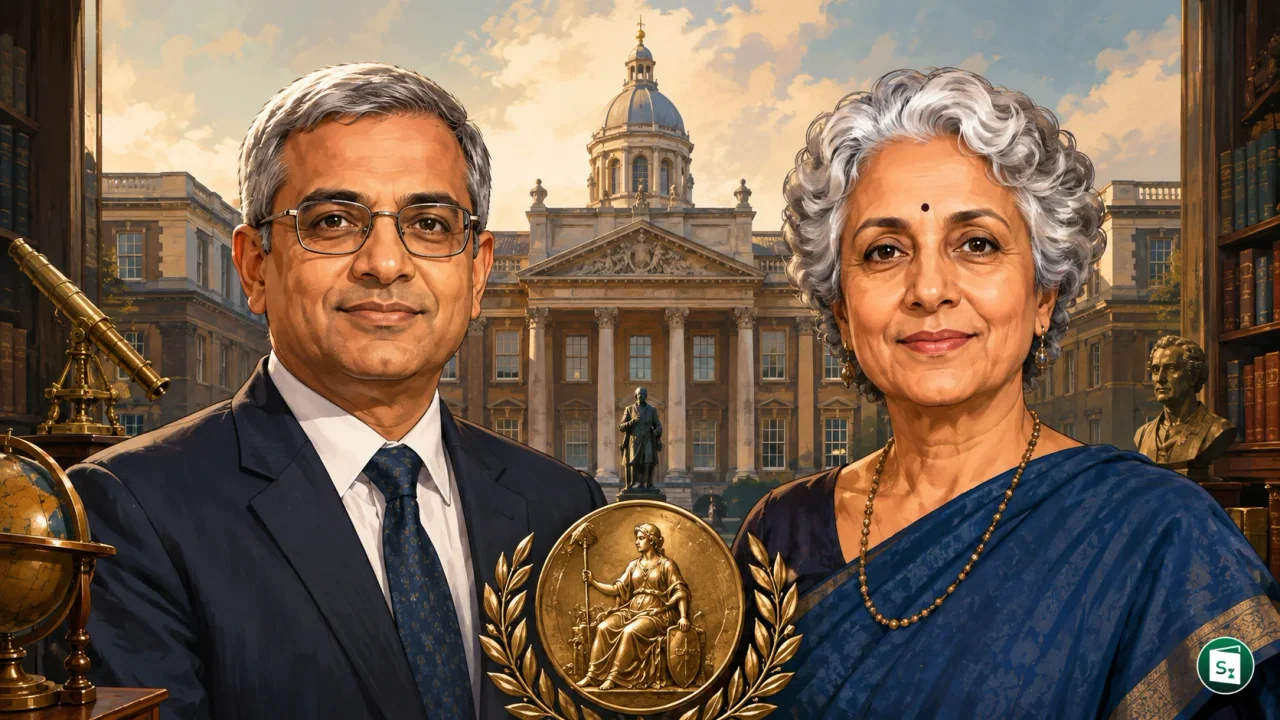
Professor Manindra Agrawal and Dr. Soumya Swaminathan were elected as Fellows of the Royal Society (FRS) in May 2026, joining an elite group of the world’s most distinguished scientists. Professor Agrawal, the Director of IIT Kanpur, is recognised for his revolutionary work in computational mathematics, while Dr. Swaminathan is honoured for her global leadership in public health and tuberculosis research. This prestigious recognition underscores India’s significant contributions to the global scientific landscape and marks a historic milestone for the country’s research community.
Recognition of Scientific Excellence: The 2026 FRS Cohort
The Royal Society officially announced its 2026 cohort of Fellows on May 27, 2026, electing more than 90 outstanding researchers from around the world. Being elected as a Fellow of the Royal Society (FRS) is one of the highest honours in the scientific world, awarded to individuals who have made “substantial contributions to the improvement of natural knowledge.”
The 2026 list includes global leaders across diverse fields such as quantum technology, epidemiology, and oncofertility. According to the Society, this year’s selection reflects an “international character” and a “diversity of perspectives,” aiming to address some of the most pressing challenges facing humanity today. The formal admission ceremony for the new Fellows is scheduled to take place on July 10, 2026, in London, where they will sign the Charter Book, a tradition that dates back centuries.
Professor Manindra Agrawal: A Titan of Theoretical Computer Science
Professor Manindra Agrawal is currently the Director of the Indian Institute of Technology (IIT) Kanpur, where he also earned his B.Tech and Ph.D. He is globally renowned for co-creating the AKS Primality Test in 2002, a breakthrough that solved a long-standing mathematical problem. Alongside his students Neeraj Kayal and Nitin Saxena, he published the paper “PRIMES is in P,” proving that determining whether a number is prime can be done efficiently and without any probability of error.
His contributions extend beyond pure mathematics into national security and public policy. Professor Agrawal designed private-key encryption algorithms for the Indian Navy and Indian Air Force, securing their critical communication networks. He also led the development of the SUTRA model during the COVID-19 pandemic to predict the virus’s trajectory across India. Over his career, he has received numerous accolades, including the Padma Shri (2013), the Infosys Prize (2008), and the prestigious Gödel Prize (2006).
Major Contributions of Manindra Agrawal
| Contribution | Significance |
|---|---|
| AKS Primality Test | First deterministic, general, and polynomial-time algorithm for primality. |
| SUTRA Model | Mathematical modelling for COVID-19 pandemic forecasting in India. |
| Encryption Algorithms | Developed secure communication tools for the Indian armed forces. |
| Isomorphism Conjecture | Advanced research in computational complexity and Polynomial Identity Testing. |
Dr. Soumya Swaminathan: Pioneering Public Health and Tuberculosis Research
Dr. Soumya Swaminathan is a world-renowned paediatrician and clinical scientist who served as the inaugural Chief Scientist of the World Health Organization (WHO) from 2019 to 2022. In this role, she established the WHO Science Division and played a central part in the global scientific response to the COVID-19 pandemic, including the development of the COVAX vaccine initiative. Prior to her tenure at the WHO, she led the Indian Council of Medical Research (ICMR) as its Director General from 2015 to 2017.
Her research career has been dedicated to the study of tuberculosis (TB) and HIV, particularly in children. She has published more than 480 peer-reviewed papers and is considered a global authority on TB-HIV co-infection and multidrug-resistant tuberculosis. Dr. Swaminathan currently serves as the Chairperson of the M.S. Swaminathan Research Foundation (MSSRF) and continues to advise the Indian government on TB elimination strategies.
Career Milestones of Dr. Soumya Swaminathan
| Position | Organization | Tenure |
|---|---|---|
| Chief Scientist | World Health Organization (WHO) | 2019 to 2022 |
| Director General | Indian Council of Medical Research (ICMR) | 2015 to 2017 |
| Chairperson | M.S. Swaminathan Research Foundation (MSSRF) | 2023 to Present |
| Director | National Institute for Research in Tuberculosis (NIRT) | 2012 to 2015 |
The Royal Society: A Legacy of 365 Years
The Royal Society of London for Improving Natural Knowledge, known simply as the Royal Society, is the oldest continuously existing scientific academy in the world. Established on November 28, 1660, it was granted a Royal Charter by King Charles II in 1662. The Society’s motto, Nullius in verba (Latin for “Take nobody’s word for it”), highlights its commitment to establishing scientific truth through experimentation rather than relying on authority.
Based in London, the Royal Society acts as the UK’s national academy of sciences. In 1665, it published the world’s first scientific journal, Philosophical Transactions, which introduced the concept of peer review to the scientific community. Historically, the Society has been home to some of the greatest minds in history, including Sir Isaac Newton, who served as its President from 1703 to 1727, Charles Darwin, Albert Einstein, and Stephen Hawking.
Quick Facts: The Royal Society
| Feature | Detail |
|---|---|
| Founding Date | November 28, 1660 |
| Royal Charter | 1662 (by King Charles II) |
| Headquarters | London, United Kingdom |
| First Journal | Philosophical Transactions (1665) |
| Official Motto | Nullius in verba |
Historical Milestones for India
The election of Professor Agrawal and Dr. Swaminathan marks several historic “firsts” for the Indian scientific community. Dr. Swaminathan has become only the second Indian woman to be elected a Fellow of the Royal Society, following virologist Gagandeep Kang (elected in 2019). Most significantly, she and her father, the late Prof. M.S. Swaminathan (the Father of the Green Revolution in India, elected in 1973), are now the first Indian father-daughter duo to hold this distinction.
India’s connection with the Royal Society dates back to 1841, when Ardaseer Cursetjee, a marine engineer, became the first Indian to be elected. Since then, over 60 scientists of Indian origin have been honoured. This list includes giants like Srinivasa Ramanujan (1918), C.V. Raman (1924), Homi J. Bhabha (1941), and Satyendra Nath Bose (1958). The 2026 cohort also includes other notable Indian-origin scientists, such as Anuj Dawar and Srinivasan Keshav, reflecting the widespread impact of the Indian scientific diaspora.
Notable Indian Fellows of the Royal Society
| Name | Year Elected | Primary Field |
|---|---|---|
| Ardaseer Cursetjee | 1841 | Marine Engineering (First Indian) |
| Srinivasa Ramanujan | 1918 | Mathematics (Number Theory) |
| C.V. Raman | 1924 | Physics (Nobel Laureate) |
| M.S. Swaminathan | 1973 | Genetics and Agriculture |
| Gagandeep Kang | 2019 | Virology (First Indian Woman) |
| Soumya Swaminathan | 2026 | Public Health and Paediatrics |
Key Takeaways
- Professor Manindra Agrawal and Dr. Soumya Swaminathan were elected as Fellows of the Royal Society (FRS) on May 27, 2026.
- Dr. Swaminathan is the second Indian woman scientist to be elected as an FRS, following Gagandeep Kang in 2019.
- Prof. M.S. Swaminathan and Dr. Soumya Swaminathan have become the first father-daughter pair from India to be Fellows of the Society.
- Professor Manindra Agrawal, the Director of IIT Kanpur, is best known for the AKS Primality Test, the first deterministic polynomial-time algorithm for primality.
- The Royal Society, established in 1660 by King Charles II, is the world’s oldest continuously existing scientific academy.
- The first Indian to be elected as a Fellow of the Royal Society was Ardaseer Cursetjee in 1841.