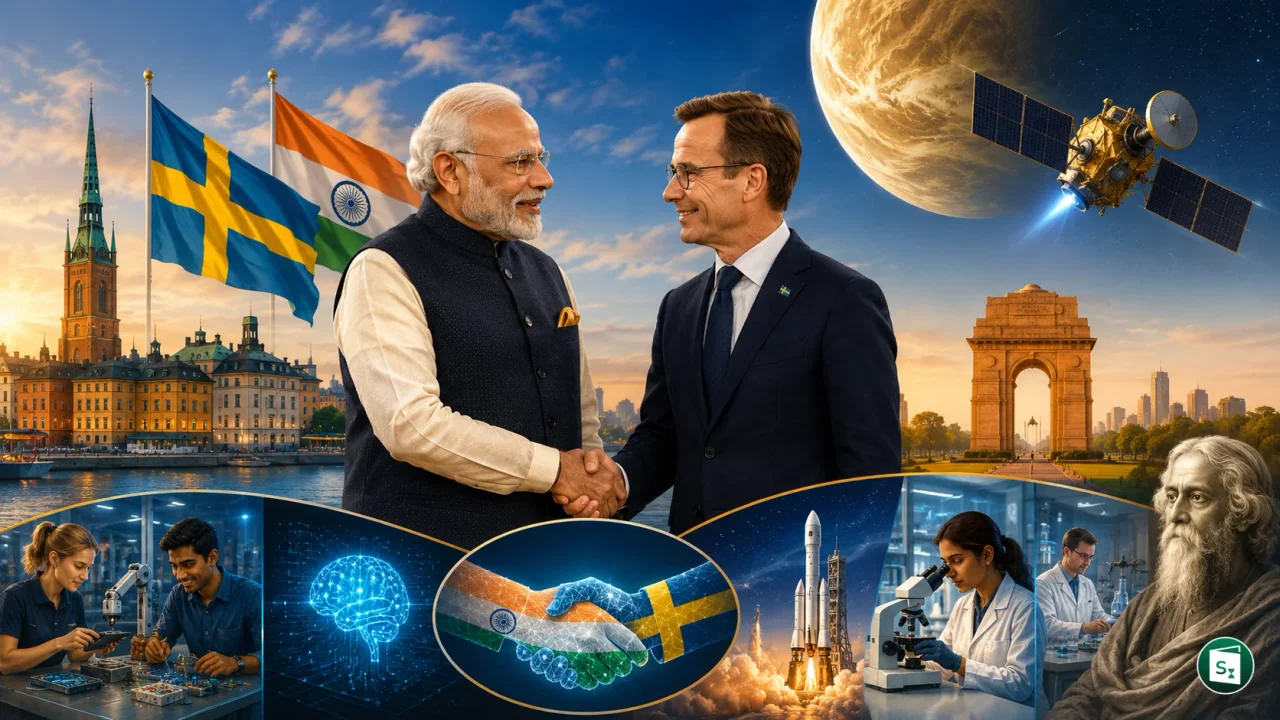
India and Sweden significantly upgraded their bilateral relationship by transitioning to a formal Strategic Partnership during Prime Minister Narendra Modi’s official visit to Gothenburg on May 30, 2026. This landmark visit, hosted by Swedish Prime Minister Ulf Kristersson, resulted in the adoption of a comprehensive Joint Action Plan (2026-2030) to guide future cooperation. The agreement marks a new era of deep-tech, space, and economic synergy between the two nations.
India and Sweden Upgrade Ties to Strategic Partnership
The elevation of bilateral relations to a Strategic Partnership reflects the growing convergence between India and Sweden on global security, innovation, and sustainability. The Joint Action Plan (2026-2030) serves as a futuristic roadmap, focusing on critical areas such as defense co-production, green transition, and emerging technologies. This transition moves the relationship beyond traditional trade into a deeper alliance involving co-development of high-tech solutions.
Prime Minister Modi and his Swedish counterpart emphasized that the partnership is anchored in shared democratic values and a mutual interest in a stable, multi-polar world. Sweden also reiterated its support for India’s permanent membership in a reformed United Nations Security Council (UNSC). The visit to Gothenburg, a major industrial hub, underscored the focus on industrial synergy and high-tech manufacturing.
Economic Synergy: Doubling Trade and Addressing ERT
A central pillar of the new partnership is the ambitious goal to double bilateral trade within the next five years. This target builds upon a record $7.75 billion trade volume achieved in 2025. During his address to the European Round Table for Industry (ERT) in Gothenburg, Prime Minister Modi highlighted India’s 12-year trajectory of reforms, performance, and transformation spanning from 2014 to 2026. He described India as a “Reform Express” that is running on the tracks of conviction and structural stability.
The ERT, founded in 1983 and headquartered in Brussels, comprises CEOs and chairs from approximately 60 of Europe’s largest multinational companies. Prime Minister Modi invited these industrial leaders to co-create and manufacture in India, leveraging the country’s Digital Public Infrastructure (DPI) and growing semiconductor ecosystem. The leaders also discussed the early implementation of the India-EU Free Trade Agreement (FTA) to further unlock economic opportunities.
Innovation Frontiers: SITAC and ISJSTC Initiatives
To operationalize the Strategic Partnership, both nations launched several flagship technology platforms. The Sweden-India Technology and AI Corridor (SITAC) was endorsed to bridge the AI ecosystems of both countries. SITAC aims to facilitate collaboration between startups, researchers, and established tech companies, focusing on responsible and scalable AI deployments. This initiative is supported by the IndiaAI Mission and Business Sweden, ensuring a value-based framework for emerging technologies.
Additionally, a virtual India-Sweden Joint Science and Technology Centre (ISJSTC) was launched to strengthen bilateral scientific research. The ISJSTC will focus on high-impact sectors including quantum computing, 6G telecommunications, and green hydrogen. To further support the business ecosystem, the India-Sweden Small and Medium Enterprises (SME) and Start-up Platform was initiated. This platform is designed to help smaller enterprises integrate into the global supply chains of both nations, fostering grassroots innovation and job creation.
Deep Space Collaboration: Sweden Joins Shukrayaan Mission
A major highlight of the visit was the expansion of space cooperation through India’s upcoming Venus Orbiter Mission, commonly known as Shukrayaan. Sweden announced its official participation in the mission, with the Swedish Institute of Space Physics (IRF) supplying the Venusian Neutrals Analyzer (VNA). The VNA is an advanced scientific instrument designed to study the interaction between solar winds and the Venusian atmosphere.
The IRF, established in 1957 and headquartered in Kiruna, Sweden, has a long history of collaborating with the Indian Space Research Organisation (ISRO), dating back to the SARA instrument on Chandrayaan-1. The Shukrayaan mission, which was approved by the Union Cabinet in 2024, is scheduled for launch in 2028. The inclusion of the Swedish VNA will provide critical data on atmospheric loss processes on Venus, helping scientists understand why the planet evolved differently from Earth.
Cultural and Academic Ties: The Tagore-Sweden Lecture Series
To strengthen the intellectual and people-to-people connections, both nations rolled out the Tagore-Sweden Lecture Series. This academic initiative commemorates the centenary of the historic visit of Rabindranath Tagore to Sweden in 1926. Tagore, who became the first non-European to win the Nobel Prize in Literature in 1913, remains a powerful cultural link between India and the Nordic region.
The lecture series, titled “Vikas Bhi Virasat Bhi” (Development along with Heritage), is designed to explore how traditional knowledge can coexist with and inform modern technological advancements. Prominent scholars from both countries will deliver lectures on shared philosophical and social research. During the visit, Prime Minister Kristersson also presented Prime Minister Modi with replicas of handwritten epigrams penned by Tagore during his Swedish tours, symbolizing a century-old foundation of mutual respect and intellectual exchange.
Key Takeaways
- India and Sweden elevated their bilateral ties to a Strategic Partnership and adopted the Joint Action Plan (2026-2030) on May 30, 2026.
- Both nations aim to double bilateral trade over the next five years, building on the record $7.75 billion volume achieved in 2025.
- The Sweden-India Technology and AI Corridor (SITAC) was launched to bridge the artificial intelligence ecosystems of the two countries.
- Sweden will participate in India’s Shukrayaan (Venus Orbiter Mission) by providing the Venusian Neutrals Analyzer (VNA) from the Swedish Institute of Space Physics (IRF).
- The Tagore-Sweden Lecture Series was initiated to mark the centenary of Rabindranath Tagore’s 1926 visit to Sweden.
- Prime Minister Modi addressed the European Round Table for Industry (ERT), highlighting India’s 12-year trajectory of economic reforms (2014-2026).