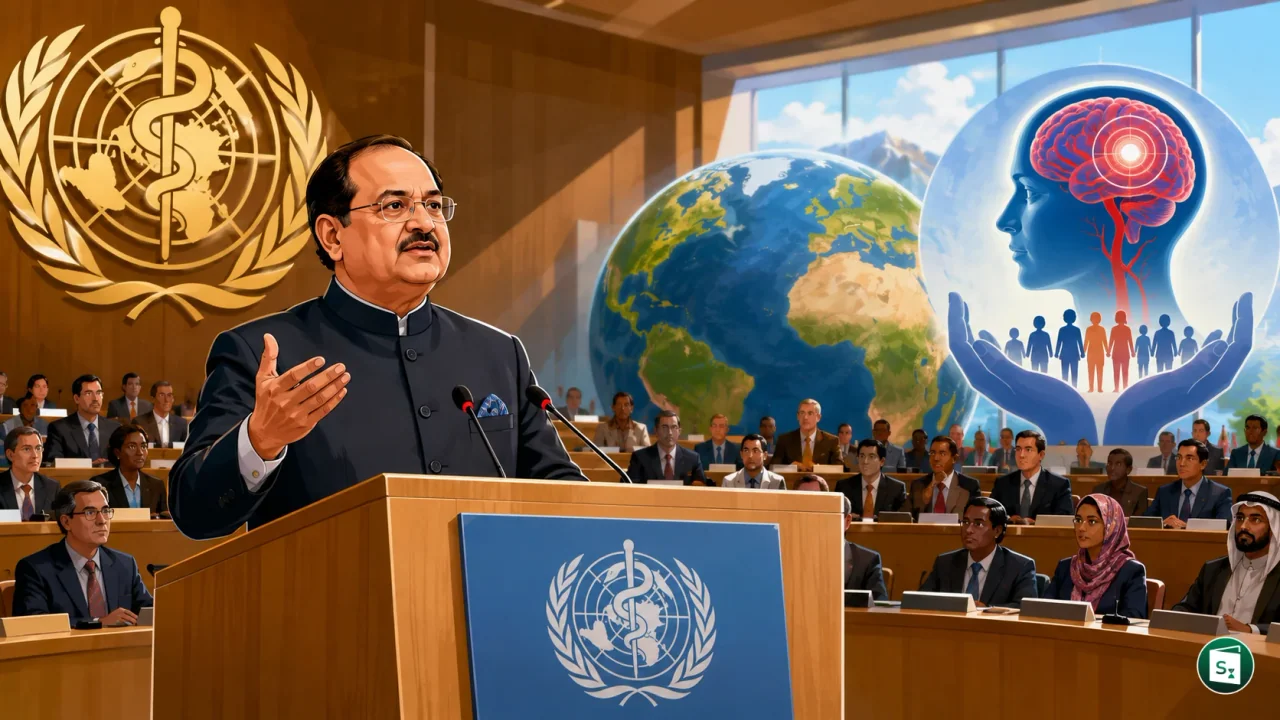
The 79th World Health Assembly (WHA79) concluded in Geneva, Switzerland, on May 30, 2026, marking a significant milestone in international cooperation with the adoption of the first-ever global resolution on stroke. Organized by the World Health Organization (WHO) under the theme “Reshaping Global Health: A Shared Responsibility,” the assembly brought together health ministers and delegates from across the globe. India’s Union Minister for Health and Family Welfare, J.P. Nadda, addressed the plenary, reaffirming India’s commitment to digital health transformation and universal health coverage.
What Is the World Health Assembly?
The World Health Assembly (WHA) is the supreme decision-making body of the World Health Organization (WHO). It is attended by delegations from all WHO Member States and focuses on a specific health agenda prepared by the Executive Board. The main functions of the assembly include determining the policies of the organization, appointing the Director-General, supervising financial policies, and reviewing and approving the proposed program budget.
The World Health Organization (WHO) itself was established on April 7, 1948, a date now celebrated annually as World Health Day. Headquartered in Geneva, Switzerland, the WHO operates as a specialized agency of the United Nations responsible for international public health. The WHA is held annually in Geneva and serves as the primary forum through which member states exercise their governing authority over the global health body.
Key Highlights of the 79th Assembly
The 79th edition of the assembly was presided over by Dr. Víctor Atallah Lajam, the Minister of Health of the Dominican Republic. Under the overarching theme of “Reshaping Global Health: A Shared Responsibility,” the session emphasized the need for collective action to address emerging health threats and bridge the gap in healthcare access between nations.
During the intensive week-long session, member states reached a consensus on a wide range of global health priorities, adopting more than 20 decisions and 13 resolutions. These outcomes covered critical areas such as antimicrobial resistance (AMR), climate change impacts on health, the health workforce crisis, and the integration of advanced technologies like Artificial Intelligence (AI) into public health surveillance. The assembly served as a critical platform for evaluating the world’s progress toward the health-related Sustainable Development Goals (SDGs) for 2030.
A Historic Resolution on Stroke Management
In a landmark decision, the WHA79 adopted its first-ever resolution on stroke, formally recognizing it as a top-tier global public health priority. The resolution, titled “Reducing the burden of stroke: strengthening prevention, acute care, rehabilitation and health-system readiness,” was spearheaded by Egypt. It received broad international support, being co-sponsored by Chile, Georgia, Palestine, Paraguay, and Tunisia.
Stroke is currently the third leading cause of death and disability worldwide, with one in four adults expected to experience a stroke in their lifetime. The resolution mandates that member states integrate comprehensive stroke care into their Universal Health Coverage (UHC) frameworks. It emphasizes the entire patient journey, from primary prevention and emergency acute care to long-term rehabilitation. By reinforcing reporting accountability through the WHO Global Non-Communicable Disease (NCD) Action Plan, the resolution aims to significantly reduce stroke-related mortality and long-term disability globally.
India’s Address: Strengthening Global Health Equity
Union Minister J.P. Nadda represented India at the WHA79 plenary, where he showcased India’s successful models for large-scale health equity. He highlighted the Ayushman Bharat initiative as a dual-pillar strategy for achieving universal health coverage. The first pillar consists of over 1.85 lakh Ayushman Arogya Mandirs (formerly Health and Wellness Centers), which provide primary healthcare services to remote communities. The second pillar, PM-JAY (Pradhan Mantri Jan Arogya Yojana), has emerged as the world’s largest public health assurance program, covering nearly 600 million beneficiaries.
A major focus of the address was India’s digital health revolution under the Ayushman Bharat Digital Mission (ABDM). The mission has already generated over 880 million unique digital health IDs, creating a secure and interoperable digital backbone for health records. Minister Nadda also reaffirmed India’s commitment to global solidarity by pledging an annual grant of USD 2 million to the Partnership for Maternal, Newborn and Child Health (PMNCH). He emphasized that India, as the “Pharmacy of the World,” remains dedicated to ensuring the equitable distribution of high-quality vaccines and medicines globally.
Advancing Global Standards: Radiation and Precision Medicine
The WHA79 introduced several forward-looking standards to govern the future of medical science and technology. For the first time, the assembly passed a comprehensive resolution on radiation and health, addressing the growing exposure to both ionizing and non-ionizing radiation in medical and environmental settings. This resolution sets global benchmarks for patient safety and occupational protection in radiology and nuclear medicine.
Additionally, a new global strategy for precision medicine was approved to ensure that advancements in genomics and targeted therapies benefit all nations. The strategy aims to prevent a “genomic divide” by facilitating technology transfer to low- and middle-income countries. The assembly also updated the Global Code of Practice on the International Recruitment of Health Personnel for the first time in 16 years. This update aims to protect the rights of healthcare workers while ensuring that international recruitment does not drain the medical workforces of developing nations.
Key Takeaways
- The 79th World Health Assembly (WHA79) was held in Geneva, Switzerland, under the theme “Reshaping Global Health: A Shared Responsibility.”
- The assembly was presided over by Dr. Víctor Atallah Lajam, the Minister of Health of the Dominican Republic.
- A historic, first-ever global resolution on stroke was adopted, led by Egypt and co-sponsored by five other nations.
- Stroke is recognized as the third leading cause of death globally, and the resolution mandates its inclusion in Universal Health Coverage frameworks.
- Union Minister J.P. Nadda addressed the plenary, highlighting that India has established over 1.85 lakh Ayushman Arogya Mandirs and 880 million digital health IDs.
- India pledged an annual grant of USD 2 million to the Partnership for Maternal, Newborn and Child Health (PMNCH) to support global health equity.
- The World Health Organization (WHO), founded on April 7, 1948, is headquartered in Geneva and celebrates its founding day as World Health Day.