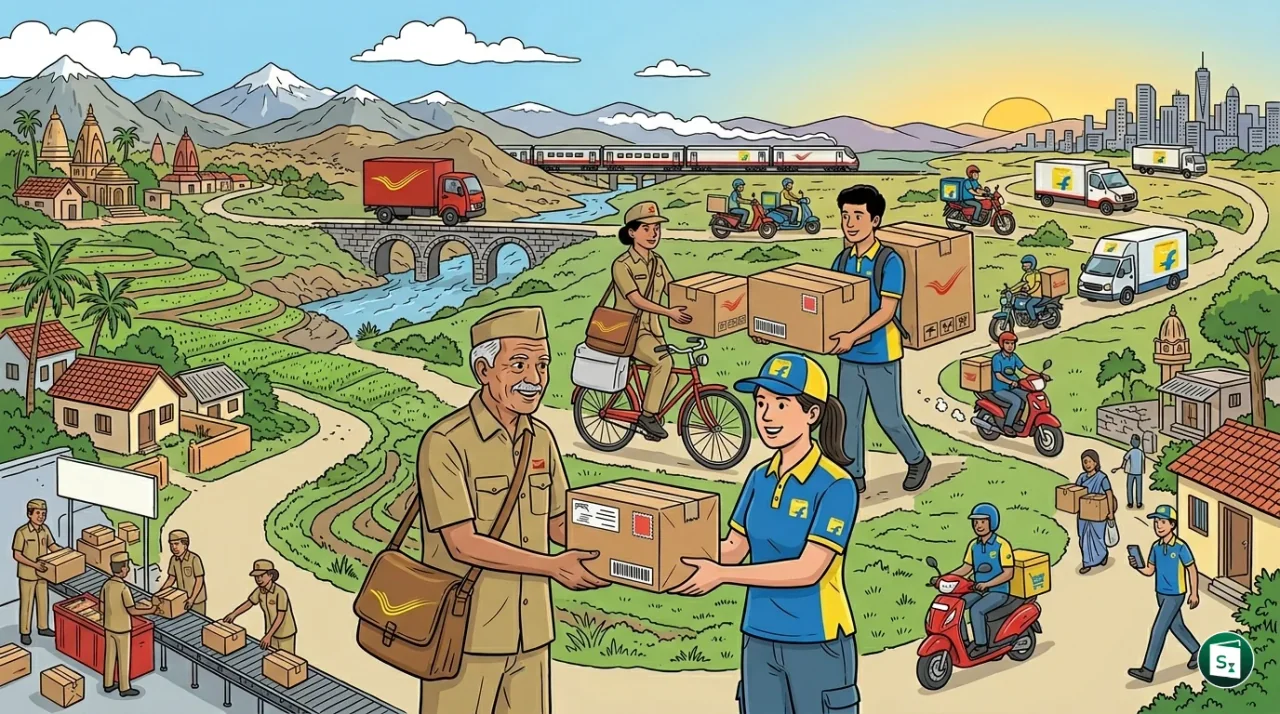
The Department of Posts signed a strategic agreement with Flipkart India on May 30, 2026, to fortify the country’s e-commerce logistics network. This partnership aims to enhance parcel delivery efficiency across urban, rural, and remote regions by leveraging the vast postal infrastructure. The collaboration marks a significant step towards providing seamless last-mile connectivity for millions of consumers in underserved areas.
Operational Framework and Technological Integration
The formalization of the agreement was led by Neeraj Kumar Jha, General Manager of the Parcel Directorate at the Department of Posts, and Harvinder Kapur, Director of Commercial at Flipkart India. Under this partnership, Flipkart will integrate its sophisticated supply chain systems with the recently modernized IT 2.0 framework of India Post. This digital synergy ensures that the entire lifecycle of a parcel, from the fulfillment center to the customer’s doorstep, is managed through a synchronized and transparent system.
To ensure security and build consumer trust, the partnership introduces several advanced features:
- OTP-based Delivery Authentication: Every parcel delivery will require an One-Time Password (OTP) verification, minimizing the risk of misdelivery or unauthorized handovers.
- Real-time Tracking: Customers will have access to end-to-end tracking through the India Post and Flipkart platforms, providing visibility into the shipment’s movement across the postal network.
- Flexible Payment Options: The collaboration supports both Prepaid and Cash-on-Delivery (COD) shipments, catering to the diverse payment preferences of Indian consumers, especially in rural markets.
The operational backbone of this partnership involves utilizing 344 specialized Delivery Centres and 94 Sorting Hubs that India Post has operationalized specifically for its parcel business. These hubs are designed to handle high volumes of e-commerce traffic with faster turnaround times.
Bridging the Urban-Rural Digital Divide
One of the primary objectives of this partnership is to expand the footprint of e-commerce into the heart of rural India, often referred to as “Bharat.” While private logistics providers have established strong networks in Tier-1 and Tier-2 cities, reaching remote villages and hilly terrains remains a significant operational challenge due to high costs and fragmented infrastructure.
India Post offers a solution to this challenge with its incomparable network of over 1.6 lakh (1,64,999) post offices. Crucially, nearly 90% of these post offices are situated in rural areas, making the Department of Posts the only organization with the capability to reach every inhabited corner of the country. By plugging into this network, Flipkart can now offer its entire product range to consumers who were previously underserved.
This collaboration is expected to:
- Enable Equitable Access: Consumers in remote regions like Hikkim in Himachal Pradesh or the island territories can now access the same e-commerce services as those in New Delhi or Bengaluru.
- Boost Local Economies: Enhanced logistics connectivity allows rural artisans and small businesses to reach a national audience more effectively through return-logistics and integrated pickup services.
- Strengthen Digital Inclusion: As more rural citizens engage with e-commerce, it drives the adoption of digital payments and increases familiarity with the broader digital ecosystem.
Evolution of the Department of Posts
The Department of Posts (DoP), operating under the Ministry of Communications, is one of the oldest and most trusted institutions in India. While postal services in India date back to the 18th century, the modern Indian Post Office was formally established on October 1, 1854, under the Indian Post Office Act. Lord Dalhousie, the then Governor-General of India, is credited with laying the foundation of the modern postal system by introducing uniform postage rates.
Over the decades, the department has continuously evolved to meet the changing needs of the nation:
- PIN Code System: The Postal Index Number (PIN) system was introduced on August 15, 1972, to simplify the sorting and delivery of mail. India is divided into nine PIN zones.
- Financial Inclusion: In 2018, the government launched the India Post Payments Bank (IPPB) to leverage the postal network for banking services in rural areas.
- IT 2.0 Modernization: By August 2025, India Post completed its IT 2.0 transformation, migrating its entire network of 1.65 lakh post offices to a unified digital platform. This modernization enabled real-time tracking, digital payment integration, and the capability to handle high-frequency e-commerce transactions.
Headquartered at Dak Bhawan in New Delhi, the Department of Posts is currently the largest postal network in the world. Its transition into a logistics powerhouse is a central pillar of India’s broader strategy to modernize public infrastructure for the digital age.
Synergy with the National Logistics Policy
The India Post-Flipkart partnership is deeply aligned with the National Logistics Policy (NLP) 2022, which aims to transform India into a global logistics hub by reducing costs and increasing efficiency. India’s logistics cost currently stands at approximately 13 to 14 percent of GDP, significantly higher than the global average of 8 percent. The NLP targets bringing this down to a single-digit figure by 2030.
This agreement supports several key pillars of the NLP:
- Last-Mile Efficiency: By utilizing the existing 1.6 lakh post offices, the partnership reduces the need for redundant infrastructure, thereby lowering the overall cost of delivery.
- Digital Integration: The collaboration leverages the Unified Logistics Interface Platform (ULIP), a single-window portal that integrates 30 different digital systems from various departments to ensure seamless cargo movement.
The Four Pillars of National Logistics Policy 2022
| Pillar | Focus Area |
|---|---|
| Integration of Digital System (IDS) | Unifying digital platforms of 7 different ministries. |
| Unified Logistics Interface Platform (ULIP) | Real-time tracking and secure data exchange between public and private players. |
| Ease of Logistics (ELOG) | Digital dashboard for industry associations to report operational bottlenecks. |
| System Improvement Group (SIG) | Inter-ministerial coordination to monitor projects and suggest legal reforms. |
By optimizing the e-commerce supply chain, this partnership also contributes to the PM Gati Shakti National Master Plan, which focuses on integrated infrastructure development across the country.
About Flipkart and Ekart
Founded in 2007 by Sachin Bansal and Binny Bansal, Flipkart has grown to become India’s leading e-commerce platform. Since 2018, the company has been majority-owned by the American retail giant Walmart. In early 2026, Flipkart completed a significant corporate restructuring, shifting its holding domicile back to India from Singapore to prepare for a domestic initial public offering.
Flipkart’s logistics operations are managed by its dedicated arm, Ekart (Instakart Services Private Limited). Ekart is one of India’s largest private supply chain networks, covering over 15,000 pin codes and serving nearly 1,800 cities. By partnering with India Post, Flipkart aims to transition toward a hybrid logistics model, combining its high-speed urban infrastructure with the deep rural reach of the public postal system. This strategy allows the company to scale its operations efficiently while supporting the government’s vision of a digitally empowered India.
Key Takeaways
- The Department of Posts signed a strategic agreement with Flipkart India on May 30, 2026, to strengthen the e-commerce logistics ecosystem.
- The partnership utilizes India Post’s network of over 1.6 lakh post offices, focusing on last-mile delivery in rural and remote regions.
- The collaboration involves integration with the IT 2.0 framework of India Post, enabling advanced features like OTP-based delivery authentication.
- India Post was established in 1854 and operates under the Ministry of Communications, with its headquarters at Dak Bhawan, New Delhi.
- The agreement aligns with the National Logistics Policy 2022, which aims to reduce logistics costs to below 10 percent of GDP by 2030.
- Ekart, the logistics arm of Flipkart, will manage the private-sector side of the partnership to reach underserved areas of “Bharat.”