The Centre for Marine Living Resources & Ecology (CMLRE), an attached office of the Ministry of Earth Sciences (MoES), released the “National Report on Deep-Sea and Distant-Water Fishery Resources of the Indian Exclusive Economic Zone (EEZ)”. The publication was unveiled during CMLRE’s Silver Jubilee celebrations in Kochi and compiles nearly four decades of oceanographic research across India’s 2.37 million square kilometre EEZ. The report is a scientific roadmap for tapping the country’s untapped deep-sea food wealth while protecting fragile marine ecosystems.
What Is the National Report on Deep-Sea Fishery Resources of the Indian EEZ?
The National Report on Deep-Sea and Distant-Water Fishery Resources of the Indian EEZ is a comprehensive scientific document that assesses the living resources present in the deeper waters beyond India’s coastline. It brings together almost 40 years of pioneering oceanographic research and three decades of systematic marine surveys carried out under the Marine Living Resources (MLR) Programme.
The report was edited by Dr V N Sanjeevan, former Director of CMLRE, and Dr Baban Ingole, retired Scientist at the National Institute of Oceanography (NIO) in Goa. It was published under the leadership of Dr R S Maheshkumar, who is the Head of CMLRE. The core authorial team that synthesised this massive repository of multidisciplinary data included Dr Hashim Manjebrayakath, Dr Smitha B R, Dr Rajeesh Kumar M P, Dr Meera K M, Dr Purbali Saha, Dr Sahina Akter, Dr Chinmay Kar and Dr Davood Nihal.
The report was formally unveiled in the presence of Dr M Ravichandran, former Secretary of MoES, former CMLRE Directors Dr P Madheswaran and Dr M Sudhakar, Dr M V Ramana Murthy, Director of the Deep Ocean Mission, and senior members of the marine science community. It is far more than a scientific archive; it provides a definitive roadmap for the sustainable development of India’s Blue Economy by balancing resource assessment with biodiversity conservation.
What Is an Exclusive Economic Zone (EEZ)?
An Exclusive Economic Zone (EEZ) is a sea zone in which a coastal nation has special rights to explore, use and manage marine resources. It extends up to 200 nautical miles (about 370 kilometres) from the baseline, which is normally the low-water line along the coast. Within this zone, the country holds exclusive rights to fish, drill for oil and gas, and carry out other economic activities, but it does not hold full sovereignty over the waters themselves, which remain subject to international law.
The concept of the EEZ is defined under the United Nations Convention on the Law of the Sea (UNCLOS) 1982, a treaty that India ratified in 1995. UNCLOS is often called the constitution of the oceans because it lays down the legal framework for all activities in the seas. India’s EEZ spans roughly 2.37 million square kilometres, an area larger than many countries, and the report compiled data across this entire expanse from the Arabian Sea and Bay of Bengal to the Andaman Sea and the Southern Ocean.
Analogy · EEZ as a Home Garden Expand analogy
Think of a home garden around your house. You can plant, water and harvest crops there, but the public road beyond the fence is not yours. The EEZ works the same way. India can harvest fish and minerals within its 200-nautical-mile marine garden, while the high seas beyond belong to everyone.
Maritime Zones Under UNCLOS
UNCLOS divides the ocean into distinct zones, each with different rights for the coastal state. Understanding these zones is essential to grasp where India can fish and where it cannot.
| Zone | Distance from Baseline | Rights of the Coastal State |
|---|---|---|
| Territorial Sea | Up to 12 nautical miles | Full sovereignty, like land territory; foreign ships have right of innocent passage |
| Contiguous Zone | Up to 24 nautical miles | Can enforce laws on customs, immigration, sanitation and pollution |
| Exclusive Economic Zone (EEZ) | Up to 200 nautical miles | Exclusive rights to explore and exploit marine living and non-living resources |
| Continental Shelf | Extends beyond 200 nautical miles in some cases | Sovereign rights over seabed and subsoil resources |
| High Seas | Beyond the EEZ | Open to all nations; no single state owns these waters |
In India, these zones are operationalised through the Territorial Waters, Continental Shelf, Exclusive Economic Zone and Other Maritime Zones Act, 1976, which was enacted to give effect to the provisions of UNCLOS.
About CMLRE: The Body Behind the Report
The Centre for Marine Living Resources & Ecology (CMLRE) is a research institute based in Kochi, Kerala, functioning as an attached office of the Ministry of Earth Sciences (MoES). It was established in 1998 by upgrading the then Sagar Sampada Cell, with dedicated facilities to implement India’s Marine Living Resources (MLR) Programme.
CMLRE organises, coordinates and promotes ocean research and development in India. Its core mandates include mapping marine resources, preparing inventories of commercially exploitable species, ensuring optimum utilisation through ecosystem management, and conducting basic research in marine living resources and ecology. The centre marked its Silver Jubilee in 2026, celebrating 25 years of contributions to marine science, deep-sea research and ocean ecology.
Besides the MLR Programme, CMLRE is the nodal agency for Vertical 3 of the Deep Ocean Mission, which focuses on technological innovations for the exploration and conservation of deep-sea biodiversity. It also contributes to Mission Mausam, a programme that advances the scientific understanding of ocean-atmosphere interactions for climate-resilient fisheries and coastal communities.
FORV Sagar Sampada: India’s Floating Laboratory
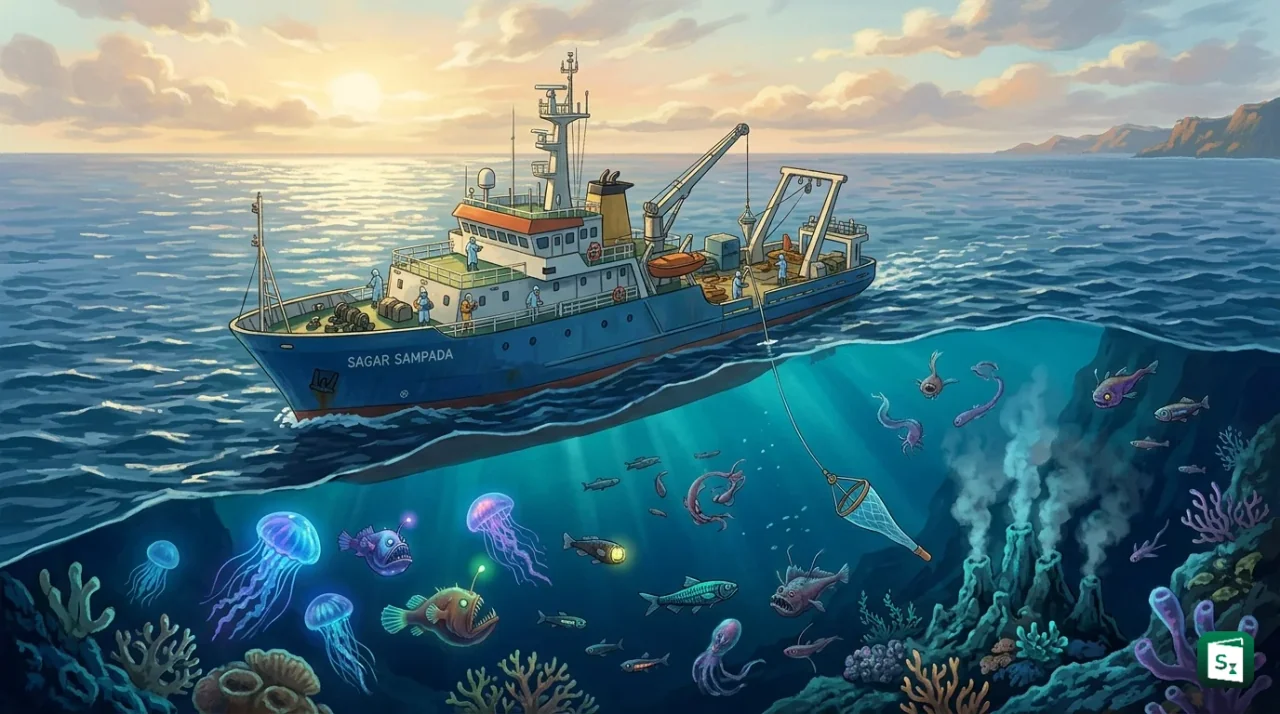
The backbone of the assessment studies behind the report is the Fishery and Oceanographic Research Vessel (FORV) Sagar Sampada, India’s flagship research vessel. It is owned by the Ministry of Earth Sciences and operated by CMLRE.
The vessel was built in 1984 in Denmark under the DANIDA programme and commissioned on 6 November 1984. It has an overall length of 71.5 metres, a breadth of 16 metres and a draft of 5.4 metres. Classified as Ice Class B, it can venture up to 60 degrees South Latitude, which enabled its scientific expeditions into the Indian Ocean sector of the Southern Ocean near Antarctica.
Sagar Sampada is essentially a floating laboratory that carries multidisciplinary teams of scientists through weeks-long expeditions across the Arabian Sea, the Bay of Bengal, the Lakshadweep waters and the Andaman Sea. Its key specifications include:
- Capacity to carry 22 scientists and technicians and 35 ship officers and crew
- Ability to trawl up to a depth of 1,000 metres
- Onboard facilities including fishery acoustic equipment, deep-sea sampling gear, analytical laboratories and meteorological instruments
- Specialised trawls such as bottom trawls, High Speed Demersal Trawl (HSDT), mid-water trawls and krill trawls
- Scientific instrumentation including a CTD profiler (to measure conductivity, temperature and depth of seawater), Acoustic Doppler Current Profiler and a hull-mounted sonar
- Average speed of 10 knots and an endurance of 35 days at sea
The vessel has completed more than 400 scientific cruises since the early 1990s under the Marine Living Resources Programme, making it one of the most heavily used research platforms in India’s ocean science history.
Key Findings of the Report
The report presents an unprecedented collective scientific effort, mapping species distributions, estimating fish abundance and capturing critical environmental data from the deep-sea frontier. Its findings are organised around four major resource groups.
The Twilight Zone’s Mesopelagic Riches
The report examines the mesopelagic layer, also called the twilight zone, which extends from 200 to 1,000 metres below the ocean surface. This zone houses dense communities of lanternfishes (myctophids), deep-sea shrimps and cephalopods. The report details how their nightly vertical migration drives the ocean’s biological carbon pump, a process that transfers carbon from the surface to the deep sea and helps regulate the global climate. These resources represent a vast, largely untapped biomass with significant commercial potential.
Underexploited Deep-Sea Demersal Stocks
The report provides a meticulous assessment of demersal resources, the fish that live on or near the seabed, inhabiting the continental slope beyond 200 metres depth. It identifies substantial, currently underexploited stocks of deep-sea shrimps, perches, scombroids, flatfishes and eels. Scombroid refers to the group of fish that includes tuna and mackerel. These findings indicate that India’s coastal fisheries, which are heavily fished, could be supplemented by sustainable harvesting from deeper waters.
Distant-Water Species
Comprehensive data is compiled on high-value open-ocean and deep-water species, including tunas, billfishes, sharks, oceanic squids and Antarctic krill. These distant-water resources are important for the country’s marine fisheries and its ocean economy, and they expand the scope of India’s fishing operations beyond the near-shore waters.
Marine Biodiversity Hotspots to Protect
Crucially, the publication documents ecologically vital regions that serve as nurseries and habitats for vulnerable ecosystems. Key areas highlighted include the Kollam Bank and Angria Bank, the deep-sea slope off Mangalore, the terrace off Trivandrum, and the waters around the Lakshadweep and Andaman-Nicobar Islands. The report stresses that these biodiversity hotspots must be conserved even as fishing activity expands.
Why the Report Matters for India’s Blue Economy
The Blue Economy refers to the sustainable use of ocean resources for economic growth, improved livelihoods and jobs, while preserving the health of marine ecosystems. India, with a coastline of about 7,517 kilometres, has a strong stake in this emerging economic frontier.
The report also highlights how modern technologies are transforming Indian oceanography. By integrating historical field observations with fisheries acoustics, environmental DNA (eDNA), autonomous observing platforms, satellite observations, artificial intelligence (AI) and ecosystem modelling, India is building a state-of-the-art framework for marine spatial planning. This framework will help decide where fishing, conservation and other ocean activities should be located.
Fisheries already form a substantial part of India’s economy. The country is the second-largest fish producer in the world, contributing about 8 per cent of global fish output. In the financial year 2024-25, fish production crossed 197 lakh tonnes, while seafood exports touched a record ₹62,408 crore. The sector contributes about 1.1 per cent of national GDP and roughly 7.3 per cent of agricultural GDP. Tapping the deep-sea resources documented in the report could further strengthen this economic pillar.
The Way Forward
The report directly reinforces India’s Vision 2047, which places the Blue Economy at the core of national growth. It also strengthens India’s commitments to UN Sustainable Development Goal 14 (Life Below Water) and the UN Decade of Ocean Science for Sustainable Development.
Going forward, the scientific foundation laid by this report must be translated into policy. This includes formulating a national deep-sea fishing policy that protects underexploited stocks from overfishing, investing in larger and more modern research vessels, and using the report’s hotspot mapping to create marine protected areas. As Dr M Ravichandran observed, sustainable prosperity will come not simply from discovering new marine resources, but from understanding them, respecting the ecosystems that sustain them, and managing them with science as the guiding compass.
Key Takeaways
- The National Report on Deep-Sea and Distant-Water Fishery Resources of the Indian EEZ was released by CMLRE, an attached office of the Ministry of Earth Sciences (MoES).
- The report compiles nearly 40 years of oceanographic research and over 400 scientific cruises across India’s 2.37 million square kilometre EEZ.
- The Exclusive Economic Zone (EEZ) extends up to 200 nautical miles from the baseline, defined under UNCLOS 1982, which India ratified in 1995.
- CMLRE, established in 1998 in Kochi, marked its Silver Jubilee in 2026, and is the nodal agency for Vertical 3 of the Deep Ocean Mission.
- The report was edited by Dr V N Sanjeevan and Dr Baban Ingole, under the leadership of Dr R S Maheshkumar, Head of CMLRE.
- FORV Sagar Sampada, built in 1984 in Denmark, is India’s flagship research vessel, operated by CMLRE and capable of trawling to a depth of 1,000 metres.
- The report covers mesopelagic (twilight zone) resources from 200 to 1,000 metres, underexploited demersal stocks, distant-water species, and biodiversity hotspots like Angria Bank and the Kollam Bank.