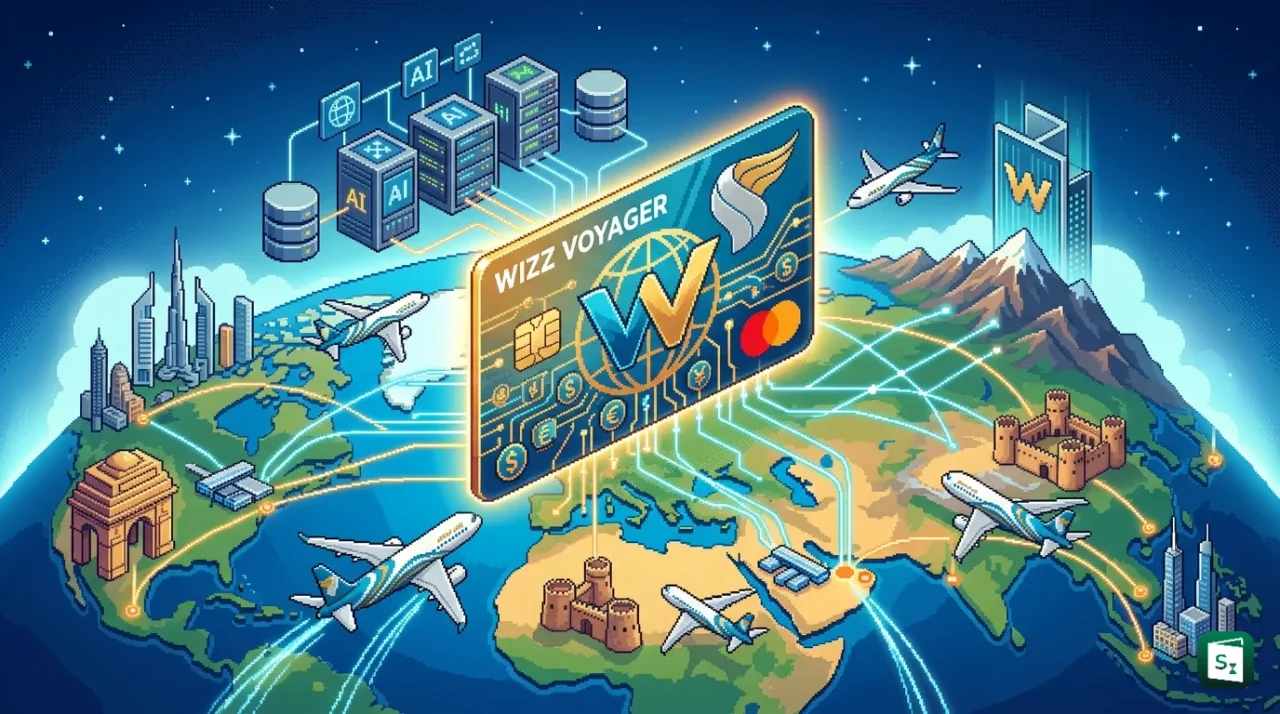
Wizzmoni Financial Services Limited, an Indian Non-Banking Financial Company (NBFC) that was earlier known as Unimoni, has joined hands with Oman Air, the national carrier of the Sultanate of Oman, to launch the Wizz Voyager Multi-Currency Card. This co-branded, AI-powered travel card lets users load, hold, and spend in more than 35 global currencies on a single card. The partnership brings Wizzmoni’s fintech capabilities together with Oman Air’s international network, so travellers can manage payments, rewards, and travel benefits from one digital platform.
What Is the Wizz Voyager Multi-Currency Card?
The Wizz Voyager Multi-Currency Card is a prepaid multi-currency forex card issued by Wizzmoni and powered by Visa. Unlike a regular credit card that bills everything in one currency, this card lets the holder load money in advance in multiple currencies and then spend in the local currency of the destination country. When you travel to Dubai, London, or Bangkok, the card automatically uses the correct currency you have loaded, which helps avoid repeated conversion charges.
A multi-currency card is a prepaid travel payment card that can store more than one foreign currency at the same time. The money sits on the card as separate digital pockets, and the user can choose which pocket to spend from. For example, a traveller planning a trip covering the United Arab Emirates and Thailand can load UAE dirhams and Thai baht on the same card, then switch between them as they move across borders.
The card is designed for frequent travellers, international students, and working professionals who spend money abroad regularly. Its digital-first setup means the entire process of applying, loading money, and tracking spending happens through the Wizz Voyager mobile app, though the physical card can also be collected from Oman Air counters, Wizzmoni branches, and authorised partner outlets.
The Partners Behind the Card
Two very different institutions, one a diversified Indian lender and the other a Gulf airline, have come together on this product. Understanding both gives a clearer picture of why the card exists and how it works.
Wizzmoni: From Unimoni to a Diversified NBFC
Wizzmoni Financial Services Limited, the card issuer, began operations in India in 1991 and was incorporated as a public limited company in 1995. For most of its life it was known as Unimoni, and it rebranded to Wizzmoni in 2018. The company is headquartered in Ernakulam, Kerala, and is the India arm of Wizz Financial, a global fintech platform led by founder and group CEO Amir Nagammy with a presence in India, the Gulf region, and the United States.
Wizzmoni is one of India’s oldest and most diversified NBFCs, with a nationwide network of more than 360 branches, over 12,000 agents, and 5 million-plus customers. It is approved by the Reserve Bank of India (RBI) and holds a series of licences that underline its reach. It got its Full-Fledged Money Changer (FFMC) licence in 2000, became the first FFMC in India to upgrade to an Authorised Dealer Category II (AD II) licence in 2006, and received RBI approval to run a prepaid wallet in 2009. It also secured its NBFC licence in 2002 and today offers forex services, remittances, travel and holidays, insurance, education loans, and gold loans.
Oman Air: A oneworld Alliance Carrier
Oman Air is the national flag carrier of the Sultanate of Oman. It began operations in 1993 and is based at Muscat International Airport, operating to around 42 destinations across 22 countries and territories. The airline became the newest member of the oneworld alliance in June 2025, which connects its network to over 900 destinations worldwide and gives its passengers access to more than 700 airport lounges.
The airline has been pushing beyond core flight operations into retail and ancillary services, a strategy that this partnership fits directly. Through the co-branded card, Oman Air extends its relationship with customers beyond the airport and taps into the spending a traveller makes in the destination country.
Key Features and How the Card Works
The Wizz Voyager card is built around four broad capabilities: multi-currency loading, AI-powered digital control, rewards tied to airline travel, and security features.
| Feature | What It Does |
|---|---|
| Multi-currency support | Hold and spend in 35+ global currencies, including exotic ones like the Malaysian ringgit, Vietnamese dong, and Georgian lari |
| On-the-fly conversion | Exchange between currencies instantly inside the Wizz Voyager app |
| AI-powered spend insights | Categorised, trip-by-trip spending breakdowns and budget nudges |
| Instant card controls | Lock, unlock, freeze, or set spending limits from the phone in real time |
| Milestone-based rewards | Earn Oman Air flight vouchers, cabin upgrades, and exclusive travel benefits as spending crosses set milestones |
| Travel extras | Airport lounge access, travel SIM and eSIM data packs, and add-on insurance covers |
| Security | Biometric login, location-based fraud monitoring, and 256-bit encryption |
The rewards system is the most distinctive part. Instead of giving generic cashback, the card converts everyday spending into travel assets. Reach a spending milestone and you earn vouchers and upgrades valid on Oman Air, and travellers can browse Oman Air holidays and ancillary services directly through the card’s digital platform. In this way, the card merges the booking phase and the payment phase of a journey into a single ecosystem.
The card is prepaid, which means users load money before they travel and can only spend what is loaded. A smartphone app provides real-time tracking of every transaction, currency conversion calculators, and automatic switching between loaded balances. For extra convenience, holders get one free ATM withdrawal per month and can withdraw cash at retail counters where supported.
Why This Partnership Matters
The launch comes at a time when more Indians are travelling abroad than ever before. India recorded a record 3.89 crore outbound departures in 2024, driven by leisure travel, visits to relatives, and business trips. A large share of Indian international travel is directed at the Gulf region, including the UAE, Saudi Arabia, Qatar, and Oman, where Indian workers and tourists make up a big part of the traffic. This makes an Oman Air co-branded card a strategically placed product for a corridor that Wizzmoni already serves heavily through remittances and money transfer.
The partnership also reflects a wider shift in aviation and finance. Airlines around the world are moving from being simple transport providers to travel retailers that capture a bigger share of a passenger’s spending. A co-branded card is a direct tool for that, because it keeps the airline’s brand on the customer’s card even after the flight ends. For Wizzmoni, the deal opens a ready-made pool of travellers and gives the company a strong customer-acquisition channel. For Oman Air, it deepens customer loyalty and creates a new stream of ancillary revenue beyond ticket sales.
From the traveller’s point of view, the biggest benefit is being able to handle payments, rewards, and travel planning in one place instead of juggling a forex card, a separate loyalty programme, and several travel apps. Such embedded financial services, where payments are built into ordinary travel experiences, are becoming the norm in global fintech.
Co-Branded Cards and the RBI Regulatory Framework
A co-branded card is a payment card that carries the names of two organisations, usually a financial institution and a business partner such as an airline, a retail chain, or a hotel group. The partner typically brings customer access and benefits, while the financial institution brings the payment infrastructure and regulatory compliance. Common examples in India include airline co-branded cards from Air India, Emirates, Etihad, and Qatar Airways, as well as retail and fuel cards.
In India, co-branded prepaid cards are governed by the RBI’s regulatory framework. A prepaid payment instrument (PPI) is a payment tool that stores value that can be used to make purchases. Since a multi-currency forex card is prepaid in nature, it falls within this framework. Under the RBI’s Master Direction on Prepaid Payment Instruments, only certain authorised entities can issue PPIs, and co-branding arrangements between banks and non-banks require regulatory approval, with the principal licence holder taking responsibility for the product’s compliance.
Foreign exchange transactions themselves are regulated under the Foreign Exchange Management Act (FEMA), 1999, which empowers the RBI to frame rules for current account transactions such as foreign travel. Issuers of forex cards need authorisation from the RBI, typically as Authorised Dealers (AD) or Full-Fledged Money Changers (FFMC), and must follow know-your-customer (KYC) norms. Travellers can buy foreign exchange up to 60 days before departure, and payments above ₹50,000 for such purchases must be made digitally rather than in cash.
Understanding NBFCs
The Wizz Voyager card is issued by an NBFC, so the term deserves a clear definition. An NBFC is a company registered under the Companies Act that carries on the business of lending, investment, or a financial activity, but does not hold a banking licence and cannot accept demand deposits. NBFCs are registered with and regulated by the Reserve Bank of India under the Reserve Bank of India Act, 1934, but they are not part of the payment and settlement system and cannot issue cheques drawn on themselves.
Multi-Currency Cards vs Forex Cards vs Credit Cards
Travellers from India often confuse these payment options, so the distinction is worth spelling out. A forex card is a prepaid card loaded with foreign currency before travel. A multi-currency card is a specific type of forex card that can hold several currencies at once. A credit card is different altogether, because it lets you spend borrowed money and pay later, usually with a foreign transaction fee of around 3 to 3.5 percent on every purchase made abroad.
| Feature | Multi-Currency Card | Standard Forex Card | Credit Card Abroad |
|---|---|---|---|
| Prepaid | Yes | Yes | No, credit is used |
| Number of currencies | Multiple (35+) | Usually one or two | One billing currency |
| Foreign transaction fee | Minimal to none | Minimal to none | Often 3 to 3.5 percent |
| Cash withdrawal abroad | Yes | Yes | Yes, with fees and interest |
| Rewards | Airline and travel rewards | Few | Credit card reward points |
| Best for | Multi-country trips | Single-destination trips | Everyday and emergency use |
There is also a growing category of zero-forex-markup cards, such as those from Niyo and Scapia, which charge no currency conversion fee and are popular among frequent travellers. The market has become highly competitive, with Indian banks like HDFC, ICICI, Axis, and SBI all offering their own forex card products alongside dedicated fintech players.
The practical rule is simple. A traveller on a single-country trip can manage with a standard forex card. A traveller hopping across several countries in one trip gets genuine convenience from a multi-currency card like the Wizz Voyager, since currency conversion happens at their chosen time and rate rather than at every shop counter.
The Way Forward
The success of the Wizz Voyager card will ultimately depend on how competitive its exchange rates are, how smooth its digital onboarding feels, and how valuable its rewards prove to be. The AI-powered features are a point of difference, but travellers tend to judge a product on practical terms such as fees, rates, acceptance, and the real value of the vouchers on offer.
For the wider sector, this launch is part of a clear trend. Airlines are becoming de facto fintech providers, and financial companies are embedding themselves inside travel, education, and retail experiences. If partnerships like this succeed, more airlines and financial institutions are likely to follow, and traditional banks may find themselves competing harder to keep travel-heavy customers who can now manage most of their foreign spending without a bank account at all.
Key Takeaways
- The Wizz Voyager Multi-Currency Card is a co-branded, AI-powered prepaid travel card launched by Wizzmoni Financial Services Limited and Oman Air, issued on the Visa network.
- The card supports spending in 35+ global currencies, including exotic ones such as the Malaysian ringgit, Vietnamese dong, and Georgian lari.
- Wizzmoni, formerly Unimoni, is an NBFC headquartered in Ernakulam, Kerala, that began operations in India in 1991 and holds an AD II licence from the RBI, the first FFMC in India to get it.
- Oman Air is the national carrier of the Sultanate of Oman, based at Muscat International Airport, and joined the oneworld alliance in June 2025.
- The card’s milestone-based rewards system earns users Oman Air flight vouchers, cabin upgrades, and exclusive travel benefits.
- Foreign exchange and prepaid cards in India are regulated under the FEMA, 1999, and the RBI’s Master Direction on Prepaid Payment Instruments, with travel forex purchases allowed up to 60 days before departure.