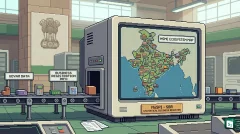
Union Minister Nirmala Sitharaman launched several transformative initiatives by the Small Industries Development Bank of India (SIDBI) on May 30, 2026, to strengthen the rural financial ecosystem. During the bank’s 37th foundation day in Mumbai, the Finance Minister unveiled platforms aimed at improving credit access for micro enterprises and traditional artisans. These measures are designed to integrate semi-urban and rural businesses into the formal economy through digital lending and cluster-based modernization.
Strengthening Rural Finance: The SIDBI-RRB Co-Lending Platform
The SIDBI-RRB Co-Lending Platform is a digital joint lending initiative designed to bridge the credit gap for small businesses in “Bharat” (rural India). By combining the institutional expertise of the Small Industries Development Bank of India (SIDBI) with the grassroots reach of Regional Rural Banks (RRBs), the platform ensures that structured finance reaches underserved geographies.
RRBs, which were established following the recommendations of the Narasimham Committee (1975), have a deep presence in rural areas but often face resource constraints. Under this co-lending model, SIDBI provides credit expertise and refinancing support, while RRBs manage the local customer relationships and loan processing. The platform offers business loans ranging from ₹20 lakh to ₹100 lakh for asset investment and operational needs, with interest rates aligned to the risk profile of the borrower.
Modernizing Rural Enterprises: The MoRE Programme
The Modernization of Rural Enterprises (MoRE) Programme is a strategic roadmap to transform India’s rural non-farm sector. Launched with a vision to support 10,000 rural micro and artisanal units over the next three years, the program focuses on enhancing productivity through technology adoption and skill upgradation. By transitioning manual production processes to automated or semi-automated systems, the MoRE initiative seeks to make rural enterprises competitive in the global market.
Cluster-Based Interventions for Artisans
Instead of providing isolated funding to individual units, the MoRE Programme employs a cluster-based approach. This strategy targets specific geographic or product-based concentrations, such as handloom weaver clusters, pottery hubs, and brass work centers. By focusing on these clusters, SIDBI aims to provide collective support in the form of shared infrastructure, modern machinery, and direct market linkages through e-commerce platforms. This ensures that traditional artisans can scale their operations while maintaining their unique cultural heritage.
Micro Credit Card Scheme: Revolutionizing Access to Working Capital
To simplify working capital access for the smallest businesses, the government introduced the Micro Credit Card Scheme. This initiative allows Udyam-registered micro enterprises to access a revolving credit limit of up to ₹5 lakh. The primary feature of this scheme is the 75% guarantee coverage, which reduces the risk for lenders and eliminates the need for mandatory primary security or collateral.
By leveraging the Udyam Registration portal, the scheme ensures a paperless and digital sanctioning process. This formal credit line is expected to help micro-entrepreneurs manage day-to-day operational expenses without relying on informal, high-interest moneylenders. The credit card functions as a flexible financial tool, allowing businesses to draw funds as needed and repay them according to their cash flow cycles.
Strategic Vision: SIDBI as a Market Maker
Union Minister Nirmala Sitharaman emphasized that SIDBI must evolve from a traditional lender into a market maker and risk-sharing partner for the startup and MSME ecosystem. Established on April 2, 1990, under an Act of the Indian Parliament, SIDBI is headquartered in Lucknow and serves as the principal financial institution for the promotion and development of MSMEs.
The launch of SIDBI MachFin Mart, a digital marketplace for machinery, further reflects this strategic shift. This portal allows small businesses to discover competitive prices for modern equipment and access embedded loan sanctions for their purchases. With a recent ₹5,000 crore equity support from the government, SIDBI, under the leadership of Chairman Manoj Mittal, aims to add 25 lakh new MSME beneficiaries by 2028. This capital infusion will strengthen the bank’s ability to support the “bottom of the pyramid” through innovative digital and cluster-based solutions.
Key Takeaways
- The SIDBI-RRB Co-Lending Platform was launched on May 30, 2026, to boost credit flow to MSMEs in semi-urban and rural areas.
- The MoRE Programme targets the modernization of 10,000 rural micro and artisanal units through cluster-based interventions over three years.
- The Micro Credit Card Scheme provides Udyam-registered micro enterprises with a revolving credit limit of up to ₹5 lakh.
- These credit cards offer a 75% guarantee coverage, allowing loans to be issued without the requirement of mandatory primary security.
- SIDBI, established in 1990 and headquartered in Lucknow, is one of India’s five All India Financial Institutions (AIFIs).
- The Narasimham Committee (1975) provided the foundational blueprint for the establishment of Regional Rural Banks (RRBs) in India.