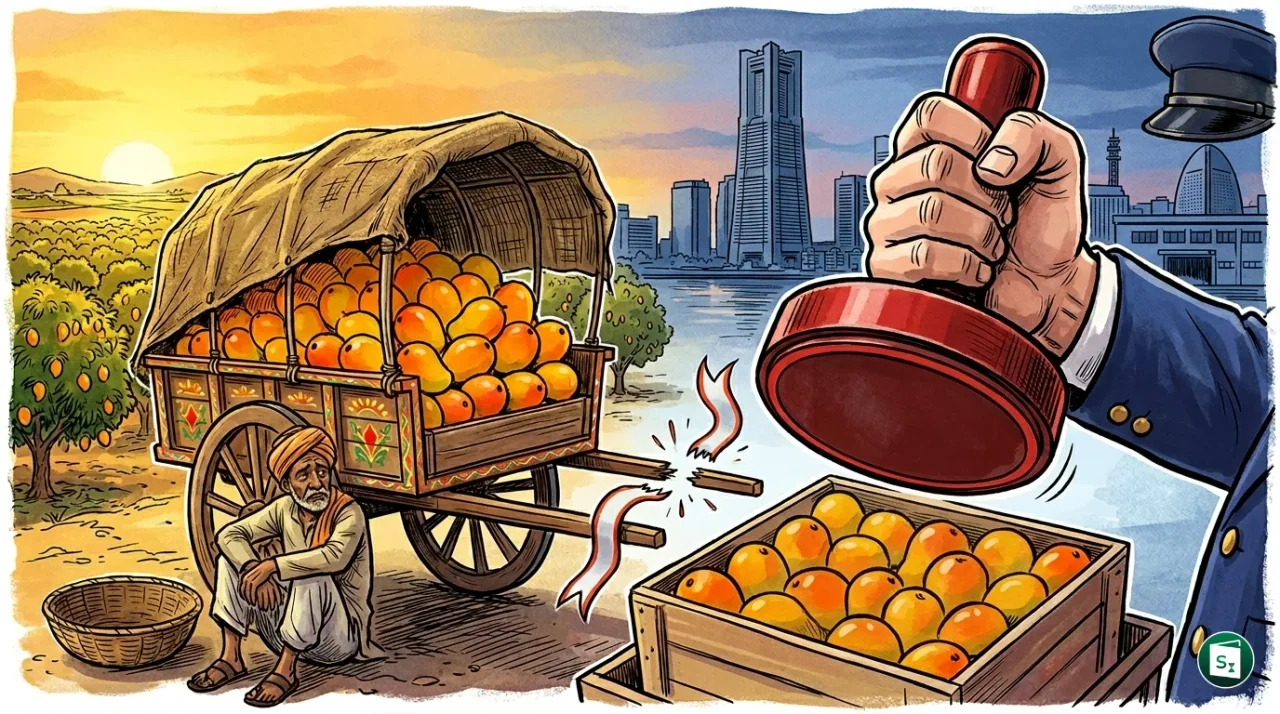
Japan has officially suspended all fresh mango imports from India for the 2026 season due to critical safety lapses identified at Indian export processing facilities. The decision, issued by the Yokohama Plant Protection Association, halts a 20-year streak of uninterrupted trade during the crucial peak harvesting months. This suspension follows recent audits by Japanese quarantine officials that revealed operational deficiencies in the mandatory heat treatment protocols required for Indian produce.
Why Has Japan Suspended Mango Imports?
The suspension was triggered after audits conducted by inspectors from Japan’s Ministry of Agriculture, Forestry and Fisheries (MAFF) in March 2026. These inspections at a Vapour Heat Treatment (VHT) facility in Rehmanpur, Uttar Pradesh, uncovered significant structural and operational deficiencies in the pest-control processes. Specifically, Japanese officials identified failures in fumigation and disinfection procedures. These steps are critical for preventing the entry of invasive pests, such as the fruit fly (Bactrocera dorsalis), into Japan.
As a result, the Yokohama Plant Protection Association announced that any Indian mangoes with inspection certificates issued on or after March 25, 2026, would not be accepted for import. This zero-tolerance policy is part of Japan’s stringent Plant Protection Law. The law aims to safeguard Japan’s domestic agriculture from foreign pests that could devastate local crops. While the suspension currently impacts the 2026 season, it has raised concerns about the long-term reliability of India’s export infrastructure for high-value premium markets.
The Vapour Heat Treatment (VHT) Protocol
Fresh mangoes exported to Japan must undergo a non-chemical quarantine process known as Vapour Heat Treatment (VHT). This protocol is mandatory because Japan maintains a zero-tolerance policy for fruit flies, which are common in tropical regions like India. Unlike the United States, which accepts irradiation, Japan relies exclusively on VHT to ensure that no live larvae or eggs are present in the fruit.
The VHT process involves exposing the mangoes to saturated water vapor to gradually increase their temperature. For the treatment to be considered successful, the innermost fruit pulp must reach a temperature of 47.5 degrees Celsius and be maintained at that level for at least 20 minutes. This process must be conducted under the physical supervision of Japanese quarantine inspectors stationed in India. Furthermore, the packaging must be secured with a fine mesh to prevent re-infestation after the treatment is complete. The current suspension highlights that even minor deviations from this rigorous protocol can lead to a total halt in trade.
Historical Context: Two Decades of Uninterrupted Trade
The current suspension is particularly significant because it ends a 20-year period of stable trade between the two nations. Japan had originally imposed a total ban on Indian mangoes in 1986 due to recurring concerns over pest infestations. It took two decades of bilateral negotiations, scientific studies, and the development of specialized infrastructure for the ban to be lifted in June 2006.
Since the lifting of the ban, India has successfully exported premium varieties such as Alphonso and Kesar to the Japanese market. The trade agreement covers specific varieties and designated production zones across states like Maharashtra, Gujarat, Andhra Pradesh, Uttar Pradesh, and West Bengal. The 2026 suspension marks the first major disruption since trade resumed. It threatens the hard-won access to one of the world’s most lucrative horticultural markets. The loss of this window is critical as it coincides with the peak summer harvest in India.
Role of APEDA and Export Infrastructure
The Agricultural and Processed Food Products Export Development Authority (APEDA) is the nodal agency responsible for facilitating the export of fresh produce from India. Established in 1986 under the APEDA Act, 1985, the authority operates under the Ministry of Commerce and Industry and is headquartered in New Delhi. APEDA plays a central role in certifying VHT facilities and coordinating the annual visits of Japanese inspectors.
To maintain high standards, APEDA utilizes the Hortinet system. This is an integrated traceability system that tracks the journey of mangoes from the farm to the final destination. Despite these systems, the recent audit findings suggest a breakdown in the monitoring of certified facilities. The suspension is a setback for APEDA’s recent initiatives aimed at boosting exports through improved sea-freight protocols and better cold-chain management. Currently, APEDA is in negotiations with Japan’s MAFF to rectify the technical deficiencies and resume trade as soon as possible.
Impact on the Indian Mango Industry
The suspension comes at a critical time when Indian mango farmers were looking forward to a robust export season. While Japan represents a relatively small share of India’s total global mango exports by volume, it is a high-value premium market. In the 2025-26 period, the market was valued at approximately $1.54 million. The loss of this market during the peak April-June season disproportionately affects growers of premium varieties. For instance, Gujarat’s Kesar mango holds a significant share of the Japanese market and will be heavily impacted.
Beyond the immediate financial loss, the suspension carries a reputational risk for Indian agricultural exports. Japan’s strict phytosanitary standards are often seen as a benchmark for quality globally. Failure to meet these standards could lead other high-end markets to scrutinize Indian produce more closely. The industry now faces the challenge of upgrading its treatment facilities. Restoring the confidence of international quarantine authorities is essential to ensure that such disruptions do not become a recurring feature of India’s export trade.
Key Takeaways
- Japan has suspended fresh mango imports from India for the 2026 season due to safety lapses at a Vapour Heat Treatment (VHT) facility in Uttar Pradesh.
- The decision was issued by the Yokohama Plant Protection Association after audits revealed deficiencies in pest-control and fumigation procedures.
- Fresh mangoes exported to Japan must reach a core pulp temperature of 47.5 degrees Celsius for 20 minutes to eliminate the risk of fruit fly infestation.
- This is the first major trade disruption in 20 years, following the lifting of a previous two-decade ban in June 2006.
- The Agricultural and Processed Food Products Export Development Authority (APEDA), established in 1986, is the nodal agency coordinating these exports.
- Premium mango varieties such as Alphonso and Kesar from designated zones in Maharashtra, Gujarat, and other states are primarily affected by the suspension.