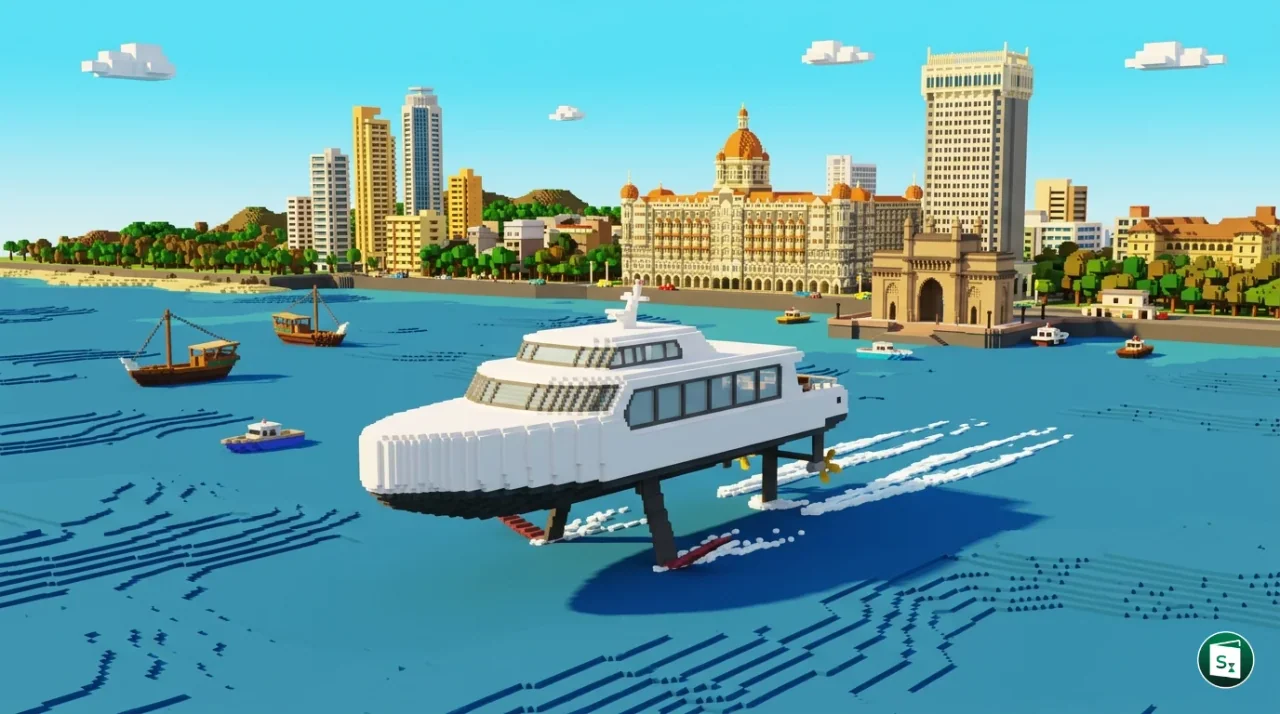
Mumbai witnessed a historic shift in maritime transport on May 29, 2026, with the inauguration of India’s first electric hydrofoil vessel, the Candela P12. This innovative flying boat employs computer-guided underwater wings to lift its hull, enabling high-speed travel with zero emissions and minimal wake. Operated by the Delhi-based startup JalVimana, the vessel is part of the Maharashtra government’s broader strategy to establish a comprehensive and sustainable water-based transit network across the Mumbai Metropolitan Region.
What is the Candela P-12 Electric Hydrofoil?
The Candela P-12 is the world’s first serial-production electric hydrofoil ferry, developed by the Swedish tech firm Candela. Unlike traditional boats that push through the water, a hydrofoil vessel uses underwater wings, or foils, to lift the entire hull above the water surface once it reaches a certain speed. This process, known as foiling, significantly reduces water resistance and drag.
By flying above the waves, the Candela P-12 consumes nearly 80 percent less energy than conventional high-speed vessels. This efficiency allows the vessel to operate entirely on electricity while maintaining high speeds and a long range, making it a viable alternative to fossil-fuel-powered ferries. The computer-stabilized foils also ensure a smooth ride by eliminating the bumpy motion caused by waves, providing a passenger experience similar to a modern train or airplane.
Analogy · The Hydrofoil Principle Expand analogy
Think of a traditional boat as a swimmer trying to run through waist-deep water where the resistance makes it slow and exhausting. A hydrofoil is like that same swimmer being lifted onto a pair of high-speed skates that glide just above the surface, allowing them to move much faster with far less effort.
Technical Specifications and Efficiency
The introduction of the Candela P-12 brings cutting-edge maritime engineering to Indian shores. The vessel is designed for high-frequency urban commuting, balancing speed, passenger comfort, and environmental sustainability.
| Feature | Specification |
|---|---|
| Passenger Capacity | 30 passengers |
| Top Speed | 30 knots (approx. 55 km/h) |
| Service Speed | 25 knots (approx. 46 km/h) |
| Battery Capacity | 252 kWh |
| Range | 40 to 50 nautical miles (75 to 92 km) |
| Energy Savings | 80 percent reduction in friction |
One of the standout features of the P-12 is its zero-wake technology. Traditional high-speed boats create large waves, or wakes, that can damage shorelines, moored boats, and marine ecosystems. Because the P-12 flies above the water, it creates almost no wake, allowing it to travel at high speeds even in sensitive city channels and areas with strict speed limits.
Transforming Mumbai’s Maritime Infrastructure
The deployment of the Candela P-12 is being managed by JalVimana, a maritime startup led by CEO Niraj Thakur. The company has partnered with the Maharashtra Maritime Board (MMB) to integrate these electric vessels into Mumbai’s existing transport grid. The first vessel arrived at the Jawaharlal Nehru Port Authority (JNPA), formerly known as JNPT, which serves as India’s premier container handling port.
The Maharashtra Maritime Board was established on November 22, 1996, under the Maharashtra Maritime Board Act, 1996. Headquartered in Ballard Estate, Mumbai, the MMB is the nodal agency for managing non-major ports and promoting inland water transport across the state’s 720-kilometre coastline. By introducing hydrofoils, the MMB aims to revive water routes that have been underutilized for decades, providing a faster alternative to the city’s congested road and rail networks.
Initial operations are focused on the Gateway of India to Alibaug corridor, a route that currently takes over an hour by traditional ferry. The P-12 is expected to cut this travel time significantly. Additionally, the service will provide high-speed connectivity to the Elephanta Caves, a UNESCO World Heritage site located on Elephanta Island in Mumbai Harbour.
The Mumbai Water Metro Project and Harit Nauka Guidelines
The introduction of the Candela P-12 is a key component of the ambitious ₹6,500-crore Mumbai Water Metro project. This project is modeled after the successful Kochi Water Metro in Kerala and aims to connect the various islands and coastal suburbs of the Mumbai Metropolitan Region. The first phase of the project focuses on developing 16 major routes using a fleet of modern electric and hybrid vessels.
This initiative also aligns with the Harit Nauka (Green Boat) guidelines issued by the Ministry of Ports, Shipping and Waterways (MoPSW). These guidelines provide a roadmap for the greening of India’s inland waterways by transitioning from diesel-powered vessels to zero-emission electric, hydrogen, or hybrid alternatives. Furthermore, the project leverages the National Waterways Act, 2016, which declared 111 inland waterways as National Waterways to promote cost-effective and environment-friendly transport. National Waterway 10, which covers the Amba River and the Mumbai-Goa coastal route, is central to these expansion plans.
Strategic Significance and Future Connectivity
The deployment of the Candela P-12 has massive strategic implications for the Mumbai Metropolitan Region (MMR). One of the most critical future routes planned for the hydrofoil is the connection between South Mumbai and the upcoming Navi Mumbai International Airport. Currently, travel between these two points by road can take up to 90 minutes during peak hours. The hydrofoil service is expected to reduce this travel time to under 30 minutes, providing a seamless and high-speed transit option for air passengers.
Beyond passenger transport, the shift to electric vessels helps India meet its Net Zero 2070 goals and reduces the environmental footprint of urban mobility. As the Mumbai Water Metro project enters its next phases, the integration of such advanced technologies will be crucial for building a sustainable and resilient blue economy. The success of the Candela P-12 in Mumbai may also pave the way for similar high-speed water transit systems in other coastal Indian cities like Chennai, Kolkata, and Visakhapatnam.
Key Takeaways
- India inaugurated its first electric hydrofoil vessel, the Candela P12, in Mumbai on May 29, 2026.
- The vessel employs hydrofoil technology to lift its hull above the water surface, reducing energy consumption by 80 percent.
- Developed by the Swedish manufacturer Candela, the ferry is operated by the maritime startup JalVimana.
- This launch is a core component of the ₹6,500-crore Mumbai Water Metro project, which is modeled after the Kochi Water Metro.
- The Maharashtra Maritime Board (MMB), established in 1996 and headquartered in Ballard Estate, serves as the nodal agency for the deployment.
- The project supports the Harit Nauka (Green Boat) guidelines and leverages the framework of the National Waterways Act, 2016.