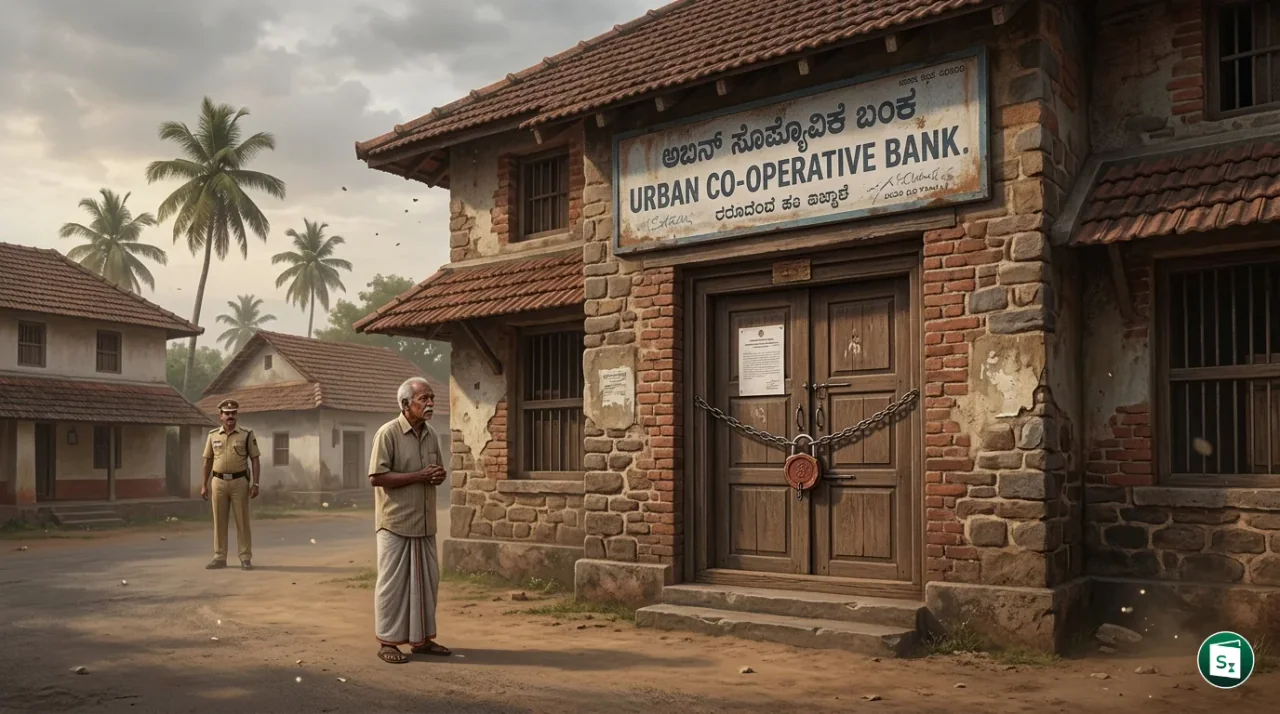
The Reserve Bank of India cancelled the banking licence of Shree Mahalaxmi Urban Co-operative Credit Bank Ltd., located in Gokak, Karnataka, on June 18, 2026, citing inadequate capital and poor earning prospects. The central bank determined that the lender’s financial position made it incapable of repaying depositors in full and ordered it to cease all banking operations with immediate effect. Nearly 98% of depositors are covered under the deposit insurance framework of the Deposit Insurance and Credit Guarantee Corporation (DICGC), which has already disbursed ₹88.21 crore to eligible account holders.
Why RBI Cancelled the Licence
The RBI issued the cancellation order on June 16, 2026, under Section 22 read with Section 56 of the Banking Regulation Act, 1949 (BR Act). The licence came into effect from the close of business on June 18, 2026. Section 22 of the BR Act deals with the licensing of banking companies and gives the RBI the power to grant, refuse, or cancel a banking licence. Section 56 extends these provisions to cooperative banks, though with certain modifications.
The central bank found that Shree Mahalaxmi Urban Co-operative Credit Bank did not have adequate capital and lacked viable earning prospects. The bank failed to comply with Section 11(1) and Section 22(3)(a) to (e) of the BR Act, which prescribe minimum capital requirements and conditions relating to the conduct of banking business in a manner that protects depositor interests. The RBI concluded that the bank, in its current financial condition, would be unable to pay its depositors in full and that allowing it to continue operations would be prejudicial to both depositor interests and public confidence in the cooperative banking sector.
Depositor Protection: The Role of DICGC
The RBI has also requested the Registrar of Co-operative Societies, Karnataka to issue a winding-up order and appoint a liquidator. Once liquidation begins, depositors become eligible to claim deposit insurance from the Deposit Insurance and Credit Guarantee Corporation (DICGC). DICGC is a wholly owned subsidiary of the RBI, established in 1978 through the merger of the Deposit Insurance Corporation (set up in 1962) and the Credit Guarantee Corporation of India. It is headquartered in Mumbai and operates under the DICGC Act, 1961.
Each depositor is insured up to ₹5 lakh for both principal and interest held in the same capacity across all branches of the bank. This cover was enhanced from ₹1 lakh to ₹5 lakh with effect from February 4, 2020, following the DICGC (Amendment) Act, 2021, which also enabled time-bound interim payments within 90 days of the RBI imposing restrictions on a bank.
According to data submitted by the bank, about 97.9% of depositors are entitled to receive the full amount of their deposits through this insurance mechanism. As of June 9, 2026, DICGC has already paid ₹88.21 crore to eligible depositors who provided their consent under Section 18A of the DICGC Act, which allows for early settlement of claims even before the formal liquidation process is complete. India was the second country in the world, after the United States, to introduce a deposit insurance scheme in 1962.
Cooperative Banks Under RBI’s Supervisory Lens
Urban Cooperative Banks (UCBs) operate under a dual regulatory framework. Their banking functions are regulated by the RBI under the Banking Regulation Act, 1949, while their incorporation, management, and winding up are governed by respective State Co-operative Societies Acts and overseen by the Registrar of Co-operative Societies. The cancellation of Shree Mahalaxmi Urban Co-operative Credit Bank’s licence followed the standard process: the RBI revoked the licence and requested the Karnataka Registrar to issue a winding-up order and appoint a liquidator.
The Banking Regulation (Amendment) Act, 2020 significantly strengthened the RBI’s powers over UCBs following the Punjab and Maharashtra Co-operative (PMC) Bank crisis in 2019, which exposed deep governance failures in the sector. The amendment gave the RBI direct authority to supersede boards, impose restrictions, and order resolution without waiting for state government action. Since then, the central bank has adopted a more proactive approach.
In December 2022, the RBI introduced a four-tier regulatory framework classifying UCBs based on deposit size, with progressively stricter capital requirements:
| Tier | Deposit Size | Minimum CRAR |
|---|---|---|
| Tier 1 | Less than ₹100 crore | 9% |
| Tier 2 | ₹100 crore to less than ₹1,000 crore | 12% |
| Tier 3 | ₹1,000 crore to less than ₹10,000 crore | 12% |
| Tier 4 | ₹10,000 crore and above | 12% |
Multiple UCBs have had their licences cancelled or been placed under All Inclusive Directions (AID) or Prompt Corrective Action (PCA) in recent years due to financial weaknesses. In April 2026, the RBI launched Mission SAKSHAM (Sahkari Bank Kshamta Nirman), a nationwide capacity-building initiative targeting 1.40 lakh participants across the UCB sector, focusing on risk management, compliance, audit, IT functions, and governance. The central bank has also released a discussion paper in January 2026 exploring the possibility of resuming fresh licensing of UCBs after a freeze that has been in place since 2004.
Key Takeaways
- The RBI cancelled the banking licence of Shree Mahalaxmi Urban Co-operative Credit Bank Ltd., Gokak, Karnataka, effective June 18, 2026, under Section 22 read with Section 56 of the Banking Regulation Act, 1949.
- The cancellation was ordered due to the bank’s inadequate capital, lack of earning prospects, and failure to comply with the capital and conduct provisions of the BR Act.
- About 97.9% of depositors are entitled to receive their full deposits from the DICGC, which provides insurance cover of up to ₹5 lakh per depositor under the DICGC Act, 1961.
- As of June 9, 2026, DICGC had already disbursed ₹88.21 crore to eligible depositors under Section 18A of the DICGC Act, which enables early claim settlement.
- The DICGC is a wholly owned subsidiary of the RBI, established in 1978, and India was the second country in the world, after the United States, to introduce deposit insurance in 1962.