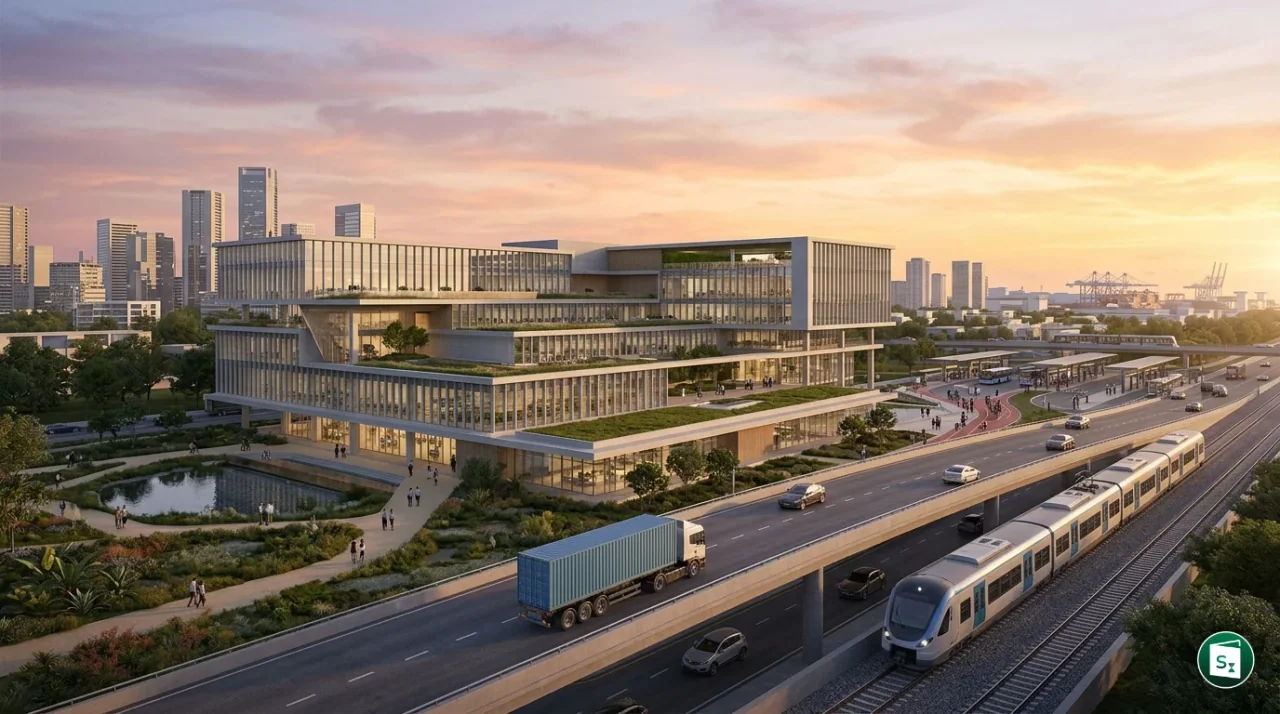
NHAI and NCAER signed a Memorandum of Understanding on June 23, 2026, to establish the NHAI Centre for Economics of Transportation, Mobility and Logistics at NCAER’s premises in New Delhi. The centre is India’s first permanent and independent research institution dedicated exclusively to studying the economics of transportation, mobility, and logistics. It marks a shift towards evidence-based policymaking in India’s rapidly expanding road transport sector.
What Is the NHAI Centre for Economics of Transportation, Mobility and Logistics?
The NHAI Centre for Economics of Transportation, Mobility and Logistics (ETML) is a dedicated research platform being set up at NCAER’s India Centre in New Delhi. It is structured as a permanent, independent institution that will conduct applied economic research on transportation, mobility, and logistics systems. The centre is founded with a contribution from NHAI, while NCAER is committed to mobilising additional resources from allied institutions and research partners.
The MoU was signed at NHAI headquarters in Dwarka, New Delhi, in the presence of NHAI Chairman Santosh Kumar Yadav, the Director General of NCAER, and senior officials from both organisations. NHAI has committed to support the establishment and operation of the centre for a period of 10 years.
Speaking at the signing, NHAI Chairman Santosh Kumar Yadav said the authority has been at the forefront of enhancing national connectivity and logistics efficiency, and this partnership with NCAER will create a dedicated platform for high-quality research and policy analysis. The centre will help strengthen planning, investment, and asset management decisions in India’s transportation sector.
Why This Centre Matters for India’s Transport Sector
India’s road infrastructure has grown at an unprecedented pace over the past decade. The national highway network has expanded from about 91,287 km in 2014 to over 1.46 lakh km today, a jump of more than 60%. The government’s flagship Bharatmala Pariyojana, approved in 2017 with a planned outlay of Rs 5.35 lakh crore, aims to develop 34,800 km of highways and has already completed over 82% of its awarded projects as of December 2025.
This infrastructure push is directly linked to India’s economic competitiveness. A landmark study by DPIIT and NCAER published in 2025 estimated India’s logistics cost at 7.97% of GDP in 2023-24, down significantly from the 13-14% range cited for much of the previous decade. This drop is attributed to integrated planning under PM GatiShakti, the Dedicated Freight Corridors, Bharatmala, and digital reforms like FASTag and the Unified Logistics Interface Platform.
However, sustaining and accelerating this progress demands more than just construction. With freight demand projected to grow 7-8% annually, policymakers need rigorous research on toll pricing, asset monetisation, modal shift strategies, and regional economic impacts of highway investments. The ETML centre is designed to fill precisely this gap by producing actionable, evidence-based research that can guide the next phase of India’s transport infrastructure development.
Research Themes and Institutional Framework
The centre will conduct policy-oriented research across a broad range of thematic areas. These include National Highway economics, freight logistics and supply chains, modal integration and multimodal transport, regional economic impacts of highway investments, toll policy and user fee frameworks, asset monetisation strategies, road safety interventions, technology adoption in highway operations and maintenance, and infrastructure financing and investment models.
Beyond producing research, the institution will function as a knowledge hub for the sector. It will publish policy briefs, working papers, and flagship reports, while also organising stakeholder consultations, workshops, and academic engagements. The centre will also focus on developing future talent and institutional capacity in transportation economics.
Governance Structure
The centre will be guided by an Advisory Committee comprising leading economists, transportation specialists, public policy experts, and eminent academicians. Dr G. Raghuram, former Director of the Indian Institute of Management Bangalore, will chair the committee. NHAI’s Member (Finance) and the Director General of NCAER will also serve on the panel.
Additionally, a Steering Committee constituted by NHAI will oversee research priorities, review outputs, and ensure alignment with the authority’s policy and operational requirements. This two-tier governance framework ensures that the centre’s research remains both academically rigorous and practically relevant to India’s infrastructure needs.
Key Takeaways
- The NHAI Centre for Economics of Transportation, Mobility and Logistics (ETML) was established following an MoU between NHAI and NCAER signed in June 2026.
- It is India’s first permanent and independent research centre dedicated to the economics of transportation, mobility, and logistics, housed at NCAER in New Delhi.
- NHAI will support the centre for a period of 10 years through a founding contribution, while NCAER will mobilise additional resources from partner institutions.
- The Advisory Committee is chaired by Dr G. Raghuram, former Director of IIM Bangalore.
- NHAI, constituted under the NHAI Act, 1988 and operational since February 1995, manages India’s National Highway network of over 1.46 lakh km and is under the Ministry of Road Transport and Highways.
- NCAER, established in 1956, is India’s oldest and largest independent economic policy research think tank, headquartered in New Delhi.