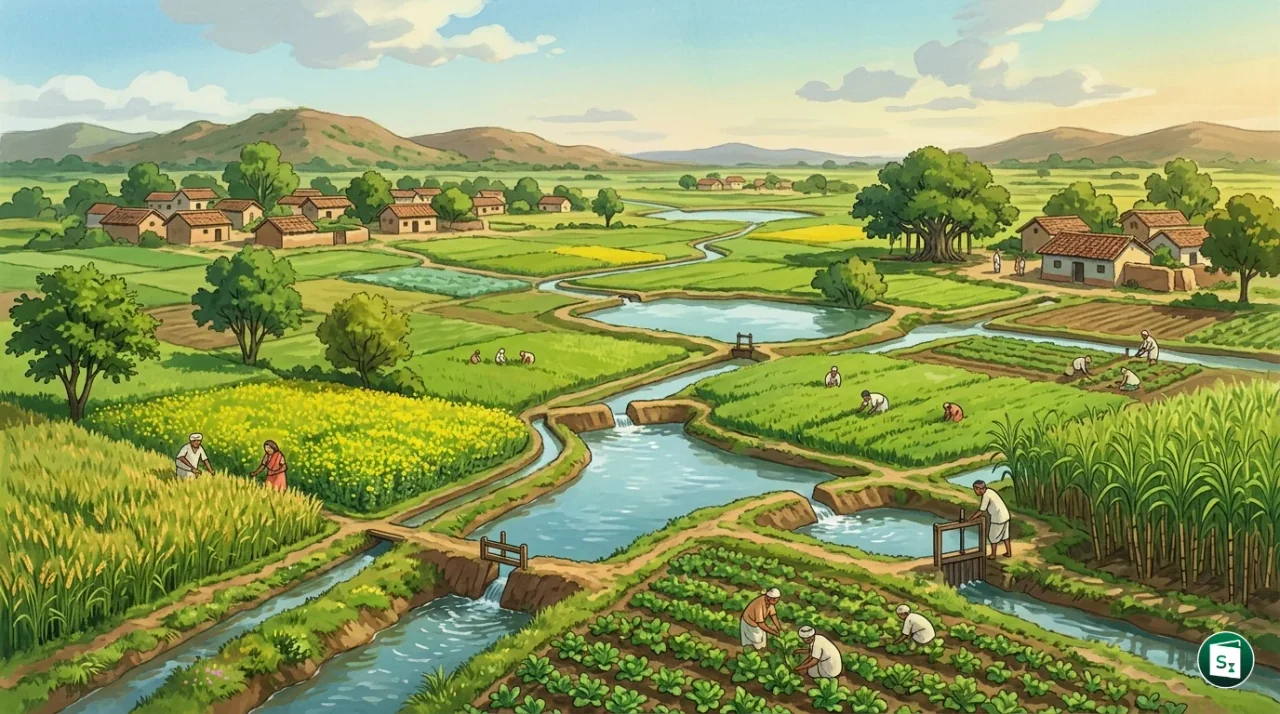
The World Bank has approved a loan of ₹4,000 crore to support the Jal Sanrakshit Haryana (Water Secure Haryana) project, a major state-level initiative designed to resolve the state’s severe groundwater crisis. The project, which has a total financial outlay of ₹5,714 crore, will be executed in phases over a six-year period from 2026 to 2032. By covering 15 clusters across 48.94 lakh acres, the programme seeks to build long-term water sustainability through structured canal rehabilitation, micro-irrigation, and crop diversification.
Overview of the Jal Sanrakshit Haryana Project
The Jal Sanrakshit Haryana project is a comprehensive initiative launched to address the escalating water crisis in Haryana. The state’s agricultural productivity and domestic supply have long relied on intensive groundwater extraction, leading to rapid resource depletion. The new project represents a coordinated, multi-sectoral approach to shift the state toward sustainable water budgeting and conservation.
Funding and Implementation Plan
The total financial outlay of the project is estimated at ₹5,714 crore. The World Bank is supporting the programme with a loan of ₹4,000 crore, which will cover the major share of the capital expenditure for infrastructure upgrades. The remaining cost of ₹1,714 crore will be met through state budgetary allocations.
To ensure sustained monitoring and systemic changes, the project is structured to be implemented in phases over a six-year period from 2026 to 2032. This timeline allows implementing agencies to establish community-level institutions, construct water harvesting assets, and rehabilitate the existing distribution networks systematically.
Targeted Districts and Coverage
The project covers a vast area of 48.94 lakh acres divided into 15 clusters. It prioritizes regions facing acute groundwater decline and soil salinity. A significant portion of the physical interventions, such as the restoration of local water bodies, is focused on seven key districts:
- Bhiwani
- Jind
- Kaithal
- Mahendragarh
- Rewari
- Charkhi Dadri
- Sirsa
These districts represent some of the most water-stressed zones in Haryana, where the depth of the water table has reached critical levels. By focusing on these clusters, the programme aims to target the root zones of agricultural water consumption.
Core Interventions for Water Sustainability
The project addresses water scarcity through a combination of engineering, agricultural, and digital reforms. The objective is to maximize the utility of surface water, minimize losses during transit, and recharge depleted aquifers.
Canal Rehabilitation and Micro-Irrigation
A primary focus of the infrastructure works is the restoration of the state’s surface distribution system. The project targets the rehabilitation of 678 remaining canals to prevent seepage and improve water delivery to tail-end farms. By upgrading these channels, the state aims to reduce distribution losses.
Alongside canal repair, the programme promotes the adoption of micro-irrigation systems such as drip and sprinkler setups. These technologies deliver water directly to the plant roots, reducing agricultural water demand significantly compared to traditional flood irrigation. To make these systems accessible, the state provides subsidies to farming communities.
Groundwater Recharge and Crop Diversification
To actively replenish aquifers, the project will develop and restore 147 water bodies across the seven prioritized districts. These structures will capture rainwater and runoff, facilitating natural infiltration into the ground. Additionally, treated wastewater from urban Sewage Treatment Plants will be redirected for agricultural use, reducing the reliance on fresh groundwater.
On the agricultural front, the project integrates with Haryana’s existing Mera Pani Meri Virasat scheme. Launched in 2020, this scheme offers a financial incentive of ₹7,000 per acre to farmers who diversify away from water-intensive paddy to alternative crops such as maize, pulses, cotton, and oilseeds. By integrating crop diversification into the clusters, the programme aims to reduce the state’s overall agricultural water footprint.
Digital Water Management
To ensure transparency and scientific planning, the project implements a digital water management system. This platform tracks water availability, consumption patterns, and storage levels in real-time. By enabling localized water budgeting, the system helps local authorities and village committees make informed decisions regarding water allocation.
Institutional Roles and Implementing Agencies
The implementation of the project is structured across multiple departments to ensure a coordinated response:
- Irrigation and Water Resources Department (IWRD): As the primary nodal agency, the department handles the largest share of the budget, receiving ₹3,328 crore for structural repairs, major canal rehabilitation, and river basin planning.
- Micro-Irrigation and Command Area Development Authority (MICADA): This body coordinates the installation of on-farm micro-irrigation systems, develops minor water-delivery channels, and implements command area reforms.
- Department of Agriculture and Farmers Welfare (DAFW): This department executes crop diversification campaigns, promotes water-saving techniques, and addresses land drainage issues to reclaim waterlogged fields.
In addition to state departments, the project emphasizes community-led governance. Village water committees will be empowered to plan, operate, and maintain local water infrastructure. A dedicated community fund will support these local committees in managing the maintenance and repair of khaals (traditional water channels), ensuring the long-term viability of the project assets.
Haryana’s Critical Groundwater Crisis
The launch of the Jal Sanrakshit Haryana project comes at a time when the state is dealing with severe depletion of its underground aquifers. Historically, Haryana was at the forefront of the Green Revolution in the late 1960s, adopting high-yielding crop varieties that required intensive irrigation. This led to a permanent shift toward a water-intensive rice-wheat cropping system. Supported by subsidized power for agricultural tube wells, farmers extracted groundwater at rates far exceeding natural recharge capacity.
Recent hydrological data highlights the scale of this crisis:
- Declining Water Table: The average groundwater depth in Haryana dropped from 21.17 metres in June 2020 to 23.02 metres in June 2025.
- Over-Exploitation: The number of blocks classified as over-exploited, where extraction exceeds recharge, increased from 85 to 91 over the same five-year period.
- Extraction Rate: The state’s overall stage of groundwater extraction is estimated at 135.74%, indicating a massive deficit.
- Severely Depleted Districts: Districts like Mahendragarh and Kurukshetra have recorded average water tables deeper than 52 metres and 41 metres respectively.
This rapid depletion threatens both agricultural sustainability and drinking water security. The World Bank funded project aims to reverse these trends by creating alternative water sources, optimizing existing networks, and promoting crop diversification.
Key Takeaways
- The World Bank has approved a loan of ₹4,000 crore to support the Jal Sanrakshit Haryana (Water Secure Haryana) project.
- The project has a total financial outlay of ₹5,714 crore and is implemented in phases over a six-year period from 2026 to 2032.
- The programme covers 15 clusters spanning 48.94 lakh acres across water-stressed regions of the state.
- Key interventions include the rehabilitation of 678 remaining canals and the development of 147 water bodies to recharge depleted aquifers.
- The Irrigation and Water Resources Department of Haryana acts as the primary implementing agency with an allocated budget of ₹3,328 crore.
- The project integrates with the Mera Pani Meri Virasat crop diversification scheme, which was launched in 2020 and offers ₹7,000 per acre to farmers shifting from paddy.