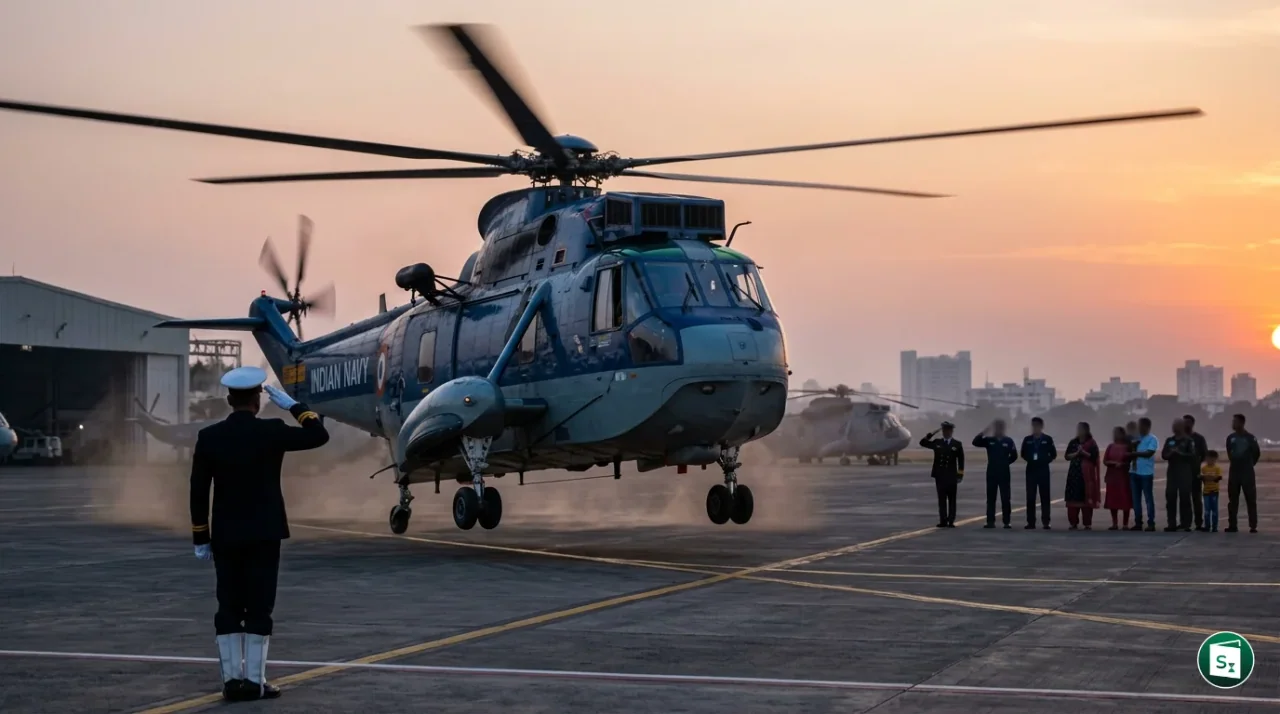
The Indian Navy decommissioned its fleet of Sea King Mk42B multi-role helicopters on June 14, 2026, ending 36 years of operational service. Operated by the Indian Naval Air Squadron 330 (INAS 330), the legendary aircraft concluded their run with a final ceremonial flight at the INS Shikra naval air station in Mumbai. Known as the Flying Frigates, the retirement of these helicopters marks a major transition as the Navy modernizes its anti-submarine and utility warfare capabilities.
Final Ceremonial Flight at INS Shikra
The decommissioning ceremony of the Sea King Mk42B helicopter fleet was held at INS Shikra in Mumbai on June 14, 2026. The event featured a final flypast by the remaining helicopters of the squadron, marking the formal end of their active service. The ceremony was attended by senior naval officers, veterans, and personnel of the Western Naval Command, which is headquartered in Mumbai.
The location of the ceremony, INS Shikra, is the premier helicopter base of the Navy. Originally commissioned as a general shore establishment named INS Kunjali on July 1, 1954, the site underwent several transitions to support growing aviation needs. It was redesignated as Naval Air Station Kunjali II in 1998 to focus on rotary-wing operations. The base was formally commissioned as INS Shikra on January 22, 2009, by the then Chief of the Naval Staff. Today, it serves as a crucial hub for naval helicopter operations, maintenance, and training on India’s western seaboard.
Evolution and Capabilities of the Sea King Mk42B
The Indian Navy began operating Westland Sea King helicopters in 1971, initially acquiring the Mk42 and Mk42A variants. To upgrade its airborne offensive capabilities, the Navy inducted the advanced Mk42B variant between 1985 and 1990. Built by the British manufacturer Westland Helicopters, the Mk42B was designed specifically for advanced anti-submarine and anti-ship combat.
The Sea King Mk42B earned the nickname Flying Frigates because of its self-contained mission capabilities. Unlike standard helicopters of its era, the Mk42B housed a comprehensive suite of sensors, processors, and weapons. These systems allowed it to search for, track, and destroy enemy threats independently, a combination of roles that typically required a surface warship. Powered by twin Rolls-Royce Gnome H1400-T turboshaft engines, the helicopter could carry a variety of armaments:
| Capability Area | Details and Equipment |
|---|---|
| Primary Roles | Anti-Submarine Warfare (ASW), Anti-Surface Vessel Warfare (ASuW), and Search and Rescue (SAR) |
| Offensive Weapons | Sea Eagle air-to-surface anti-ship missiles, light torpedoes, and depth charges |
| Sensors and Avionics | Dipping sonar, acoustic processing systems, search radar, and an advanced automatic flight control system |
Operational Achievements of INAS 330
The Indian Naval Air Squadron 330 (INAS 330), nicknamed the Harpoons, operated the Sea King Mk42B fleet. The squadron was commissioned on April 17, 1971, at INS Garuda in Kochi under the command of Commander M.P. Wadhawan. In October 1995, the squadron shifted its permanent base to INS Shikra in Mumbai to support Western Fleet operations. The squadron functioned under the motto Any sea, Any mission, Any deck, which highlighted its ability to operate from various ship platforms in all weather conditions.
The squadron saw action during the 1971 Indo-Pakistani War shortly after its formation, logging more than 156 hours of war effort. It achieved a milestone on July 26, 1971, when a Sea King helicopter landed on the aircraft carrier INS Vikrant for the first time, cementing a decades-long partnership with the carrier. The squadron executed its first operational anti-submarine mission on October 18, 1971, and carried out its first vectored attack on a suspected submarine contact on November 30, 1971. Over its 55-year history, the squadron earned 22 Nausena Medals and several awards for operational excellence.
Future of Retired Airframes and Continuing Variants
The retired Sea King Mk42B airframes will not be scrapped immediately. The Indian Navy plans to reuse the decommissioned helicopters through a reduce to produce philosophy. Under this plan, engineers will strip some airframes of their specialized anti-submarine warfare electronics to convert them into utility transport helicopters. These modified utility variants are colloquially known as Barlies. Other retired airframes will serve as test platforms for developmental trials of new maritime sensors and weapons.
While the Mk42B variant has retired from frontline operations, other Sea King models continue to serve in the Navy. The INAS 350 (“Saaras”) squadron, based at INS Dega in Visakhapatnam, continues to fly the Sea King Mk42C variant. This version is designed for combat support, search and rescue, and troop transport, ensuring the Sea King legacy continues in a utility capacity on the eastern seaboard.
Transition to the MH-60R Seahawk Fleet
To replace the aging Sea King Mk42B fleet, the Indian Navy is transitioning to the Sikorsky MH-60R Seahawk multi-role helicopters, commonly known as the Romeo variant. India signed a government-to-government deal with the United States in February 2020 to acquire 24 MH-60R Seahawk helicopters. These advanced aircraft are equipped for anti-submarine warfare, anti-surface warfare, search and rescue, and electronic surveillance.
The transition to the Seahawk fleet is managed through newly commissioned squadrons. The Navy raised its first MH-60R squadron, INAS 334 (“Seahawks”), on March 6, 2024, at INS Garuda in Kochi. To strengthen its presence along the western seaboard, the Navy commissioned its second Seahawk squadron, INAS 335 (“Ospreys”), on December 17, 2025, at INS Hansa in Goa. The integration of these helicopters provides the Western Fleet with modern detection sensors, advanced weaponry, and robust networking capabilities to safeguard the Indian Ocean Region.
Key Takeaways
- The Indian Navy decommissioned its fleet of Sea King Mk42B helicopters, known as the Flying Frigates, on June 14, 2026, ending 36 years of active service.
- The INAS 330 (“Harpoons”) squadron, originally commissioned on April 17, 1971, at INS Garuda in Kochi, operated the Sea King Mk42B fleet from its base at INS Shikra in Mumbai.
- Under a reduce to produce philosophy, the Navy will strip some retired airframes of specialized anti-submarine gear to repurpose them as Barlies utility transport helicopters.
- The legacy Sea King Mk42B fleet is being replaced by Sikorsky MH-60R Seahawk multi-role helicopters, procured via a February 2020 agreement with the United States.
- The MH-60R Seahawk helicopters are operated by two active naval squadrons: INAS 334 based in Kochi and INAS 335 based in Goa.
- The Sea King Mk42C utility variant remains operational under INAS 350 (“Saaras”) at INS Dega in Visakhapatnam to provide combat support on the eastern seaboard.