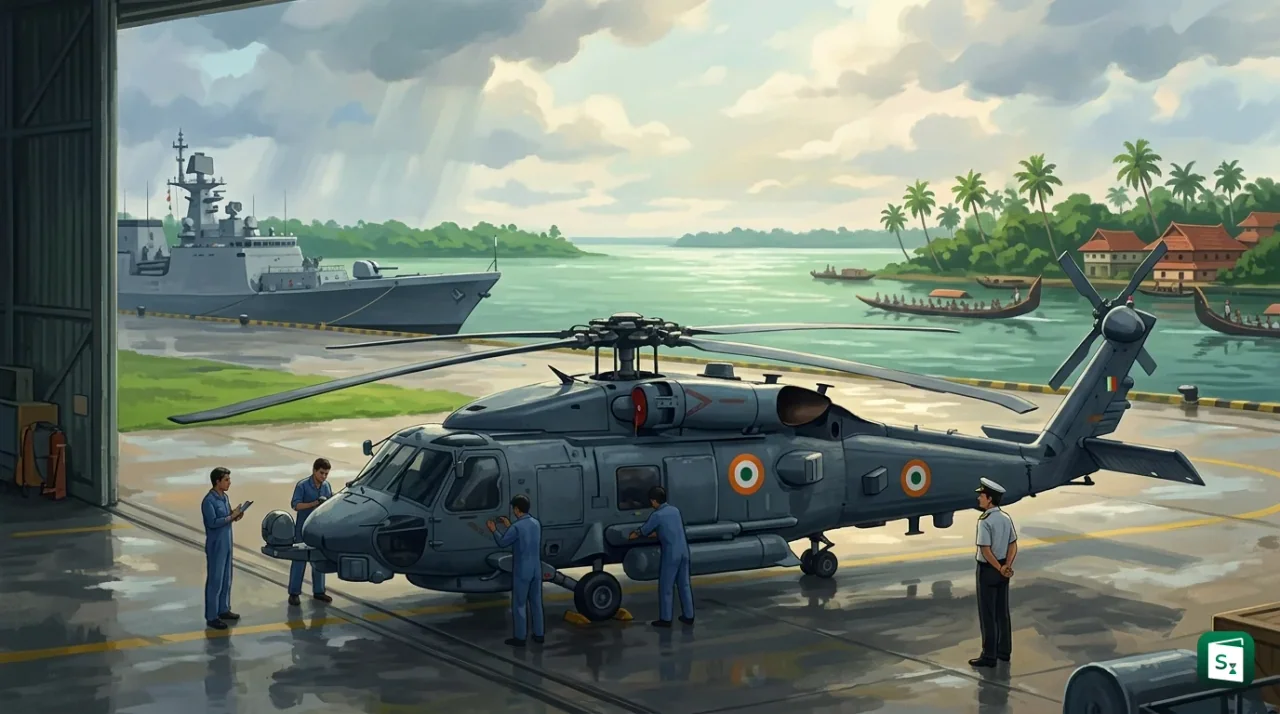
The United States delivered the 21st MH-60R Seahawk multi-role maritime helicopter to the Indian Navy at Kochi, Kerala, bringing the fleet within three aircraft of the full complement of 24 ordered under a Foreign Military Sales agreement signed in 2020. The helicopter, manufactured by Lockheed Martin, touched down at the naval air station INS Garuda as part of the $2.6 billion deal signed between New Delhi and Washington. With two more helicopters expected to arrive shortly, the Indian Navy is on track to complete the induction of this advanced platform designed to replace its ageing Sea King fleet.
The MH-60R Seahawk Deal at a Glance
India signed the contract to procure 24 MH-60R Seahawk multi-role helicopters under the US government’s Foreign Military Sales (FMS) programme in 2020. The FMS route allows allied nations to purchase defence equipment through the US government rather than directly from the manufacturer, simplifying procurement and ensuring interoperability with US forces. The deal, valued at approximately $2.6 billion, includes the helicopters along with their sensors, weapons, training systems, and logistics support.
The first MH-60R intended for the Indian Navy completed its maiden flight in Owego, New York, in 2021. Deliveries began soon after, and by March 2024, the Indian Navy had received enough aircraft to commission its first operational squadron. In December 2025, India signed a separate sustainment package worth approximately ₹7,995 crore (about $946 million) with the United States. This five-year follow-on support contract covers spares, repairs, maintenance facilities, training, and technical support to ensure high operational availability of the fleet.
Lockheed Martin produces the MH-60R through its Sikorsky division. The helicopter is the maritime variant of the legendary UH-60 Black Hawk family, a platform that has been in service with the US military since 1979 and is operated by more than 30 countries worldwide.
Capabilities That Set the Seahawk Apart
The MH-60R Seahawk, commonly called the “Romeo” in naval aviation circles, is among the most advanced shipborne helicopters in service anywhere in the world. It was developed to US Navy specifications and is designed to operate from frigates, destroyers, cruisers, and aircraft carriers, giving it true blue-water reach.
Anti-Submarine and Anti-Surface Warfare
The helicopter’s primary mission is Anti-Submarine Warfare (ASW). It carries a sophisticated sensor package that includes a dipping sonar, which can be lowered into the water to detect submarines, and sonobuoys that are dropped into the ocean to track underwater contacts. These are complemented by a multi-mode radar, Electronic Support Measures (ESM), and electro-optical/infrared (EO/IR) cameras that together build a comprehensive picture of the battlespace.
For offensive action, the MH-60R can be armed with Mk-54 lightweight torpedoes to engage submarines and AGM-114 Hellfire air-to-surface missiles to destroy surface threats. It can also carry rockets and crew-served machine guns. The on-board mission computer fuses data from all sensors to present a single integrated tactical picture, allowing the crew to track and engage multiple targets simultaneously.
Multi-Role Flexibility
Beyond combat, the Seahawk performs search and rescue (SAR), medical evacuation (MEDEVAC), vertical replenishment (VERTREP), and logistics support. With a crew of three to four (pilot, co-pilot, and sensor operators) and a cabin that can carry five passengers or an internal load of up to 1,860 kg, the helicopter adds considerable utility to warship operations. It has a maximum cruise speed of 267 km/h, a range of approximately 834 km, and can remain airborne for over three hours on a typical mission.
The Fleet It Replaces: End of the Sea King Era
The MH-60R Seahawk is being inducted to replace the Indian Navy’s ageing Westland Sea King helicopters, which served the fleet for more than five decades. The British-origin Sea King entered Indian Navy service in 1971 and saw action during the 1971 Indo-Pakistani War, where its anti-submarine patrols played an important role. Over the years, multiple variants including the Mk.42 and Mk.42B were inducted, with the Mk.42B customised by GKN Westland to meet India’s specific operational requirements.
In June 2026, the Indian Navy formally retired its Sea King Mk.42B fleet and disbanded Naval Air Squadron INAS 330 “Harpoons” after 55 years of distinguished service. The retiring fleet had faced challenges including airframe fatigue, spare parts shortages, and an ageing sensor suite that struggled against modern, quieter submarines. Of the remaining aircraft, a few were converted for utility roles, and some were retained as test platforms for research and development. The Sea King’s retirement marks the end of an era and the beginning of a new chapter in Indian naval aviation.
Two Squadrons, Two Coasts
The Indian Navy has operationalised the MH-60R Seahawk through two dedicated squadrons, ensuring coverage of both the eastern and western seaboards.
The first squadron, INAS 334 “Seahawks”, was commissioned at INS Garuda in Kochi on 6 March 2024. INS Garuda, commissioned on 11 May 1953, is the oldest operating naval air station of the Indian Navy and serves as the hub for maritime air operations on the west coast. The second squadron, INAS 335 “Ospreys”, was commissioned at INS Hansa in Goa in December 2025. The two-squadron structure allows the Navy to deploy Seahawks from aircraft carriers, destroyers, and Project 17A stealth frigates on both coasts, extending anti-submarine coverage across the Indian Ocean Region (IOR).
| Squadron | Nickname | Commissioned | Base | Location |
|---|---|---|---|---|
| INAS 334 | Seahawks | March 2024 | INS Garuda | Kochi, Kerala |
| INAS 335 | Ospreys | December 2025 | INS Hansa | Goa |
The India-US Defence Partnership Context
The MH-60R deal sits within a broader and deepening defence relationship between India and the United States. In 2016, the US designated India as a Major Defence Partner (MDP), a unique status that facilitates the transfer of advanced defence technology. In October 2025, the two countries signed a 10-year Framework for the US-India Major Defence Partnership (2025-2035), renewing and expanding the defence cooperation framework first established in 2005.
Under this framework, India has acquired several major US-origin defence platforms through the FMS route. These include C-17 Globemaster III transport aircraft, C-130J Super Hercules tactical airlifters, P-8I Poseidon maritime patrol aircraft, CH-47F Chinook heavy-lift helicopters, AH-64E Apache attack helicopters, and now the MH-60R Seahawk. India’s status as a Major Defence Partner also allows for deeper co-production and technology-sharing arrangements, moving beyond a buyer-seller model towards co-development and industrial partnerships.
What This Means for the Indian Navy
The induction of the MH-60R Seahawk significantly enhances the Indian Navy’s anti-submarine warfare capability at a time when submarine activity in the Indian Ocean Region is rising. China has steadily increased the deployment of its naval vessels, including submarines, in the IOR, making the need for modern ASW platforms urgent.
The Seahawk’s advanced dipping sonar and sonobuoy systems can detect and track even the quietest modern submarines. Its ability to operate from both shore bases and warships gives the Navy flexibility to project anti-submarine cover far from the coast. When operating from aircraft carriers like INS Vikramaditya and INS Vikrant, or from Project 17A stealth frigates and Kolkata-class destroyers, the Seahawk extends the strike and surveillance range of the battle group by hundreds of kilometres.
Beyond ASW, the helicopter’s multi-role capability means it can handle surveillance, search and rescue, logistics, and anti-piracy missions. This versatility reduces the need for multiple single-purpose helicopter types and simplifies fleet management. The five-year sustainment package signed in December 2025 ensures that the Navy can maintain high sortie rates without the spare parts and maintenance bottlenecks that plagued the Sea King fleet in its later years.
Going forward, the Navy’s longer-term requirement for multi-role helicopters is expected to be met partly by the indigenous Indian Multi-Role Helicopter (IMRH) programme, being developed by Hindustan Aeronautics Limited (HAL), which includes a navalised Deck-Based Multi-Role Helicopter (DBMRH) variant. For now, the MH-60R Seahawk fills a critical gap and brings the Indian Navy’s rotary-wing capability firmly into the 21st century.
Key Takeaways
- The United States delivered the 21st MH-60R Seahawk multi-role helicopter to the Indian Navy at INS Garuda, Kochi, under a $2.6 billion deal signed in 2020 for 24 units.
- The MH-60R is manufactured by Lockheed Martin through its Sikorsky division and is acquired through the Foreign Military Sales (FMS) programme of the US government.
- The helicopter is designed primarily for Anti-Submarine Warfare (ASW) and Anti-Surface Warfare (ASuW), equipped with dipping sonar, sonobuoys, Mk-54 torpedoes, and Hellfire missiles.
- The Seahawk is replacing the Westland Sea King fleet, which served the Indian Navy for 55 years and was formally retired in June 2026 with the disbandment of INAS 330 “Harpoons”.
- Two squadrons operate the MH-60R: INAS 334 “Seahawks” (commissioned March 2024 at INS Garuda, Kochi) and INAS 335 “Ospreys” (commissioned December 2025 at INS Hansa, Goa).
- A five-year sustainment package worth approximately ₹7,995 crore ($946 million) was signed in December 2025 to support the fleet’s operational readiness.